RICHMOND, Va. — In a stunning display of desperation and sloppiness, Virginia Democrats have filed a typo-riddled emergency motion with the U.S. Supreme Court following a decisive Virginia Supreme Court ruling that struck down their unconstitutional attempt to gerrymander congressional districts in their favor. The fiasco, highlighted by former Attorney General Jason Miyares, underscores a broader pattern: when Democrats lose under the rule of law, they resort to frantic legal maneuvers while demonstrating basic incompetence even in their legal filings.
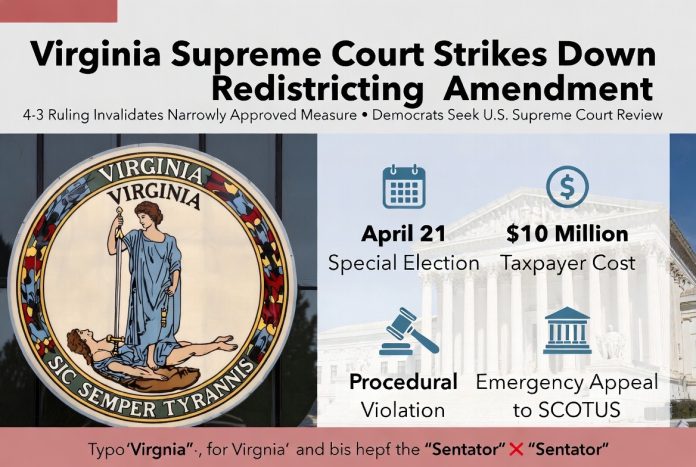
On May 8, 2026, the Virginia Supreme Court ruled 4-3 that Democratic lawmakers violated the state constitution’s procedural requirements when placing a controversial redistricting constitutional amendment on the April 21 special election ballot. The amendment, narrowly approved by voters amid heavy Democratic spending, sought to enable mid-decade redistricting that would have dramatically reshaped Virginia’s congressional map to favor Democrats—potentially flipping it from a competitive 6-5 Democratic edge to a lopsided 10-1 advantage.
Justice D. Arthur Kelsey, writing for the majority, made clear that the legislature’s rushed and improper process “incurably taints” the referendum, nullifying its legal effect. This was not a partisan decision overriding voters’ will, as Democrats hysterically claimed, but a straightforward enforcement of Virginia’s own constitutional safeguards designed to prevent exactly this kind of hasty power grab. Republicans, including Miyares and former House Majority Leader Eric Cantor, who co-chaired Virginians for Fair Maps, rightly celebrated it as a victory for the rule of law over raw partisan ambition.
Rather than accept the outcome, House Speaker Don Scott and Democratic Attorney General Jay Jones rushed to file a “Joint Motion to Delay Issuing Mandate” to buy time for an appeal to the U.S. Supreme Court. The filing has become an instant embarrassment. As Miyares pointed out on X, the document misspells “Virginia” as “Virgnia” right in the caption and refers to a state senator as a “Sentator.” These are not minor oversights in a high-stakes federal appeal—they reflect panic and carelessness from a party that spent tens of millions pushing what Miyares correctly labeled an “illegal, unconstitutional gerrymandering amendment.”
Conservatives have long warned about Democrats’ selective reverence for democracy. When voters approved the measure by a slim margin after a multimillion-dollar ad blitz, Democrats hailed it as the sacred “will of the people.” Yet when the state’s highest court—applying the actual text of the Virginia Constitution—invalidated the flawed process, the same Democrats decried it as “MAGA rigging the system” and an assault on voters. This hypocrisy is glaring. The court did not disenfranchise anyone; it protected the integrity of the constitutional amendment process that Democrats themselves disregarded.
The financial toll on Virginia taxpayers further fuels conservative outrage. Miyares estimates roughly $10 million in public funds were wasted on the special election, on top of an estimated $70 million in political spending by Democrats and allied groups. This was no organic grassroots effort—it was a coordinated attempt to entrench power ahead of the 2026 midterms, exploiting a narrow window to counter Republican advantages elsewhere. Virginia’s current maps, drawn by courts after previous redistricting disputes, already tilt slightly Democratic. The rejected maps would have been an aggressive partisan carve-out, the very definition of gerrymandering that Democrats decry only when it benefits Republicans.
The legal merits of the Democratic appeal are even weaker. Miyares, a seasoned litigator, explained that the appeal runs headlong into the “adequate and independent state grounds doctrine”—a bedrock principle of federalism. U.S. Supreme Court review is typically barred when a state court decision rests primarily on state constitutional law, as this one does. The Virginia Supreme Court interpreted its own constitution’s amendment process. Absent a clear federal question, SCOTUS is unlikely to intervene. Miyares called the motion a “Hail Mary to save face” that will be “dead on arrival.”
This episode reveals deeper issues within Virginia’s Democratic leadership. After defeating Miyares in the attorney general’s race, Jay Jones’ office is now associated with this sloppy filing. Critics have noted Jones’ past inflammatory rhetoric, including texts wishing harm on Republican opponents. Virginians deserve serious, competent governance—not rushed, error-filled legal pleadings born of ideological entitlement.
From a conservative perspective, this is a textbook case of Democrats prioritizing partisan power over process, competence, and constitutional fidelity. They attempted an end-run around normal redistricting timelines, violated their own state’s rules, spent lavishly to push it through, and now cry foul when checked by the judiciary. The Virginia Supreme Court’s ruling reaffirms that no party is above the law—especially not when trying to rig the map for perpetual dominance.
Republicans in Virginia and nationally should use this as a rallying cry. Upholding fair maps protects competitive elections and prevents the sort of extreme gerrymanders that erode trust in democracy. With the 2026 midterms approaching, maintaining Virginia’s existing maps preserves a battleground delegation rather than handing Democrats an artificial supermajority. President Trump and GOP leaders have rightly praised the decision as a win for election integrity.
In the end, the typos are symptomatic of a larger malaise: a party so convinced of its own moral and intellectual superiority that it cannot even proofread a critical legal document. Virginians rejected the underlying power grab at the ballot box in prior cycles by electing Republican governors like Glenn Youngkin and supporting fair maps. The courts have now reinforced that rejection.
As Miyares aptly noted, if Democrats had heeded earlier warnings—including his own AG opinion—they could have avoided this costly debacle. Instead, they doubled down, wasted resources, and delivered fresh ammunition to critics who argue they are unfit to govern responsibly. The rule of law prevailed in Virginia. Conservatives will continue fighting to ensure it does nationwide, against any party that treats constitutions as suggestions rather than binding law.