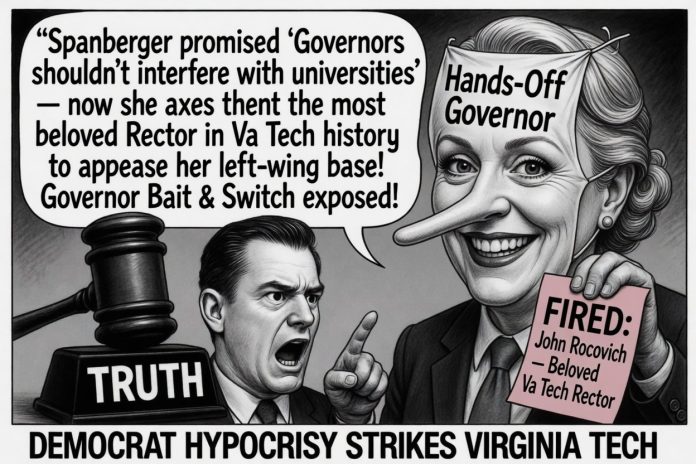
RICHMOND, Va. — In a move that reeks of political retribution and outright hypocrisy, Democratic Governor Abigail Spanberger has abruptly fired John G. Rocovich, the longtime rector of Virginia Tech’s Board of Visitors, without offering any specific public explanation. The decision, announced Wednesday, has ignited fierce backlash from Republicans who see it as a blatant power grab designed to purge conservative influence from the state’s flagship university and appease the far-left base that propelled Spanberger into office.
Attorney General Jason Miyares, Virginia’s top Republican law enforcement official, wasted no time in calling out the governor’s duplicity. In a pointed statement, Miyares reminded Virginians that Spanberger, as governor-elect, had loudly proclaimed that governors “shouldn’t interfere with the governance of universities.” Yet here she is, just months into her term, axing the most beloved rector in Virginia Tech history without a shred of transparency. “This is shameful to appease her leftwing base & proves once again she is Governor Bait & Switch,” Miyares declared.
The facts are damning. Rocovich, a Roanoke attorney and dedicated Virginia Tech alumnus, has poured decades of service into his alma mater. He previously served as rector from 2002 to 2004, was reappointed to the board in 2023 by then-Gov. Glenn Youngkin, and played a pivotal role in recruiting legendary football coach James Franklin, who helped rescue the Hokies’ program during a rocky period. Under Rocovich’s leadership, the university strengthened its athletics fundraising, donor relations, and overall institutional stability. His removal comes at a critical time: Virginia Tech is already navigating the planned departure of President Tim Sands and searching for a new athletic director. Replacing a proven, loyal steward like Rocovich with Edward “Ed” Baine — a Dominion Energy executive previously appointed by both Democratic and Republican governors — looks less like good governance and more like a calculated political installation.
Spanberger’s letter to Rocovich cited vague “violations” of the state’s Code of Conduct for Commonwealth Appointees, the Virginia Tech Board of Visitors’ Code of Ethics, and statutes requiring board members to act in the university’s best interests. She invoked her statutory authority under Virginia Code § 23.1-1300 to remove members for “malfeasance, misfeasance, incompetence, or gross neglect.” Yet no concrete evidence — no specific incidents, no public hearing, no opportunity for Rocovich to defend himself — has been released. Republicans, including House Speaker Terry Kilgore, have labeled the move a “libelous political hit job,” arguing it sets a dangerous precedent that could intimidate any board member who dares question the governor’s agenda.
This isn’t Spanberger’s first foray into university meddling. On her very first day in office in January 2026, she demanded resignations from key University of Virginia board members appointed by Youngkin and installed a new majority loyal to her vision. As governor-elect, she publicly blasted Youngkin for “politicizing” college boards and interfering in presidential searches — rhetoric she now conveniently ignores while wielding the same power she once decried. Conservative critics rightly point out the pattern: Democrats rail against “interference” when Republicans hold the governorship, only to engage in wholesale board purges the moment they regain power. It’s classic bait-and-switch politics — promising hands-off governance to win moderate votes, then delivering ideological control once in office.
The broader implications for Virginia’s higher education system are alarming. Public universities like Virginia Tech and UVA are supposed to operate with a degree of independence to foster free inquiry, academic excellence, and service to the commonwealth. When governors treat board seats as political spoils, they erode public trust and invite endless partisan warfare. Rocovich’s ouster, coming amid ongoing debates over diversity, equity, and inclusion policies that many conservatives view as discriminatory, suggests Spanberger intends to reshape Virginia’s flagship institutions in the progressive mold — regardless of the cost to merit, tradition, or institutional stability.
Miyares’ criticism resonates because it cuts to the heart of the issue: accountability. Virginians elected Spanberger expecting results on affordability, education, and public safety — not a revenge tour against boards appointed by her predecessor. Instead, she has delivered symbolic firings and vague ethics accusations that conveniently sidestep detailed justification. If there were genuine misconduct, why not lay out the evidence? The silence speaks volumes.
Republicans are right to demand answers. As the General Assembly prepares for its next session, lawmakers should consider reforms to protect university boards from gubernatorial whims — term limits, stricter removal standards, or even greater legislative oversight. Virginia’s universities belong to the people, not to whichever party occupies the Executive Mansion. Spanberger’s actions risk turning Virginia Tech from a world-class institution into just another cog in the Democratic machine.
This episode is more than a personnel dispute; it’s a case study in partisan hypocrisy. Governor “Bait & Switch” has shown her true colors. Virginians deserve better than governance by ambush. The conservative movement will continue holding her accountable — because when politicians play politics with our universities, our kids and our commonwealth pay the price.