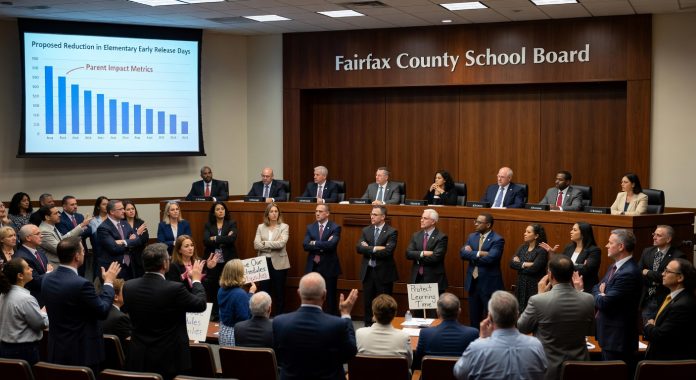
The Fairfax County School Board, which includes Chair Sandy Anderson of the Springfield District, Ricardy Anderson of the Mason District, Melanie Meren of the Hunter Mill District, Robyn Lady as Vice Chair of the Dranesville District, Seema Dixit of the Sully District, Tom Dunn representing the Dranesville District, Karl Frisch of the Providence District, Rachna Sizemore Heizer of the Braddock District, Mateo Dunne, Marcia St. John-Cunning, Kyle McDaniel, Ryan McElveen, and Ilryong Moon, convened to discuss this amendment during a recent meeting.
Board discussions revealed that the 2025-26 school year currently features 12 early release days for elementary schools. Proponents of the amendment seek to replace existing language to specify four early release days, effectively cutting the total by four days, or one-third. Arguments centered on the need for dedicated teacher planning time, with one board member, identified as Tom Dunn, emphasizing that teachers require guaranteed planning periods to ensure effective instruction. He highlighted the inequity when planning time is disrupted, noting that without it, educational quality suffers.
However, concerns emerged about the burden on parents. One speaker pointed out that right now, schools have early release days followed by nine additional such days, creating a total load that disproportionately affects working parents who must arrange childcare for students dismissed early. The proposal’s focus on ‘equity’ was questioned, as reducing these days might level the playing field for teacher preparation but could exacerbate challenges for families without flexible schedules or extended care options. References to a ‘level’ of four days suggested an attempt to standardize across schools, but critics argued this overlooks the real-world implications for student supervision and family stability.
This debate unfolds against a backdrop of ongoing calendar controversies in Fairfax County Public Schools. Recent decisions, such as the board’s vote to eliminate Veterans Day as a holiday while retaining Indigenous Peoples’ Day, have drawn sharp criticism from parents and veterans’ groups. Those moves, passed by narrow margins like 8-1 in some cases, underscore a pattern where board priorities appear to favor certain ideological goals over traditional observances and family needs. Parents have flooded board members with messages demanding more full five-day weeks, reflecting widespread frustration with shortened schedules.
From a perspective valuing parental rights and fiscal responsibility, this proposal exemplifies how unelected bureaucrats—despite being elected—all too often prioritize union-influenced teacher demands over the core mission of educating children and supporting families. Fairfax County, one of Virginia’s largest and wealthiest jurisdictions, spends over $22,000 per student annually, yet enrollment has declined by nearly 7,000 students in the past decade amid falling test scores and underperforming schools. Cutting early release days might free up teacher time, but at what cost to parents juggling jobs and childcare? The emphasis on ‘equity’ rings hollow when it burdens the very families funding these schools through high taxes.
Tom Dunn’s advocacy for planning time acknowledges teachers’ needs, but the broader conversation must address whether 12 early release days—already a significant disruption—represent excess rather than necessity. Parents deserve schedules that maximize instructional time and minimize disruptions, allowing children full days of learning while enabling caregivers to work without constant interruptions. The board’s all-Democrat composition has led to criticisms of one-party rule, with calls for accountability in the 2027 elections.
As the amendment moves forward, stakeholders watch closely. Will the board vote to impose this change, potentially leaving thousands of elementary students home earlier fewer times but still grappling with the remaining eight days? Or will voices advocating for stable, full-day schedules prevail? The decision will test whether Fairfax prioritizes educators’ convenience or the foundational unit of society: the family.
This issue highlights the need for school boards to return to basics—maximizing learning time, honoring American traditions, and respecting taxpayers. Virginia families expect no less.
Source: Field reports and eyewitness accounts.