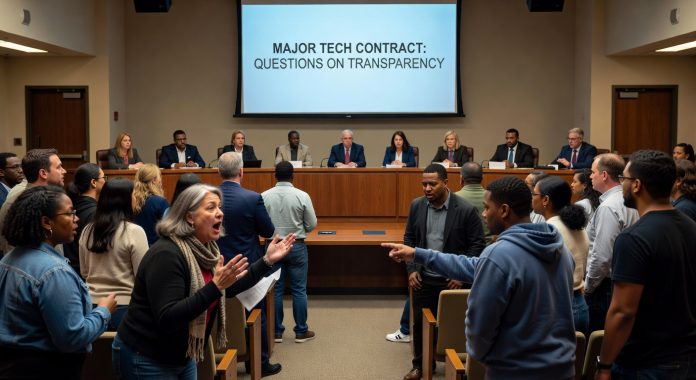
Melanie Meren, speaking passionately at the podium with a potted plant of pink flowers in hand, challenged the administration’s reluctance to disclose details on the spot. She referenced past practices, noting that in other instances, such as recompeting the chief financial officer position, updates were shared directly with the board. ‘Quarterly it’s a review about our expenses, and everything,’ she emphasized, questioning how the board could proceed without full public insight into this major tech procurement. The exchange highlighted a pattern where critical financial decisions evade thorough public scrutiny, potentially allowing for unchecked expenditures on edtech initiatives that may not deliver value for students or families.
The responding board member or official countered that the information had arrived only that afternoon, making immediate detailed disclosure challenging. Plans were outlined to provide answers by the following Friday, suggesting a delay that the demanding member viewed as insufficient. ‘This came in this afternoon,’ the response came, with assurances of forthcoming updates. Yet, the initial speaker pressed on, insisting, ‘We need to know,’ and warning against relegating discussions to private channels or posts. ‘Please do not put it in a post. This is what the public discussion is for,’ she urged, reinforcing the principle that major contracts affecting school budgets demand open deliberation.
This clash arrives amid broader scrutiny of Fairfax County Public Schools’ spending priorities. Taxpayers in this affluent Northern Virginia county fund a district serving over 180,000 students with budgets exceeding $3 billion annually. Technology contracts, often involving vendors for learning management systems, devices, and software, represent substantial outlays. Historical patterns show edtech deals ballooning without proportional academic gains, raising red flags for fiscal conservatives who prioritize core instruction over flashy digital tools. The demand for transparency aligns with calls for quarterly expense reviews to be robust and public-facing, preventing the kind of backroom dealings that erode trust.
Fairfax County’s School Board has faced repeated criticism for opaque processes. Recent meetings have seen debates over calendars, screen time policies, early release days, and even holiday observances, where decisions appeared rushed or data-deficient. Parents and community members, footing hefty property tax bills, expect elected officials to act as vigilant stewards. The tech contract tension exemplifies how private updates undermine this duty, potentially enabling vendor favoritism or cost overruns. In an era of rising education costs and stagnant student outcomes, such lapses fuel demands for structural reforms, including stricter procurement rules and mandatory public roll-calls on big-ticket items.
The board’s composition, with members from diverse districts, should foster balanced oversight, yet this incident reveals fractures. Chair Sandy Anderson and Vice Chair Robyn Lady, along with others like Karl Frisch and Ryan McElveen, hold sway in deliberations. The pushback from the unnamed member serves as a reminder that individual accountability can challenge institutional inertia. As Virginia’s General Assembly considers education funding measures, local boards like Fairfax’s must demonstrate prudent management. Delaying transparency until Friday, while understandable logistically, misses the opportunity for real-time accountability that defines responsive governance.
Ultimately, this exchange signals deeper issues in public education finance. Taxpayers deserve to know how their dollars fund tech contracts—vendors selected, costs involved, performance metrics expected. Without immediate disclosure, perceptions of waste persist, justifying calls for greater parental involvement, competitive bidding transparency, and performance-based contracting. Fairfax parents, weary of marathon meetings and incomplete information, will watch closely as updates emerge. Stronger fiscal discipline, rooted in open government principles, remains essential to restoring confidence in school leadership.
Source: Field reports and eyewitness accounts.