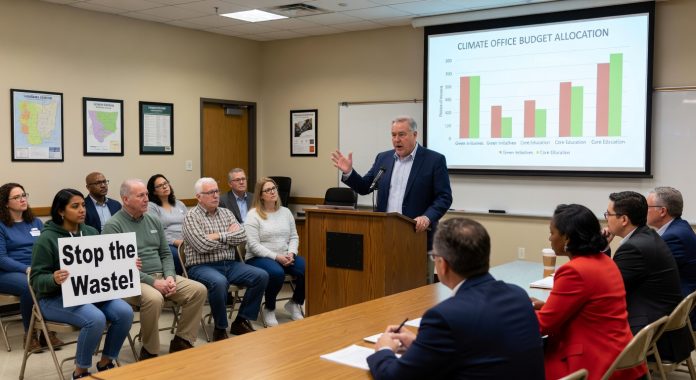
The speaker, addressing what appeared to be a Loudoun County School Board gathering, emphasized that Loudoun stands as one of the few school divisions capable of claiming a formal resolution on climate action or climate literacy. She described environmental literacy as a ‘green flag’ for schools, portraying it as a badge of honor and a ‘wonderful green flag to wave.’ This office, though established relatively recently, builds on years of prior support from the school board for such work, even before its formal creation.
According to the presentation, the district’s efforts have earned recognition and serve as a model for school divisions across regions. The representative noted extensive involvement at state, regional, and national levels through various networks. She recounted how other educators express admiration, saying ‘wow, this is a division that we want,’ upon learning of Loudoun’s longstanding commitment. Taxpayers fund this office, which proponents tout as a proactive approach exemplifying leadership in climate education.
From a conservative perspective, this allocation raises serious questions about fiscal responsibility. Loudoun County, known for its affluent communities and high property taxes, already burdens residents with some of the nation’s steepest school funding rates. Diverting resources to a climate-focused office amid persistent debates over core academic performance strikes many as an extravagant pursuit of progressive ideals over essential education. While the speaker celebrated the ‘green flag’ status, critics view it as a symbolic gesture emblematic of the left’s obsession with climate alarmism, potentially at the expense of reading, math, and practical skills for students.
The resolution on climate literacy underscores the district’s deep integration of environmental activism into its operations. Being one of few divisions with such a policy highlights not innovation but perhaps an outlier commitment to what conservatives see as ideological programming. The office’s role amplifies this, providing dedicated staff and resources to push these initiatives forward. Supporters frame it as forward-thinking, a blueprint for the nation, yet in an era of ballooning school budgets and stagnant student outcomes, such expenditures demand accountability.
Historically, the Loudoun County School Board has faced backlash for prioritizing social and political agendas over traditional education. This climate office fits a pattern where public funds support niche offices rather than bolstering teacher salaries, infrastructure, or academic rigor. The presentation’s enthusiasm—describing it as a model and waving the green flag—only fuels skepticism among fiscal conservatives who argue that parents and taxpayers deserve transparency on every dollar spent.
The board’s long-term support, predating the office, suggests entrenched priorities. Even years ago, before formalizing the office, frameworks were in place, indicating sustained investment. Nationally, networks praise this approach, but locally, residents question why climate literacy warrants a standalone office when basic proficiency rates in key subjects lag. As one of few divisions boasting such a resolution, Loudoun positions itself as a leader, yet conservatives contend this leadership veers into unnecessary bureaucracy.
Proponents insist the proactive stance sets a standard, but with taxpayers directly funding the endeavor, calls grow for reevaluation. In a county where education costs soar, dedicating public funds to climate change efforts prompts valid concerns about opportunity costs. Could those resources better serve classroom needs? The ‘green flag’ may wave proudly in presentations, but for many, it signals red flags in budgeting.
This office exemplifies broader tensions in public schooling, where environmental goals increasingly eclipse fundamentals. As the speaker noted involvement across multiple levels, the scope appears expansive, potentially involving curriculum development, partnerships, and advocacy. Yet, without detailed budget breakdowns, taxpayers remain in the dark on exact costs, heightening demands for oversight.
Loudoun’s approach, while hailed internally, contrasts sharply with conservative values emphasizing limited government, parental rights, and focus on academics. The climate office, funded by hard-earned tax dollars, stands as a stark reminder of diverging priorities in one of Virginia’s wealthiest districts.
Source: Field reports and eyewitness accounts.