by Rich Tucker
Imagine that you are at a Donald Trump event. You see a Republican wearing an anti Trump mask, holding a sign that says “No more Wars” as you approach the rally. Maybe the person also accuses the president of being overly cozy with corporations.
What if it is impossible?
The Virginia Democratic Party sent a version of a protester to a Democratic meeting in Virginia this week. It was an event sponsored by a Democrat State Senator and featured L. Louise Lucas as the President pro tempore, who is the most influential legislator of the state.
This Democrat wore a cardboard picture of the Democrat Governor wearing a mock tiara which read: ” Diva Data Center. The protester held a “No More Data Centers” sign, and suggested the governor was too close to Dominion Energy. Other rally-goers welcomed the protester’s presence despite her shaming of a governor in her own party.
The Governor’s rift with Democrats is deeper.
Spanberger’s office reportedly asked Lucas and two other Democrats to leave a bill-signing that Spanberger hosted earlier that day. Russet Per , a senator from Virginia, told Virginia Scope that it was a shame that the governor took these actions. I’ve never publicly criticized or disparaged her, and sincerely wish her the very best. It is my duty as a senator in a co-equal branch to fight for the interests of my constituents.
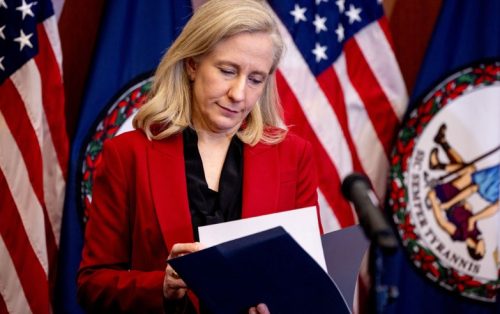
Spanberger was confronted by protesters against data centers at an event held in Loudoun County, Virginia this week.
Spanberger faces the same hurdle as all other governors. Virginia is the only State that limits the governor to a consecutive term. The governor’s best day is Election Day. From there, it can be downhill.
Spanberger, however, has taken this slide to a new level. She won 57 percent in November 2025. Four years earlier, Republican Glenn Youngkin had been narrowly elected to the same office.
The honeymoon was brief. A George Mason University survey conducted at the end of March, less than two months after Spanberger took office, found that 47 percent of respondents approved of her job. Spanberger benefited as a candidate from a weak opposition: Few voters seemed to be excited about the then-Lt. Governor. Winsome Earle Sears. It is not surprising that Republicans and Independents would fantasize about what could have been.
A 10-point decline in a short period of time is still surprising, particularly since the state is in good health. Virginia is not under any external threat or natural disaster. General fund revenues increased dramatically during the first few months of her administration. Revenues increased by 6.9 percent year-over-year in April, and total collections have been running 3.3 percentage points ahead of expectations.
The governor angered Democrats when he vetoed 31 bills that they had passed in this year. These included attempts to grant rights of collective bargaining for public employees, and to create a marketplace for cannabis products. Senate Majority leader Scott Surovell criticized Spanberger’s vetoes of bills rather than negotiating with legislators while these bills were being drafted.
He told The Virginia Mercury that it was difficult to work with an office of a governor who has opinions but does not share them prior to acting or during the legislative process. “Governor Spanberger made serious policy proposals but they came two months too late.”
Spanberger’s greatest problem appears to be a lack of support from her own party. Sen. Lucas trolling the governor in social media after the poll was released. wrote, “Interesting Poll–My Numbers Are Doing Just Fine.” The problem is that her policies do not match the rhetoric she used on the campaign trail. “Her issue is credibility.”
Spanberger’s support may be consolidated within her party. The cannabis proposal will likely be included in the budget compromise law , which lawmakers must approve next week. This bill will likely include changes to state support for data centres, as both Senate Democrats and Republicans requested.
Gov. Spanberger appears to be betting that she can steer a middle path between Virginia Republicans, and legislative Democrats. She has three-and-a-half years left on her term, and she will lead the Commonwealth through a second election in 2027 when a new Senate will be elected and a new House. Youngkin was able to maintain his position of power after Democrats gained control of the two houses of state legislatures in 2023. She may be able to follow a similar path.
It will only take time to see if she can perform the high-wire act.
Rich Tucker is the founding editor of The Virginia Flyover. He is a journalist from Richmond who writes Student driver for Substack. This column was republished by The Daily Signal with their permission.