A detailed map of the area illustrates several gas stations marked in red squares clustered around key roads including Franconia Road and nearby intersections. The Government Center itself appears in green on the map, underscoring how the housing site would sit directly adjacent to these petroleum operations. Public hearing information displayed in the materials encourages community input by providing a contact number for those wishing to testify.
Research presented in the discussion points to documented connections between living near gas stations and elevated health risks. Studies from the National Institutes of Health indicate that children residing within 100 to 250 meters of gas stations face higher chances of developing childhood leukemia or acute lymphoblastic leukemia. Exposure to benzene vapors and related petroleum compounds serves as a primary factor in these increased odds.
Key findings emphasize residential proximity as a critical element. Children living closer to the stations encounter greater risks compared to those farther away. Some analyses have shown a 1.2 to 2.2 times higher likelihood of childhood leukemia depending on the exact distance and density of stations. Higher risks tie specifically to gasoline vapors, benzene, and other compounds released during fuel dispensing.
Recommendations from the materials advocate for establishing safety buffer zones between gas stations and residential developments to limit pediatric exposure. Evidence supports such measures as a way to reduce harmful emissions in areas where children live and play. These suggestions draw from multiple scientific sources including peer-reviewed articles on environmental health.
Additional research highlighted includes a framework for estimating lifetime cancer risk from benzene emissions at gas station clusters. Published findings detail how cumulative emissions from multiple stations can elevate risks even at moderate distances. For example, models compare cancer probabilities across scenarios with varying numbers of stations and sales volumes.
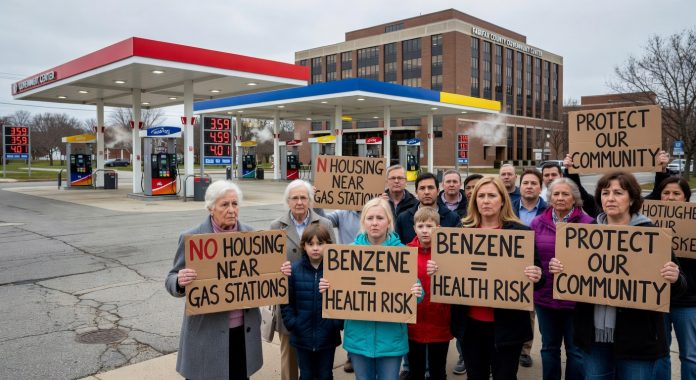
Public opposition has emerged as a central theme in the ongoing conversation. Materials reference studies from regions such as Malta and Portugal that associate proximity to gas stations with increased leukemia incidence. Another investigation concluded that lifetime cancer risks near such facilities can exceed certain regulatory thresholds proposed by environmental agencies.
The situation underscores broader challenges in urban planning where affordable housing initiatives intersect with industrial or commercial sites. Local residents argue that oversight of these environmental factors could lead to unintended consequences for community health. Discussions continue to focus on the need for thorough evaluation of exposure pathways before proceeding with construction.
Health experts cited in the materials stress that benzene represents a known human carcinogen linked to non-Hodgkin lymphoma and multiple myeloma in addition to leukemia concerns. General population exposure remains lower than that experienced by those in immediate vicinity of dispensing operations. Children in schools or homes near stations appear particularly vulnerable according to the compiled data.
As the proposal moves forward, community members continue to raise awareness about these documented risks. The emphasis remains on ensuring that development decisions incorporate comprehensive assessments of potential long-term impacts on residents. Further analysis of the site-specific conditions may help clarify the extent of necessary precautions.
Overall the facts presented reveal a complex intersection of housing policy and public safety considerations in Fairfax County. Continued attention to scientific evidence on pollutant exposure will likely shape future deliberations on similar projects.