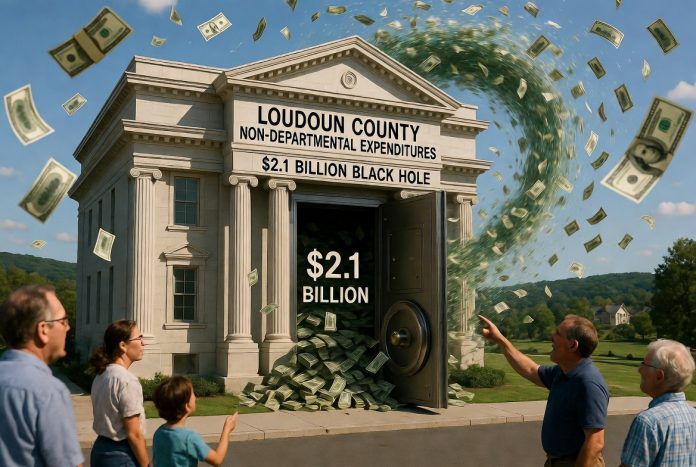
In Loudoun County’s FY 2027 Proposed Budget, the single largest line item isn’t a fire station, a school, or even sheriff’s deputies. It’s the mysterious “Non-Departmental Expenditures” bucket — a catch-all category that balloons to $2.103 billion in the proposed plan, up from $1.984 billion adopted for FY 2026. That’s a $119.5 million hidden increase tucked away from public scrutiny, where millions flow into contingencies, massive transfers, nonprofit subsidies, and untraceable reserves while the Board refuses to cut the real property tax rate stuck at $0.805.
This isn’t budgeting. It’s a black hole.
The Non-Departmental section is described in the document as “a constructed category within the General Fund that contains funding to pay for expenditures not attributed to specific agencies or departments.” Translation: a centralized slush fund where the County Administrator and Board can park politically sensitive or hard-to-justify spending without forcing individual departments to defend it line by line. Want to know where your tax dollars really go? Good luck. The $2.1 billion total includes centralized compensation hikes of $28.5 million (up from $24.7 million), but the real story is in the “Other Uses of Funds” subsection totaling $538.4 million — nearly double the entire county operating budget outside schools.
Inside that black hole you’ll find Legal and Other Contingencies at $5.54 million (down from $12.54 million the prior year, but still a massive rainy-day slush for “potential outside legal services”). The County Attorney gets to draw on it as needed, subject only to Board approval — the same Board that just froze your real property tax rate while commercial data centers rake in 31% valuation growth. Conservatives know what this means: a ready-made account for lawsuits, settlements, or politically motivated legal fights that never see the harsh light of zero-based scrutiny.
Then come the transfers — the real fiscal sleight of hand. The budget funnels $138.88 million to the Capital Projects Fund, $56.31 million to the Capital Asset Preservation Program, $255.75 million to Debt Service, $38.8 million to the Transportation District Fund, and a whopping $25.98 million to the Affordable Housing Fund (including the extra $6 million the Board specifically directed from excess local tax funding). There’s also $8.17 million in direct payments to nonprofits, $12.62 million to regional and intergovernmental organizations, $2.06 million to the Town of Leesburg for “economic development” under a mediated annexation deal, and $1.65 million to the Economic Development Authority.
This is classic big-government accounting: hide the real spending decisions in one giant, opaque line so taxpayers can’t easily see how their money is being siphoned off to pet projects, social engineering, and future debt obligations. While the Board brags about “constraining” county operating growth to 9% and schools to 8%, they quietly route surplus revenue straight into these transfers instead of returning it to homeowners through a real property tax cut. One cent of the real property tax rate is worth $19.4 million — yet they’d rather fund housing subsidies and Leesburg payouts than give families relief.
Even the so-called “savings” are illusory. The budget books $44.5 million in Personnel Vacancy Savings as a negative entry here, meaning they assume 5.3% turnover to artificially lower the headline number — only to reallocate those dollars later when departments cry for more staff. Annual and sick leave payouts, Length of Service Award Program (LOSAP) for volunteer firefighters, OPEB contributions — all centralized here so no single department has to own the cost.
Conservatives have demanded zero-based budgeting for decades precisely because of gimmicks like this. Every single dollar in Non-Departmental Expenditures should be justified from scratch each year: “Why does this contingency exist? Why are we transferring $26 million to housing instead of cutting taxes? Why are nonprofits getting $8.17 million when private charity and church giving already exist?” Instead, the Board treats this black hole as a perpetual feature, not a bug.
Loudoun’s long-term revenue forecasts warn of a plateau in the early 2030s once data center growth stabilizes. When that happens, the fixed costs and transfer obligations locked into this Non-Departmental monster will force real property tax hikes or service cuts — exactly what fiscal conservatives warned against. The vehicle tax trim from $3.09 to $3.00 is a token gesture that saves residents a mere $2.2 million while this $2.1 billion black hole grows unchecked.
Taxpayers deserve better than a budget where the biggest category is also the least transparent. Line-by-line scrutiny, zero-based budgeting, and a hard cap on transfers and contingencies are the only conservative solutions. Zero out every non-essential dollar in Non-Departmental Expenditures before asking hardworking Loudoun families for one more cent. The black hole must be closed — or the next generation of taxpayers will pay the price for today’s fiscal opacity.