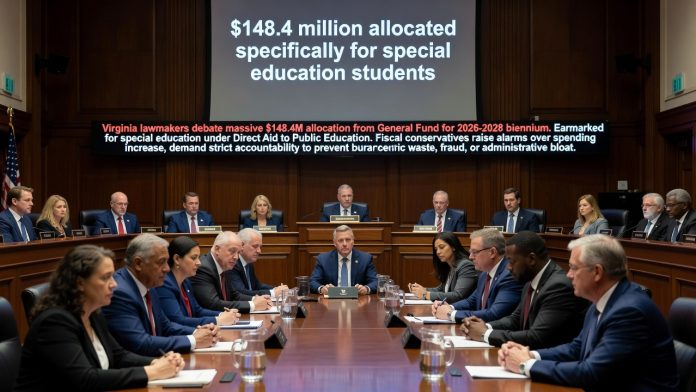
Virginia lawmakers are currently debating a massive $148.4 million allocation drawn directly from the General Fund for the 2026-2028 biennium. This staggering sum is specifically earmarked for special education students under the Direct Aid to Public Education umbrella. While supporting vulnerable children remains a core moral imperative for communities, fiscal conservatives are raising alarms about the sheer volume of this spending increase. Taxpayers must demand strict accountability to ensure these funds do not fall victim to bureaucratic waste, fraud, or administrative bloat.
The financial trajectory of this special education initiative demonstrates a concerning pattern of rapid government expansion. During the 2025 legislative session, the Special Education Add-On was initially established with a substantial $53 million investment. Now, just a short time later, the proposed budget more than doubles that initial expenditure without providing sufficient longitudinal data on its effectiveness. Such explosive growth in public spending often leads to unchecked overspending if lawmakers fail to implement rigorous financial audits.
Unprecedented Rate Hikes Demand Scrutiny
A closer look at the specific rate changes reveals a dramatic inflation of per-pupil funding that threatens to strain the state budget. Under the new proposal, funding for Level 1 services will nearly double, increasing from an already generous 4.75 percent to 9.25 percent. Even more alarming for fiscal watchdogs is the hike for Level 2 services, which skyrockets from 5.25 percent to an astonishing 17.5 percent. When government agencies experience such massive sudden influxes of cash, the risk of systemic waste and financial mismanagement increases exponentially.
This aggressive financial expansion stems from a compromise budget proposal introduced by Speaker Don Scott and Chairman Luke Torian. According to their summary, the legislation supposedly enhances funding for students with disabilities by expanding per-pupil funding for those with greater needs. However, throwing an additional $148.4 million at the Virginia Department of Education without demanding corresponding administrative cuts is a recipe for fiscal disaster. Lawmakers must ensure this massive appropriation directly reaches the classrooms rather than funding bloated administrative salaries that offer no real value to the students.
Evaluating the SISNA Program Expansion
In addition to the massive general allocation, the budget sets aside another $10.0 million in Fiscal Year 2027 specifically to expand the Support for Students with Intense Support Needs Application. Program advocates claim this targeted funding supports students with the most complex needs who are typically referred to expensive private day school placements. From a conservative standpoint, keeping these students in public facilities should theoretically reduce the overall budget and save taxpayer money. Unfortunately, public school systems historically struggle to manage specialized programs efficiently without descending into systemic overspending.
To prevent this $10 million expansion from becoming yet another government boondoggle, strict oversight mechanisms must be established immediately. Taxpayers deserve transparent, quarterly reporting to prove these public funds are actually reducing the reliance on costly private placements as promised. If the state cannot demonstrate clear financial savings and improved educational outcomes, this program will simply represent another layer of wasteful government spending. The Direct Aid to Public Education department must be subjected to rigorous, independent audits to root out any potential fraud or financial abuse.
Protecting Taxpayers While Fulfilling Moral Duties
Providing quality education for special needs students certainly aligns with strong community values and the moral obligation to care for the vulnerable. Nevertheless, a ballooning budget that aggressively jumps from $53 million to nearly $150 million in a single cycle is a textbook example of reckless government growth. State legislators have a fiduciary duty to protect the working-class citizens who ultimately foot the bill for these massive appropriations. Lawmakers must implement strict financial guardrails to prevent this well-intentioned initiative from spiraling into an unsustainable long-term financial burden.
As the 2026-2028 biennium approaches, Virginia taxpayers must closely monitor how the Department of Education handles this unprecedented influx of cash. Reducing the overall state budget and eliminating entrenched bureaucratic waste must remain top priorities for all elected officials. True compassion for special needs students is demonstrated through highly effective, efficiently managed programs that respect the sacrifices of taxpayers. Blindly throwing hundreds of millions of dollars at the education bureaucracy without demanding absolute fiscal accountability is a disservice to both the students and the hardworking taxpayers of Virginia.