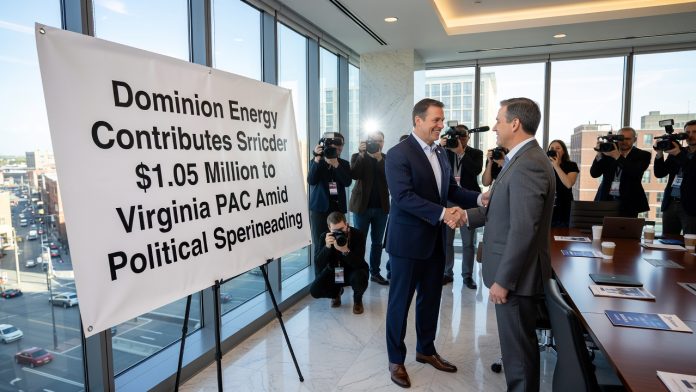
Dominion Energy Inc. contributed $1,050,000 to its own Virginia Political Action Committee on July 20, 2026. This transfer forms part of the company’s larger political involvement in the state, where total contributions reached over $5.2 million in 2026 according to campaign finance records. The Virginia PAC has directed funds to multiple candidates and committees, including $250,000 to McDougle for Senate – Ryan, $250,000 to Protect Our Progress PAC, $150,000 to Leaders for an Equitable Tomorrow PAC, $150,000 to Reagan Majority for Virginia, $100,000 to Herring for Delegate – Charniele, and $100,000 to Spanberger Inaugural Committee 2026. Additional recipients include Pillion for Senate – Todd, French for Senate – Timmy, Rouse for Senate – Aaron, Ward for Delegate – Jeion, Craig for Senate – Christie, and others such as Moving Mountains PAC and Virginia Future Generations PAC.
Dominion Energy maintains operations as a major electric utility in Virginia, where it engages in regulatory matters before the State Corporation Commission. The company’s political contributions have supported a range of recipients across party lines in recent cycles. Historical data shows past support for federal candidates including Mark Warner and Tim Kaine, as well as various state-level figures. In the current cycle, the PAC’s allocations extend to both Republican and Democratic committees and candidates.
The donation to the Virginia PAC underscores Dominion Energy’s strategy of backing officials who influence utility policy and rate structures. Recipients such as certain Democratic candidates have records of supporting expanded government oversight and spending initiatives that align with regulatory frameworks favoring established utilities. For instance, contributions to groups associated with candidates like Charniele Herring and Abigail Spanberger occur alongside Dominion’s interests in maintaining favorable conditions for large-scale infrastructure projects and rate approvals. Conservatives have expressed frustration with stances on issues including increased regulatory burdens, preferences for certain energy policies over market-driven approaches, and alignment with broader spending priorities that expand government involvement in the economy.
By channeling substantial funds through its PAC to support these elected officials and affiliated committees, Dominion Energy positions itself to benefit from policies that may prioritize corporate-regulatory partnerships. This approach potentially endorses the same stances that have drawn conservative criticism for deviating from principles of limited government and free-market competition. The utility’s pattern of bipartisan giving, including large sums to Democratic-leaning entities, highlights how corporate political activity can sustain influence regardless of ideological alignment, raising questions about the consistency of support for officials whose records include votes or positions on fiscal and regulatory matters that conservatives view as counterproductive to smaller government and taxpayer interests.
Virginia campaign finance filings confirm Dominion’s ongoing role as one of the state’s largest political contributors, with no limits on corporate donations enabling such activity. The July 2026 transfer specifically bolsters the PAC’s capacity to engage in the upcoming electoral cycle, where recipients span legislative and statewide races. This financial commitment reflects Dominion’s focus on maintaining relationships with policymakers who oversee its core business operations in electricity generation, transmission, and distribution.
Broader records from prior years indicate Dominion has directed funds to entities and candidates involved in debates over energy policy, consumer rates, and state budgeting. The inclusion of Democratic recipients alongside Republican ones demonstrates the company’s diversified approach to political engagement. Conservatives note that such support for officials with records favoring expansive regulatory environments or alignment with progressive fiscal policies could indirectly advance those agendas through sustained corporate backing.
Dominion Energy’s contributions, including the recent $1.05 million allocation, continue a trend of substantial political spending aimed at shaping the environment in which it operates. This includes aid to candidates whose past actions on utility regulation and related economic issues have conflicted with conservative preferences for reduced government intervention. The donor’s choice to fund these figures frames its involvement as potentially complicit in perpetuating the very policies and stances that prioritize established interests over broader market reforms.