THE ILLUSION OF A TAX CUT
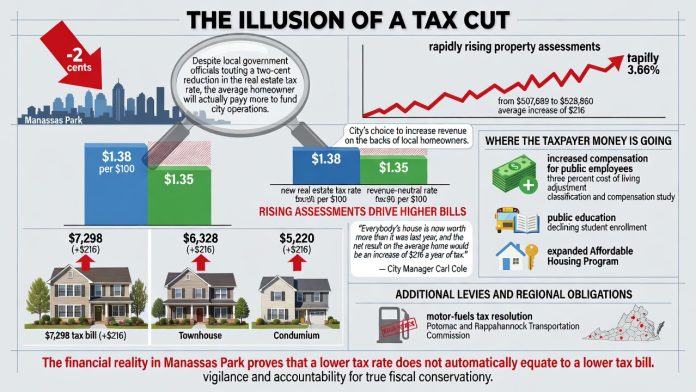
Taxpayers in Manassas Park are facing a frustrating reality regarding their property tax bills for the upcoming fiscal year 2027 budget cycle. Despite local government officials touting a two-cent reduction in the real estate tax rate, the average homeowner will actually pay more to fund city operations. This fiscal dynamic highlights a common challenge for conservative taxpayers who demand genuine tax relief rather than bureaucratic maneuvering.
The new real estate tax rate is set at $1.38 per $100 of assessed value, which represents a slight drop from the previous year. However, residential property assessments surged by an average of 3.66 percent across the city. Because property values skyrocketed, the two-cent rate reduction fails to offset the increased assessments, resulting in higher out-of-pocket costs for residents. Hardworking families are now left to cover an effective tax increase of 2.22 percent while navigating an already challenging economic climate.
RISING ASSESSMENTS DRIVE HIGHER BILLS
The average assessed value for a single-family home in Manassas Park climbed significantly from $507,689 last year to $528,860 this year. Consequently, the average single-family tax bill will reach $7,298, representing a direct increase of $216 over the previous cycle. City Manager Carl Cole explicitly acknowledged this dynamic during budget discussions, confirming that the rising values effectively erased the rate cut. Cole explained to residents that rapidly rising property assessments more than offset the two-cent rate reduction.
Addressing the situation directly, Cole stated that everybody’s house is now worth more than it was last year, and the net result on the average home would be an increase of $216 a year of tax. This financial burden extends beyond single-family homeowners, impacting townhouse and condominium owners in equal measure. The average townhouse assessment now stands at $458,536, generating a substantial tax bill of $6,328 for those property owners. Similarly, condominium assessments average $378,257, which translates to a yearly tax obligation of $5,220.
IGNORING THE REVENUE-NEUTRAL PATH
Fiscally conservative advocates frequently champion the revenue-neutral tax rate as the only true measure of holding government spending flat. For Manassas Park, the revenue-neutral rate would have been $1.35 per $100 of assessed value. By adopting the higher $1.38 rate, the city effectively chose to increase its tax revenue on the backs of local homeowners. This decision forces residents to fund expanded government operations instead of allowing families to keep more of their hard-earned money.
City officials attempted to justify the effective tax increase by pointing out that it remains below recent national inflation rates. However, this argument offers little comfort to taxpayers who are already stretching their household budgets to pay for groceries, gas, and utilities. When local governments use inflation as an excuse to raise tax revenues, they prioritize public sector growth over private sector financial stability. True conservative governance would dictate cutting municipal expenses rather than capturing a windfall from inflated housing markets.
WHERE THE TAXPAYER MONEY IS GOING
The additional revenue extracted from homeowners is slated to fund several municipal initiatives, including increased compensation for public employees. City staff members are scheduled to receive a three percent cost of living adjustment to their salaries. Furthermore, the local government is conducting an ongoing classification and compensation study that could lead to even higher personnel costs in the future. Taxpayers are essentially footing the bill for government wage increases while their own real wages may be stagnating under national economic pressures.
Public education and social programs are also absorbing portions of the municipal budget. The Manassas Park City Schools adopted a tight budget plan, notably doing so amid a period of declining student enrollment. Simultaneously, the city approved updates to its Affordable Housing Program that will expand eligibility for subsidized living arrangements. Funding these expanded social initiatives relies heavily on the increased property tax revenues generated by the higher assessments on existing homeowners.
ADDITIONAL LEVIES AND REGIONAL OBLIGATIONS
Beyond direct property taxes, local leaders are also advancing other measures that impact the financial bottom line of residents. The city approved a motor-fuels tax resolution associated with the Potomac and Rappahannock Transportation Commission. This regional transportation funding mechanism serves as yet another layer of taxation that affects anyone driving in and around the locality. Each of these incremental fiscal decisions aggregates into a heavier overall burden for the conservative taxpayer trying to make ends meet in Virginia.
A core tenet of conservative governance is that local municipalities should live within their means just as families do. When property values surge, a responsible government should lower the tax rate to the revenue-neutral point to prevent a backdoor tax increase. The failure to adopt the $1.35 rate in Manassas Park illustrates a missed opportunity to protect the financial well-being of the community. Homeowners are left to navigate the consequences of a growing local government that prioritizes expanded budgets over taxpayer relief.
THE PATH FORWARD FOR MANASSAS PARK TAXPAYERS
As the new fiscal year approaches, residents must remain vigilant regarding how their local officials manage public funds. The illusion of a two-cent rate cut serves as a cautionary tale about the complexities of municipal finance and property assessments. Taxpayers have a right to demand total transparency and strict adherence to revenue-neutral policies during future budget cycles. Holding elected representatives accountable is the only way to ensure that local taxation remains fair, transparent, and economically sustainable.
The financial reality in Manassas Park proves that a lower tax rate does not automatically equate to a lower tax bill. Until city leaders commit to true fiscal conservatism, hardworking homeowners will continue to bear the brunt of rising assessments and expanding government budgets. Families deserve to keep the wealth they build through their property investments rather than surrendering it to municipal coffers. Ultimately, achieving genuine tax relief will require a fundamental shift in how the city approaches spending and revenue collection.
Email the Manassas Park City Council at:
Alanna Mensing (Mayor): a.mensing@manassasparkva.gov,
Darryl Moore (Vice Mayor): d.moore@manassasparkva.gov,
Haseeb Javed: h.javed@manassasparkva.gov,
Yesy Amaya: y.amaya@manassasparkva.gov,
Michael Carrera: m.carrera@manassasparkva.gov,
Stacy Seiberling: s.seiberling@manassasparkva.gov,
Kevin Moreau: k.moreau@manassasparkva.gov,