Massive Tax Surplus Raises Questions
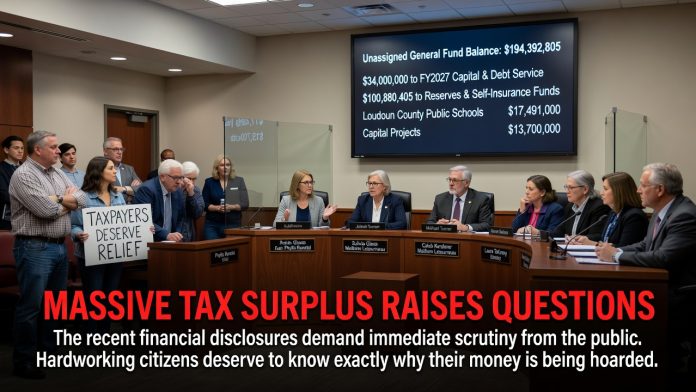
The recent financial disclosures demand immediate scrutiny from the public. Hardworking citizens deserve to know exactly why their money is being hoarded.
The Loudoun County Board of Supervisors recently announced a staggering $194,392,805 in unassigned general fund balances for the current fiscal cycle. This massive surplus was primarily driven by an unexpected overperformance in commercial and industrial real estate taxes, alongside high yields from personal property taxes on computer equipment. While local officials praise the surplus as a sign of fiscal health, fiscal conservatives argue that such a massive over-collection indicates that taxpayers are simply paying way too much. Hardworking families and business owners continue to bear the brunt of heavy taxation while the county government stockpiles their money.
Local governments in Virginia are legally prohibited from operating with a deficit, forcing strict adherence to available funds. However, consistently generating surpluses nearing two hundred million dollars suggests a persistent failure to accurately calibrate tax rates to actual community needs. By continually collecting more revenue than required to operate the county, officials are effectively holding onto private wealth that could otherwise stimulate the local free market. Returning these excess funds to the taxpayers through significant rate reductions would provide immediate relief during a time of widespread economic pressure.
Allocating the Excess Funds
The distribution of these massive funds requires strict oversight from the community. Taxpayers must pay close attention to where this money ultimately goes.
Rather than returning this massive windfall to the citizens, the Board of Supervisors decided to distribute the $194,392,805 across various government accounts and future budgets. The board directed $34,000,000 toward one-time needs in the upcoming fiscal year 2027 capital and debt service budgets. Additionally, a massive sum of $100,880,405 was immediately funneled into county reserve balances and self-insurance funds. Critics argue that parking over one hundred million dollars in reserve accounts unnecessarily ties up taxpayer capital instead of reducing the overall tax burden.
The Loudoun County Board of Supervisors consists of Chair Phyllis Randall, Juli Briskman, Michael Turner, Sylvia Glass, Caleb Kershner, Matthew Letourneau, Kristen Umstattd, Laura TeKrony, and Koran Saines. These officials voted on the complex distribution of the excess capital, steering millions toward existing bureaucratic priorities. Historically, Loudoun County has utilized any available fund balance for one-time purposes that align with the board’s existing projects rather than prioritizing direct taxpayer refunds. This long-standing practice ensures that excess tax revenue remains firmly within the grasp of the growing county government.
Loudoun County Public Schools also received a substantial portion of the surplus, securing $17,491,000 from the unassigned funds. Public education spending remains a heavily debated topic among conservative watchdogs who demand greater transparency and accountability for every single dollar allocated. While funding educational infrastructure is important, pouring excess millions into the school system without demanding strict spending reforms often leads to administrative bloat. Taxpayers deserve absolute certainty that this seventeen million dollar allocation will directly benefit students rather than expanding unnecessary bureaucratic programs.
Capital Projects and Bureaucratic Spending
Essential infrastructure should always be funded through a balanced, transparent budget. Relying on surprise revenue windfalls prevents proper financial oversight by the voting public.
Beyond the school system and reserve accounts, the county directed another $13,700,000 toward various county capital projects. This specific allocation covers facility design initiatives under the Department of General Services, design work for the Goose Creek Bridge improvements, and the construction of new sidewalks. While infrastructure maintenance is a core function of local government, funding these projects through surprise tax surpluses bypasses the traditional budgetary scrutiny expected by taxpayers. Proper fiscal management dictates that essential infrastructure should be funded through a balanced budget rather than relying on massive tax over-collections.
County officials defend the allocations by claiming that using the remaining fund balance helps avoid new debt and prevents future real property tax increases. They also note that the fiscal year 2025 fund balance of $194,392,805 is actually lower than the fund balances recorded in the previous two fiscal years. Furthermore, administrators argue this current surplus aligns consistently with the revenue growth forecasts previously established by county staff. However, celebrating a slightly smaller, yet still massive, surplus does little to comfort taxpayers who want to see their overall tax bills significantly reduced.
The Call for True Fiscal Restraint
Excess tax collections must be viewed as a clear mandate for financial relief. The county must immediately stop siphoning wealth from the private sector.
The ongoing reliance on massive commercial and personal property tax revenues to pad county reserves raises serious concerns about long-term fiscal responsibility. When a local government routinely collects nearly two hundred million dollars more than it needs, the fundamental budgeting process is clearly flawed. Conservative advocates maintain that government should only collect exactly what is required to provide essential services, leaving the rest in the pockets of the citizens. Every dollar hoarded in a government contingency fund is a dollar taken away from local businesses, families, and private economic growth.
True fiscal conservatism demands that excess tax collections be viewed as a mandate for immediate tax relief rather than a slush fund for future spending. While officials boast about lowering real property tax rates for homeowners over the past ten years, the persistent generation of huge surpluses proves those reductions were not nearly aggressive enough. If the county can afford to lock away over one hundred million dollars into self-insurance and reserves, it can certainly afford to implement deeper, more meaningful tax cuts. Taxpayers must hold the Board of Supervisors accountable for how these excess funds are managed and demand an end to chronic over-taxation.
Moving forward, Loudoun County residents must demand greater transparency and a fundamental shift in how the local government approaches its annual budget. The current model of over-collecting taxes, declaring a surplus, and then distributing the excess to various government agencies inherently promotes bloated spending. A responsible, conservative approach would mandate that any unassigned general fund balance above a minimal emergency threshold be automatically refunded to the taxpayers. Until such policies are enacted, the county will likely continue to siphon excess wealth from the private sector to fund its ever-expanding bureaucratic footprint.
Email the Board of Supervisors at:
Phyllis J. Randall (Chair, At-Large) – Phyllis.Randall@loudoun.gov,
Michael R. Turner (Vice Chair, Ashburn District) – Mike.Turner@loudoun.gov,
Juli E. Briskman (Algonkian District) – Juli.Briskman@loudoun.gov,
Sylvia R. Glass (Broad Run District) – Sylvia.Glass@loudoun.gov,
Caleb Kershner (Catoctin District) – caleb.kershner@loudoun.gov,
Matthew F. Letourneau (Dulles District) – Matt.Letourneau@loudoun.gov,
Kristen C. Umstattd (Leesburg District) – Kristen.Umstattd@loudoun.gov,
Laura A. TeKrony (Little River District) – Laura.TeKrony@loudoun.gov,
Koran Saines (Sterling District) – Koran.Saines@loudoun.gov