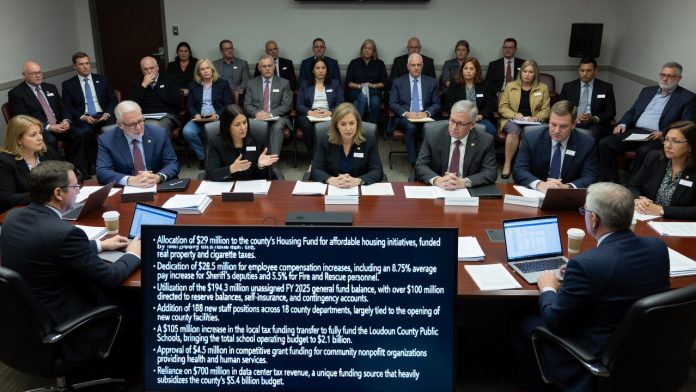
Loudoun County taxpayers are facing the financial weight of a massive $5.4 billion budget that continues to expand local government at an alarming rate. Despite claims of fiscal restraint, the newly approved spending plan relies heavily on unpredictable corporate tax revenues to subsidize endless bureaucratic growth. Local homeowners are left to shoulder the hidden costs of this expansion through rising property assessments that effectively increase their tax burden. This staggering budget highlights a clear departure from conservative principles of limited government and strict fiscal responsibility.
Democrat elected officials oversee a sprawling county apparatus that continuously demands more funding from hardworking citizens. Taxpayers must now scrutinize how these individuals are managing public funds amidst unprecedented municipal spending.
Ballooning School Budgets and Bureaucracy
A significant portion of the county’s financial bloat stems from a massive $105 million increase in local tax funding transferred directly to Loudoun County Public Schools. This aggressive funding hike brings the total school operating budget to an astonishing $2.1 billion. School Board Chair April Chandler defended the spending, stating, “This budget invests in critical programs, expands opportunities for students, and honors our commitments to employees, all while positioning LCPS for continued success.” However, funneling billions into the education system without demanding strict operational efficiencies places an unnecessary financial strain on local taxpayers.
Beyond the massive education expenditures, the county government is rapidly expanding its own bureaucratic footprint. The new budget authorizes the addition of 188 new staff positions spread across 18 different county departments. Defending the spending, County Administrator Tim Hemstreet claimed the budget “meets the Board’s guidance and reflects my recommendations on constraining budget growth.” Adding nearly two hundred new government employees directly contradicts the concept of constrained growth and represents a permanent expansion of taxpayer liabilities.
Taxpayer Funds Funneled to Nonprofits and Housing
In a clear example of government overreach into private markets, officials have allocated $29 million to a dedicated Housing Fund for affordable housing initiatives. This massive wealth redistribution scheme is funded directly by revenue equivalent to one cent of the real property tax rate, alongside proceeds from the cigarette tax. Using public tax dollars to manipulate the local housing market is a highly questionable practice that strays far from the core functions of municipal government. Taxpayers should not be forced to subsidize housing developments through their hard-earned property tax payments.
Furthermore, the county continues to outsource its responsibilities by distributing $4.5 million in competitive grant funding to various community nonprofit organizations. This allocation includes a significant year-end fund balance appropriation of over half a million dollars that could have been returned to taxpayers. The maximum award amount for the standard human services nonprofit grant was increased from $113,000 to $135,000 for the upcoming fiscal years. Handing over millions in public funds to private, unelected nonprofit groups creates a severe lack of accountability and invites potential waste.
Reliance on Data Centers and Tax Realities
The entire foundation of this inflated $5.4 billion budget rests precariously on $700 million in data center tax revenue. While this unique funding source currently subsidizes the county and generates nearly half of local tax revenue, relying so heavily on a single industry is incredibly risky. The county also utilized a massive $194.3 million unassigned general fund balance, directing over $100 million into reserve balances and contingency accounts rather than offering direct tax rebates. Shuffling hundreds of millions of dollars into government reserves demonstrates a blatant refusal to respect the taxpayers who overpaid those funds in the first place.
Despite the massive influx of corporate cash, everyday citizens are still seeing their cost of living go up. The real property tax rate remains unchanged at $0.805 per $100 of assessed value, but rising property assessments mean the average homeowner will see their tax bill rise by about $141. Officials are attempting to placate voters with a minor vehicle personal property tax rate reduction to $3.09 per $100 in 2026, which would save the owner of a $30,000 vehicle roughly $352. These small automotive tax cuts serve merely as a distraction from the crushing reality of ever-increasing residential property tax bills.
Prioritizing Public Safety Over Government Bloat
Amidst the excessive spending on social programs and new administrative staff, the dedication of $28.5 million for employee compensation does include vital support for public safety. This allocation provides a much-needed 8.75 percent average pay increase for Sheriff’s deputies and a 5.5 percent increase for Fire and Rescue personnel. General county employees will also receive a 4.25 percent merit raise and a 2 percent salary adjustment to remain competitive in the market. Fully funding law enforcement and emergency responders is a fundamental conservative priority and one of the few legitimate uses of local tax dollars in this budget.
Moving forward, Loudoun County must fundamentally reassess its spending habits to protect the financial stability of its residents. The current strategy of utilizing temporary data center windfalls to fund permanent expansions in government size is a recipe for future economic disaster. Elected officials must commit to slashing wasteful programs, halting the hiring of non-essential personnel, and returning surplus funds directly to the taxpayers. Only through strict fiscal discipline and a commitment to limited government can Loudoun County truly safeguard its economic future.
Email the Board of Supervisors at:
Phyllis J. Randall (Chair, At-Large) – Phyllis.Randall@loudoun.gov,
Michael R. Turner (Vice Chair, Ashburn District) – Mike.Turner@loudoun.gov,
Juli E. Briskman (Algonkian District) – Juli.Briskman@loudoun.gov,
Sylvia R. Glass (Broad Run District) – Sylvia.Glass@loudoun.gov,
Caleb Kershner (Catoctin District) – caleb.kershner@loudoun.gov,
Matthew F. Letourneau (Dulles District) – Matt.Letourneau@loudoun.gov,
Kristen C. Umstattd (Leesburg District) – Kristen.Umstattd@loudoun.gov,
Laura A. TeKrony (Little River District) – Laura.TeKrony@loudoun.gov,
Koran Saines (Sterling District) – Koran.Saines@loudoun.gov