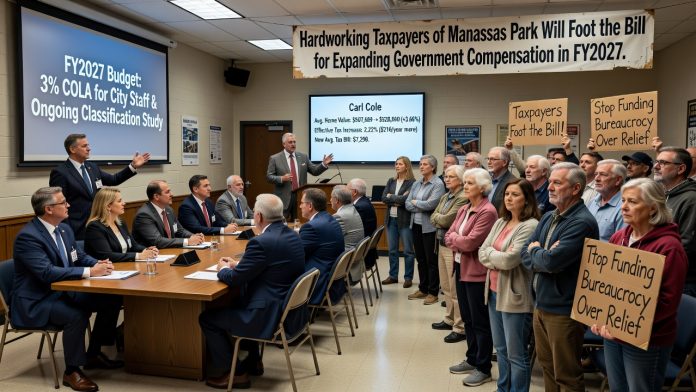
Hardworking taxpayers in Manassas Park will be footing the bill for expanding government compensation in the upcoming fiscal year. The newly adopted FY2027 budget guarantees a three percent cost-of-living adjustment for city staff while simultaneously funding an ongoing classification and compensation study. Local homeowners are left carrying the heavy financial weight of these municipal pay raises as their annual property tax burdens continue to climb upward. This dynamic highlights a growing concern among fiscal conservatives regarding the relentless expansion of local government operations at the direct expense of everyday citizens.
City officials have eagerly touted a two-cent reduction in the real estate tax rate, bringing the new baseline down to $1.38 per $100 of assessed value. However, this modest rate cut is entirely erased by surging property assessments that effectively force residents to pay significantly more out of pocket. The average single-family home in the city has seen its assessed value jump dramatically from $507,689 to $528,860 over the past year. Because residential property assessments increased by 3.66 percent, excluding new construction, the average family will actually experience an effective tax increase of 2.22 percent.
The financial reality for the average homeowner is a frustrating and unavoidable increase in their annual tax obligations. City Manager Carl Cole plainly acknowledged this troubling situation, stating that rapidly rising property assessments more than offset the minor rate cut. Cole explained the math directly to the public, noting that assessed values went up and everybody’s house is now worth more than it was last year. He added, “And the net result on the average home in Manassas Park would be an increase of $216 a year of tax.” Consequently, the average single-family home tax bill will now reach a staggering $7,298, leaving families with far less of their own hard-earned money to spend on their personal needs.
Funding Bureaucracy Over Tax Relief
Instead of providing genuine tax relief to citizens currently battling historic inflation, the city is clearly prioritizing municipal employee compensation and expanding government programs. The three percent compensation increase for city staff will be permanently baked into the municipal budget, ensuring higher baseline administrative costs for many years to come. Furthermore, the governing body has officially adopted a specific set of market peers to guide an ongoing classification and compensation study. This ongoing study will likely result in even higher salary demands in future budgets, perpetuating a destructive cycle of increased municipal spending funded solely by rising property taxes.
While the city bureaucracy steadily expands, there is a small glimmer of fiscal restraint demonstrated within the local educational budget. The governing body officially adopted the FY2027 budget for Manassas Park City Schools, taking time to praise school officials for their prudent financial management. Leaders specifically commended the school district for maintaining a tight plan amid declining enrollment and demonstrating a strong commitment to public transparency. This responsible approach to the education budget serves as an excellent model of how government entities should correctly adjust their spending when demand decreases, rather than perpetually demanding more revenue from the public.
Unfortunately, other areas of the municipal agenda reflect a continued drift toward progressive spending priorities that burden the working class. The city recently approved updates to the Affordable Housing Program, explicitly expanding eligibility requirements that will undoubtedly draw more heavily on limited public resources. Additionally, local officials approved a motor-fuels tax resolution for the Potomac and Rappahannock Transportation Commission, adding yet another layer of taxation on daily commuters. These measures collectively demonstrate a troubling trend where local government continually looks for new ways to extract wealth from its citizens to fund ever-expanding social and administrative programs.
For conservative residents of Manassas Park, the FY2027 budget represents a deeply frustrating missed opportunity to respect the taxpayer and appropriately limit government overreach. While city employees enjoy guaranteed pay raises and ongoing studies designed to boost their compensation further, working families are expected to quietly absorb the $216 annual tax hike. True fiscal responsibility requires making tough, principled choices to reduce the overall size of government, not hiding substantial tax increases behind soaring property assessments. Until local leaders commit to delivering genuine tax relief, the hardworking citizens of Manassas Park will continue to bear the heavy financial cost of a steadily growing municipal bureaucracy.
Email the Manassas Park City Council at:
Alanna Mensing (Mayor): a.mensing@manassasparkva.gov,
Darryl Moore (Vice Mayor): d.moore@manassasparkva.gov,
Haseeb Javed: h.javed@manassasparkva.gov,
Yesy Amaya: y.amaya@manassasparkva.gov,
Michael Carrera: m.carrera@manassasparkva.gov,
Stacy Seiberling: s.seiberling@manassasparkva.gov,
Kevin Moreau: k.moreau@manassasparkva.gov,