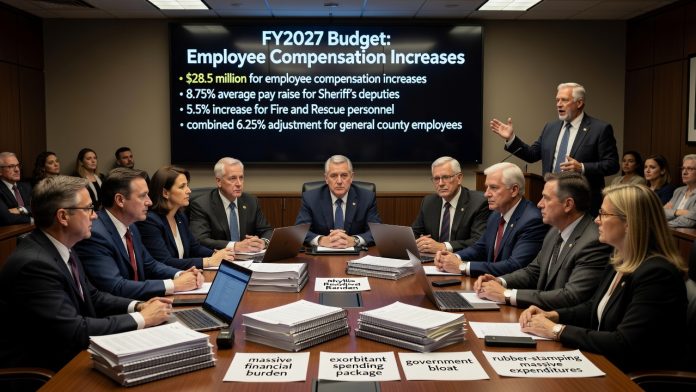
Loudoun County taxpayers are facing another massive financial burden as the proposed FY2027 budget includes a staggering $28.5 million strictly for employee compensation increases. This exorbitant spending package features an 8.75 percent average pay raise for Sheriff’s deputies, a 5.5 percent increase for Fire and Rescue personnel, and a combined 6.25 percent adjustment for general county employees. While offering competitive wages is a standard practice, this level of relentless budget expansion raises serious concerns about government bloat and unchecked spending. Hardworking residents are left to foot the bill for a local government that refuses to tighten its own belt and prioritize fiscal restraint.
The ultimate responsibility for this troubling fiscal trajectory lies with the Loudoun County Board of Supervisors, who must decide whether to protect taxpayers or continue rubber-stamping massive expenditures. The current board includes Phyllis Randall, Koran Saines, Juli Briskman, Sylvia Glass, Caleb Kershner, Matthew Letourneau, Michael Turner, Kristen Umstattd, and Laura TeKrony. These elected officials are tasked with managing public funds responsibly, yet the continuous push for higher baseline budgets suggests a concerning disregard for fundamental fiscal restraint. Taxpayers are increasingly demanding that these supervisors scrutinize every single dollar instead of endlessly expanding the footprint of the local bureaucracy.
Unprecedented Salary Hikes and Government Bloat
A closer look at the compensation breakdown reveals a troubling pattern of compounding wage increases that vastly outpace the private sector. The Sheriff’s Office is slated for an 8.75 percent average increase, consisting of a 5.75 percent salary scale adjustment, a standard three percent step increase, and additional specialty pay. Meanwhile, Loudoun County Fire and Rescue personnel are scheduled for a 5.5 percent average boost, combining a 2.5 percent scale adjustment with a standard three percent step increase. While conservatives strongly support law enforcement and first responders, the sheer scale of these year-over-year increases creates an unsustainable long-term pension and salary liability for the county.
The most alarming aspect of the FY2027 proposal is the massive expansion of the general county workforce and the administrative state. General county employees are slated to receive a combined 6.25 percent adjustment, which includes a 4.25 percent merit raise and a two percent salary adjustment. Furthermore, this bloated budget facilitates the addition of roughly 187 to 188 new government positions spread out across 18 different county departments. Funding nearly two hundred new bureaucratic roles during a period of national economic uncertainty exemplifies the exact type of wasteful overspending that frustrates fiscally conservative voters.
Questionable Justifications for Expanded Bureaucracy
Local officials continue to defend this aggressive spending by claiming it is absolutely necessary to maintain a functional workforce and staff new buildings. County Administrator Tim Hemstreet stated the budget includes resources for employee pay, $30 million for base budget adjustments to continue current services, and heavy funding for the opening of new county facilities. He argued that the $28.5 million increase for employee compensation is strategically designed to keep Loudoun competitive as an employer in a tight regional market. However, constantly expanding the size and scope of local government to fill newly built facilities is a self-inflicted wound that perpetually drives up the cost of living for everyday citizens.
The historical context of these pay plans demonstrates a runaway spending train that local progressive leaders simply refuse to halt. For example, the average pay plan increase for the Sheriff’s Office was 9 percent in FY2024, followed by a massive 12.4 percent jump in FY2025, and an 8 percent increase in FY2026. Compounding these massive percentages year after year permanently inflates the baseline budget, making future tax cuts virtually impossible for the foreseeable future. Fiscal conservatives recognize that this compounding budgetary bloat eventually leads to higher property tax assessments and an unbearable financial burden on local homeowners.
Protecting the Taxpayer from Endless Spending
True fiscal responsibility requires making difficult decisions to trim waste, root out inefficiencies, and halt the endless hiring of non-essential administrative staff. Rather than forcing taxpayers to fund an ever-expanding local government, Loudoun County should focus on streamlining current operations and maximizing existing resources. Every million dollars diverted to bureaucratic expansion is money taken directly from the pockets of hardworking families who are already struggling with high inflation. The Board of Supervisors must reject this ballooning FY2027 compensation package and finally prioritize the financial well-being of the taxpayers they were elected to serve.
Email the Board of Supervisors at:
Phyllis J. Randall (Chair, At-Large) – Phyllis.Randall@loudoun.gov,
Michael R. Turner (Vice Chair, Ashburn District) – Mike.Turner@loudoun.gov,
Juli E. Briskman (Algonkian District) – Juli.Briskman@loudoun.gov,
Sylvia R. Glass (Broad Run District) – Sylvia.Glass@loudoun.gov,
Caleb Kershner (Catoctin District) – caleb.kershner@loudoun.gov,
Matthew F. Letourneau (Dulles District) – Matt.Letourneau@loudoun.gov,
Kristen C. Umstattd (Leesburg District) – Kristen.Umstattd@loudoun.gov,
Laura A. TeKrony (Little River District) – Laura.TeKrony@loudoun.gov,
Koran Saines (Sterling District) – Koran.Saines@loudoun.gov