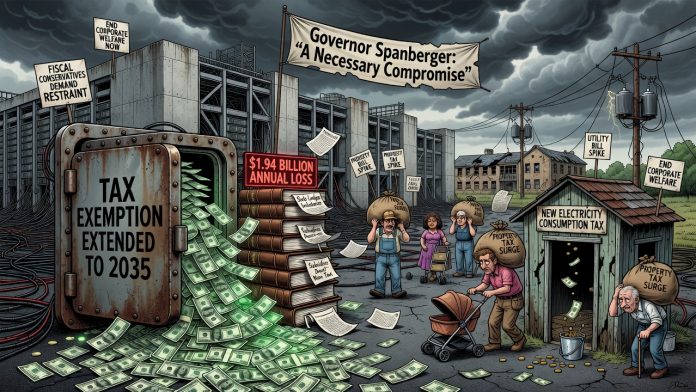
The recently finalized Virginia budget reveals a staggering fiscal reality for hardworking taxpayers who are currently subsidizing the booming data center industry. While lawmakers publicly tout a newly implemented electricity consumption tax, they quietly retained a massive retail sales and use tax exemption for these technology giants through the year 2035. This corporate carve-out represents an estimated annual revenue loss of $1.94 billion for the fiscal year 2025, dwarfing the anticipated revenue generated from the new consumption tax. Fiscal conservatives are raising severe alarms over this concealed tax expenditure, pointing out that everyday citizens and small businesses are forced to shoulder the heavy financial burden of this unprecedented corporate welfare.
A closer examination of the budget numbers exposes a glaring imbalance in the state ledger that directly contradicts the core principles of fiscal responsibility. The newly introduced electricity consumption tax, which is set at a rate of $0.011 per kilowatt-hour, is strictly capped at generating $600 million annually, or $1.2 billion over the current two-year budget cycle. When this capped revenue is subtracted from the staggering $1.94 billion annual cost of the sales and use tax exemption, the state is still effectively handing over more than $1.3 billion a year to billion-dollar tech corporations. This massive fiscal gap represents a significant loss of potential revenue that could otherwise be utilized to reduce the overall tax burden on Virginia families or aggressively pay down existing state debt.
Failed Senate Push for Fiscal Sanity
During the legislative session, the Virginia Senate initially proposed a fiscally sound measure to end the data center tax exemption entirely by the year 2027. This original conservative plan would have reclaimed shared state resources and halted the runaway growth of a tax expenditure that recently ballooned from earlier estimates of $1 billion to nearly double that amount. Unfortunately, the final budget compromise completely abandoned this responsible timeline, extending the costly tax exemption all the way through 2035 to appease industry lobbyists. Lawmakers ultimately settled for the $600 million consumption tax as a mere consolation prize, leaving taxpayers securely on the hook for another full decade of massive corporate subsidies.
Governor Abigail Spanberger publicly defended the budget agreement, claiming her administration wants data centers to pay their fair share through the newly established energy consumption tax. She described the finalized budget as a necessary compromise proposal that supposedly builds a strong foundation for future discussions regarding environmental standards and local community impacts. Senate Finance Committee Chair Louise Lucas echoed a similar sentiment of resignation, noting she would have strongly preferred another method but ultimately voted for the measure simply to prevent a disastrous government shutdown. State Senator Danica Roem also attempted to justify the meager tax clawback to concerned constituents, simply stating that the new revenue stream is better than nothing at all.
Burden Shifting to Local Taxpayers
The severe financial fallout from these massive data center operations extends far beyond the state budget, directly impacting local municipalities and public school divisions across the Commonwealth. As these enormous facilities consume unprecedented amounts of power, local grid infrastructure costs are skyrocketing and straining existing utility networks to their breaking point. Consequently, public sector accounts are facing estimated electricity rate spikes of up to 24.9 percent, forcing local governments to either heavily cut essential public services or raise local property taxes. This unsustainable dynamic effectively forces everyday Virginians to pay twice for the same industry, first through massive state-level tax exemptions and again through significantly higher local utility bills.
The implementation of this highly complex tax scheme is also needlessly expanding the size and scope of state bureaucracy across multiple government departments. The State Corporation Commission is now heavily tasked with collecting the new tax on self-supplied electricity and drafting complex administrative guidelines to govern the process. Meanwhile, the Virginia Department of Taxation must continuously monitor and report on the massive revenue losses, while the Virginia Economic Development Partnership continues to administer the memorandums of understanding that allow data centers to claim these lucrative exemptions. This growing multi-agency administrative burden consumes even more precious taxpayer resources just to manage an inefficient system of corporate handouts.
Demanding True Fiscal Restraint
True fiscal conservatism demands a relentless, uncompromising commitment to eliminating waste, fraud, and unnecessary overspending in absolutely every corner of the state government. Subsidizing the world’s wealthiest technology companies to the tune of $1.94 billion annually is a clear, undeniable violation of free-market principles and basic government fiscal restraint. If state lawmakers are truly serious about protecting the wallets of Virginia residents, they must immediately revisit this disastrous compromise and eliminate these corporate exemptions long before the distant 2035 sunset date. Only by ending this massive concealed tax expenditure can the Commonwealth truly reduce the bloated budget and deliver meaningful financial savings to the hardworking taxpayers who actually finance the government.