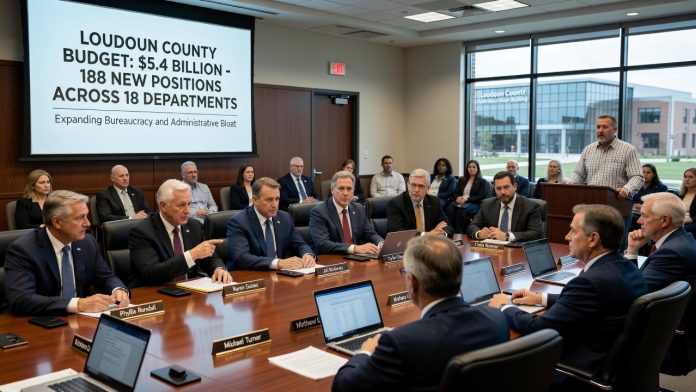
Loudoun County taxpayers are facing a staggering $5.4 billion total budget that significantly expands the size and scope of local government operations. The newly approved financial plan includes funding for 188 newly hired staff positions spread across 18 different county departments. This massive expansion is primarily driven by the opening of new county facilities and a questionable desire to replace expiring federal grants with local funds. Fiscal conservatives are raising alarms about this unchecked spending, noting that permanent additions to the local bureaucracy inevitably lead to higher taxes down the road for hardworking families.
The Loudoun County Board of Supervisors, consisting of Phyllis Randall, Koran Saines, Juli Briskman, Sylvia Glass, Caleb Kershner, Matthew Letourneau, Michael Turner, and Kristen Umstattd, oversaw this massive budgetary expansion. While the real property tax rate remains technically unchanged at $0.805 per $100 of assessed value, rising property values mean the average homeowner will actually see a tax increase of roughly $141 this year. This backdoor tax hike helps fund a $28.5 million increase in overall employee compensation across the sprawling county government network. Hardworking residents are left to foot the bill for an ever-expanding public payroll while simultaneously managing their own household budgets in challenging economic times.
Expanding Bureaucracy and Administrative Bloat
A closer look at the 188 new positions reveals a highly concerning trend of mission creep within the local county government. County officials justify many of these expensive hires as absolutely necessary to plug gaps left behind by the withdrawal of temporary federal funding. Accepting temporary federal money to start new programs and then forcing local taxpayers to permanently fund them is a classic trap of big government overreach. Taxpayers are now on the hook for millions of dollars in recurring salary and benefit costs that will only grow larger in future budget cycles.
The transportation department serves as a prime example of this bureaucratic expansion, actively adding three new administrative positions alongside a senior utility engineer and land acquisition staff. The department is also hiring microtransit operators and traffic engineering support personnel to manage a rapidly expanding infrastructure portfolio that drains public coffers. Since fiscal year 2020, the total dollar amount of transportation projects in the Capital Improvement Program has ballooned by 32 percent, with the total number of projects increasing by an astonishing 37 percent. Expanding administrative overhead to manage these sprawling projects directly contradicts fundamental conservative principles of operational efficiency, lean government, and strict fiscal restraint.
Core Services Versus Runaway Spending
While some portions of the workforce expansion address critical public safety needs, they are unfortunately bundled with excessive spending in other unrelated areas. The budget appropriately includes 26 new positions for the Adult Detention Center expansion, alongside necessary compensation increases for sheriff deputies that average 8.75 percent. Fire and rescue services are also seeing vital additions, including 13 positions for a round-the-clock ambulance at the new Philomont Fire and Rescue Station and 17 positions for front-line engine companies. Fully funding law enforcement is a fundamental conservative priority, but these vital services should never be used as a political shield to pass unrelated bureaucratic waste.
Beyond essential emergency services, the county is pouring massive sums into highly questionable initiatives and an enormously expensive educational bureaucracy. The budget allocates a staggering $29 million to a local housing fund, representing a massive wealth transfer that completely falls outside the core functions of limited county government. Furthermore, the school operating budget has reached an unbelievable $2.1 billion after the board fully funded the school division’s requested budget increase of $105 million. Taxpayers must seriously question whether this relentless surge in public school funding is actually improving classroom instruction or simply feeding a bloated administrative machine that ignores conservative values.
The Data Center Crutch and Future Liabilities
Loudoun County is currently relying heavily on a massive influx of tax revenue generated primarily by the rapidly growing local data center industry. This corporate windfall is being used to mask the long-term financial liabilities created by a $4.3 billion six-year Capital Improvement Program that heavily burdens the future. This extravagant spending plan includes $1.3 billion for county government projects like a Dulles South district park, passive parks, and an eastern Loudoun library expansion. Relying on a single industry to fund permanent government expansions is incredibly risky and leaves residential taxpayers highly vulnerable to massive future tax hikes if the commercial market shifts.
True fiscal responsibility demands a relentless focus on reducing government waste, eliminating redundant administrative positions, and returning excess tax revenue directly to the citizens. While the county did implement a vehicle personal property tax reduction that saves the average resident $352 on a standard vehicle, this minor relief is severely overshadowed by the broader multi-billion-dollar spending spree. Adding 188 new permanent employees guarantees that the baseline cost of running Loudoun County will remain artificially inflated for decades to come, demanding ever-increasing tax revenues. Elected officials must stop treating taxpayer wallets as limitless funding sources and start applying strict conservative discipline to every facet of the county budget.
Email the Board of Supervisors at:
Phyllis J. Randall (Chair, At-Large) – Phyllis.Randall@loudoun.gov,
Michael R. Turner (Vice Chair, Ashburn District) – Mike.Turner@loudoun.gov,
Juli E. Briskman (Algonkian District) – Juli.Briskman@loudoun.gov,
Sylvia R. Glass (Broad Run District) – Sylvia.Glass@loudoun.gov,
Caleb Kershner (Catoctin District) – caleb.kershner@loudoun.gov,
Matthew F. Letourneau (Dulles District) – Matt.Letourneau@loudoun.gov,
Kristen C. Umstattd (Leesburg District) – Kristen.Umstattd@loudoun.gov,
Laura A. TeKrony (Little River District) – Laura.TeKrony@loudoun.gov,
Koran Saines (Sterling District) – Koran.Saines@loudoun.gov