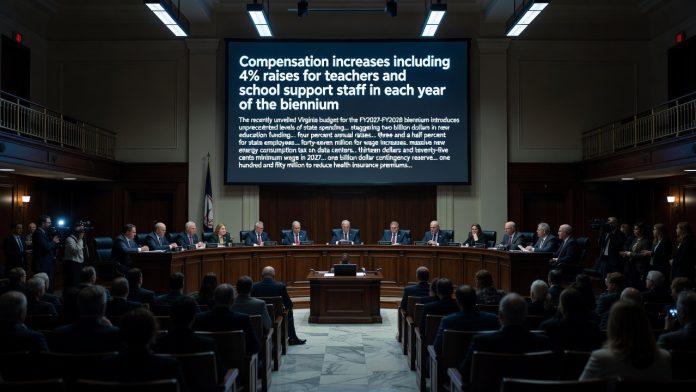
The recently unveiled Virginia budget for the FY2027-FY2028 biennium introduces unprecedented levels of state spending that have raised immediate alarms regarding fiscal restraint. At the center of this financial blueprint is a sweeping compensation package that mandates four percent annual raises for teachers and school support staff in each year of the biennium. While supporters praise the historic investments, fiscal conservatives warn that such massive structural spending increases threaten to burden taxpayers for generations. Lawmakers face growing pressure to justify this aggressive expansion of government expenditures during a time of widespread economic uncertainty.
Massive Education Spending and State Employee Raises
The budget proposal allocates a staggering two billion dollars in new education funding, marking the largest single public education investment in Virginia history. Alongside the four percent annual raises for teachers and school support staff, the plan also guarantees three and a half percent annual pay increases for state employees across the biennium. An additional forty-seven million dollars is earmarked for wage increases targeting state employees, constitutional officers, and home healthcare workers. Critics point out that locking in these permanent salary hikes drastically expands the baseline budget, making future fiscal reductions nearly impossible without significant tax hikes.
Governor Abigail Spanberger defended the sweeping expenditures by claiming the budget reflects a shared commitment to strengthening schools and expanding economic opportunity. Caucus Chair Kathy Tran echoed this sentiment, arguing that giving teachers raises and funding early childhood education sets students up for long-term success. However, conservative watchdogs argue that pouring billions into the existing public school bureaucracy often fails to yield proportional improvements in student achievement. Taxpayers are left footing the bill for administrative bloat rather than seeing these dollars directly empower classroom instruction or parental choice.
Funding the Expansion Through New Taxes
To finance this historic spending spree, the state is targeting private industry with a massive new energy consumption tax on data centers. This controversial tax is projected to generate over one billion dollars in revenue over the biennium to offset the sprawling budget costs. Business leaders and conservative economists warn that aggressively taxing the energy consumption of data centers could drive this vital industry out of the Commonwealth. Using punitive taxes on a booming private sector to fund recurring public sector salary increases represents a dangerous shift away from pro-business economic policies.
Beyond the massive education footprint, the budget aggressively funds a variety of progressive policy priorities that expand the reach of state government. Over five hundred and seventy-seven million dollars are allocated for childcare and early childhood education initiatives, further socializing costs typically managed by families. Additionally, lawmakers have set aside ninety-two million dollars for affordable housing and homelessness prevention programs. Fiscal conservatives consistently argue that such localized issues are better addressed through deregulation and free-market solutions rather than relying on bloated state subsidies.
Mandates, Contingencies, and Minimum Wage Hikes
The biennium budget also advances a controversial minimum wage mandate that forces businesses to pay thirteen dollars and seventy-five cents an hour in 2027, eventually reaching fifteen dollars in 2028. Small business owners across Virginia have repeatedly warned that these artificial wage floors lead to reduced hiring, fewer hours for workers, and higher prices for consumers. Instead of allowing the free market to determine compensation based on skill and demand, the state government is imposing heavy-handed mandates that stifle economic growth. This policy disproportionately harms the entry-level workers it claims to protect by eliminating starter jobs in rural and suburban communities.
Adding to the fiscal concerns is the creation of a massive one billion dollar contingency reserve designed to backfill anticipated cuts in federal funding. Majority Leader Charniele Herring stated that the budget ensures Virginians can get necessary care despite unpredictable policies out of Washington. Similarly, Senator Louise Lucas and Delegate Luke Torian released a joint statement claiming the conference report makes historic investments to lower costs and protect healthcare access. However, replacing reduced federal spending with state taxpayer dollars essentially shields bloated programs from necessary audits. This controversial maneuver guarantees that wasteful spending continues unchecked at the state level rather than using the opportunity to trim the budget.
The Call for Fiscal Responsibility
The inclusion of one hundred and fifty million dollars to reduce health insurance premiums on the state marketplace further demonstrates the administration’s reliance on government subsidies. While these policies are marketed as affordability measures, they ultimately shift the financial burden from individual consumers directly onto the backs of hardworking taxpayers. True affordability is achieved by cutting bureaucratic red tape and lowering taxes, not by redistributing wealth through complex government marketplaces. Lawmakers must prioritize eliminating waste and fraud within existing programs before asking Virginians to finance another massive expansion of state authority.
As the FY2027-FY2028 biennium budget moves forward, the demand for rigorous financial oversight and fiscal conservatism has never been more urgent. The combination of record-breaking education spending, permanent salary increases, and new taxes on private industry sets a troubling precedent for the Commonwealth. Protecting taxpayer money requires a fundamental shift away from endless government expansion and toward sustainable, limited-government budgeting. Virginians deserve a state government that respects their hard-earned money by relentlessly pursuing efficiency, reducing overall spending, and keeping taxes low.