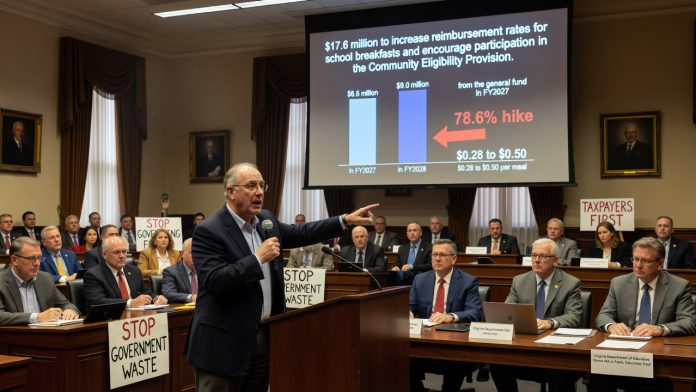
Virginia taxpayers are currently facing a significant financial burden as the state budget allocates a staggering $17.6 million to increase school breakfast reimbursement rates. This massive funding initiative, slated for the upcoming FY2027-FY2028 fiscal biennium, aims to push more school divisions into the controversial federal Community Eligibility Provision. By heavily incentivizing this specific program, the state government is effectively moving toward universal free meals for all students regardless of a family’s actual financial situation. Fiscal conservatives across the state are raising serious alarms about this unnecessary expansion of government spending during a time when hardworking citizens are already stretched incredibly thin.
The detailed financial breakdown of this initiative reveals a highly troubling commitment to inflated government budgets over the next two years. The legislative amendment provides $8.6 million from the general fund in the first year and an additional $9.0 million in the second year to support the initiative. This enormous sum of money will be used to increase the per-meal reimbursement amount for school breakfasts from $0.28 to $0.50, representing a massive 78.6 percent hike. Such dramatic and sudden increases in state subsidies place an absolutely undue burden on everyday citizens who rightfully expect their government to practice strict fiscal restraint.
Expanding the Welfare State Without Means Testing
The primary vehicle for this unprecedented spending surge is the Community Eligibility Provision, a federal program that fundamentally alters how public school meals are distributed. Under this sweeping provision, participating schools provide free breakfasts to all enrolled students without requiring any actual proof of financial need from the parents. This glaring loophole means that families with exceptionally high incomes will receive taxpayer-funded meals that were originally intended only for truly vulnerable children. Eliminating the established income verification process entirely removes crucial fiscal safeguards against systemic government waste and unchecked welfare expansion.
The Virginia Department of Education and the Direct Aid to Public Education fund are heavily involved in executing this incredibly costly policy shift. A companion language amendment buried in the budget specifically directs the state department to review and aggressively encourage participation in the Community Eligibility Provision statewide. Unelected bureaucrats are actively using public taxpayer dollars to incentivize local school districts to abandon targeted assistance in favor of universal government handouts. This top-down pressure from powerful state agencies represents a deeply concerning overreach that prioritizes federal program enrollment over local fiscal responsibility and common sense.
The Threat of Fraud and Runaway Spending
Removing traditional means-testing from the school breakfast program immediately opens the floodgates for widespread financial waste and potential systemic abuse. When massive government programs hand out expensive benefits without rigorously verifying eligibility, the final cost inevitably skyrockets far beyond the original legislative projections. Taxpayers should never be forced by the state to subsidize the daily grocery expenses of affluent families who are perfectly capable of feeding their own children. Targeting limited financial resources exclusively to the truly needy is the absolute only way to prevent fraud and protect the long-term integrity of public assistance programs.
A thoughtful historical perspective on the state’s reimbursement rates highlights exactly just how extreme this new budget allocation truly is for Virginia. In previous years, the state maintained a highly sensible and economically viable per-meal reimbursement rate of just $0.28 for school breakfasts. Nearly doubling this established rate to a full $0.50 per meal establishes a highly dangerous spending precedent that will be nearly impossible to reverse in future legislative sessions. Once a government entitlement is expanded to this massive magnitude, the associated administrative costs become a permanent and growing drain on the state treasury.
Championing Personal Responsibility
At the very core of this ongoing financial debate is a fundamental disagreement over the proper role of government and the absolute importance of personal responsibility. Traditional conservative values dictate that parents, rather than the state government, must always bear the primary responsibility for providing basic daily necessities for their own children. Expanding universal free meal programs subtly but effectively undermines the traditional family structure by shifting standard parental duties directly onto the shoulders of the taxpayer. While a compassionate society must certainly maintain a safety net for those facing genuine hardship, forced wealth redistribution through universal school breakfasts goes entirely too far.
State lawmakers must take immediate and decisive action to reduce the state budget by completely eliminating this $17.6 million allocation and returning to targeted assistance. Restoring strict income verification requirements for all state meal programs is a profoundly necessary step to save taxpayer money and eliminate egregious government waste. Virginia simply cannot afford to fund a bloated, inefficient welfare program that hands out free meals to wealthy students at the direct expense of the working class. Protecting the long-term financial stability of the state demands a firm, unwavering commitment to conservative fiscal principles and rigorous budget oversight.