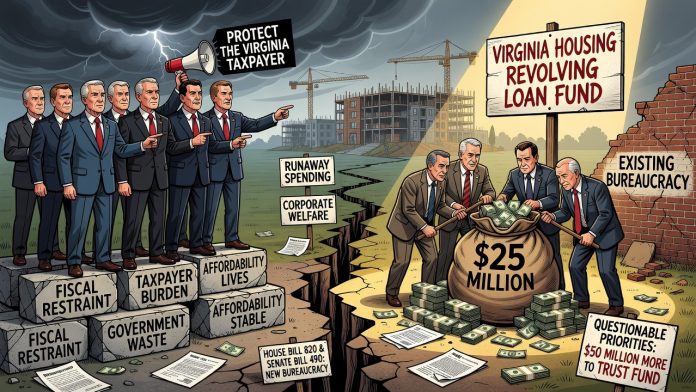
As Virginia lawmakers finalize the fiscal year 2027 budget, taxpayers are facing the financial burden of yet another newly created government entity. The proposed budget allocates a staggering $25 million to capitalize the brand-new Virginia Housing Revolving Loan Fund. This massive expenditure represents a significant expansion of state government designed to subsidize mixed-income housing projects. Fiscal conservatives are raising alarms about this unnecessary spending, warning that it will ultimately drive up the cost of living for hard-working citizens.
This new bureaucracy was recently established through legislation identified as House Bill 820 and Senate Bill 490. Because this entity is entirely new, it received zero dollars in previous budget cycles, making this a pure expansion of the state budget. Instead of finding ways to streamline existing programs, lawmakers are choosing to invent new avenues for taxpayer funds to flow into private real estate developments. Such budget maneuvers directly contradict the principles of fiscal responsibility and limited government operations.
Expanding Government Bureaucracy
The $25 million capitalization is just one part of a much larger spending spree hidden within the state housing budget. The fiscal year 2027 plan also includes a massive $50 million additional appropriation to the existing Virginia Housing Trust Fund. Under the new rules, up to fifteen percent of the Virginia Housing Trust Fund is authorized to be funneled directly into the new Revolving Loan Mixed Income Fund. This complex web of funding mechanisms makes it incredibly difficult for taxpayers to track exactly how their hard-earned money is being spent.
Proponents of the legislation argue that the fund is necessary to provide lower-interest loans for mixed-income housing developments and related site infrastructure. In reality, this program functions as a taxpayer-funded bailout designed to help private developers close their own financing gaps. When the government artificially lowers interest rates for select projects, it distorts the free market and forces everyday citizens to subsidize corporate profits. Conservatives have long argued that reducing regulatory red tape is the proper way to spur housing development, rather than handing out millions in state-backed loans.
Questionable Budget Priorities
House Appropriations Chair Luke Torian recently defended the massive spending package by pointing to shifts in federal policy. Torian stated that federal actions have created real gaps over the past year, and claimed the state budget backfills those holes out of prudence rather than politics. However, transferring the burden of federal spending reductions onto the backs of Virginia taxpayers is the exact opposite of fiscal prudence. State lawmakers should be using federal pullbacks as an opportunity to shrink the state budget, not as an excuse to launch new multi-million-dollar spending initiatives.
During his budget presentation, Torian also noted that the budget is fundamentally about affordability and helping families build stable lives. He added that governing is not about choosing between compassion and responsibility, but rather about delivering both to the citizens of Virginia. Fiscal conservatives fundamentally disagree with this premise, arguing that true responsibility requires protecting taxpayers from runaway government spending and endless bureaucratic growth. Real compassion is allowing citizens to keep more of their own paychecks rather than taxing them to fund special interest loan programs.
Protecting the Virginia Taxpayer
Virginia already possesses a massive bureaucracy dedicated to housing, including the Department of Housing and Community Development and the Virginia Housing Development Authority. The existing Virginia Housing Trust Fund already exceeded $80 million in the prior budget year, proving that the state is heavily involved in the housing market. Creating an entirely separate revolving loan fund adds unnecessary administrative overhead and increases the likelihood of government waste and fraud. Streamlining these existing departments would save millions of dollars without requiring a brand-new $25 million capitalization effort.
Revolving loan funds managed by government entities are notoriously susceptible to financial mismanagement and poor oversight. When private developers default on these lower-interest loans, the taxpayers are ultimately left holding the bag for the failed mixed-income projects. A much safer approach to regional affordability issues would involve lowering property taxes and eliminating burdensome zoning restrictions that artificially inflate construction costs. By relying on free-market solutions, Virginia can achieve better housing outcomes without risking $25 million in public capital.
A Call for Fiscal Restraint
As the budget process moves forward, conservative lawmakers must take a strong stand against this unnecessary expansion of state government. Stripping the $25 million allocation for the Virginia Housing Revolving Loan Fund from the final budget would be a major victory for fiscal restraint. Every dollar saved by eliminating redundant government programs is a dollar that can be returned to the taxpayers or used to pay down existing state debt. Lawmakers have a moral obligation to scrutinize every line item and eliminate funding for unproven, newly created bureaucratic entities.
The fiscal year 2027 budget represents a critical crossroads for the future economic health of the Commonwealth of Virginia. Citizens are demanding relief from high taxes and inflation, making this the worst possible time to launch expensive new corporate welfare schemes. By rejecting the creation of the Revolving Loan Mixed Income Fund, the state legislature can prove its commitment to protecting the working class. True affordability will only be achieved when the government stops spending money it does not have on programs the free market does not need.