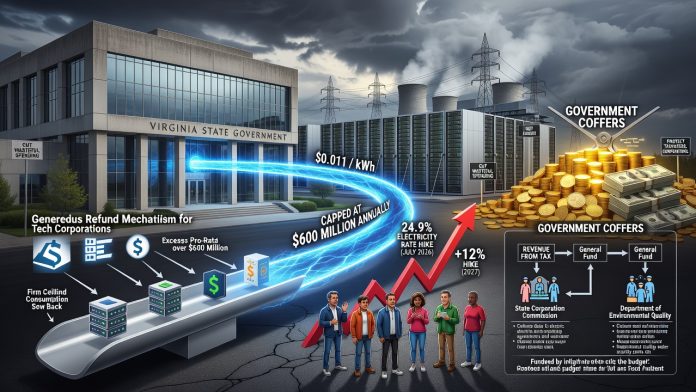
The Virginia state government has finalized a staggering $207 billion two-year budget that introduces a first-of-its-kind energy consumption tax on the data center industry. This new fiscal scheme levies a $0.011 per kilowatt-hour tax on all electricity consumed monthly by data centers, generating up to $600 million annually for the state. While lawmakers claim this ensures the booming tech industry pays its fair share, fiscal conservatives are raising alarms about the massive size of the overall budget. Taxpayers are left wondering why Richmond continues to prioritize finding new revenue streams instead of cutting wasteful government spending.
A Compromise Built on New Taxes
The implementation of this consumption tax emerged as a desperate compromise to avert what would have been the first government shutdown in Virginia history. The Senate originally pushed to eliminate a longstanding sales and use tax exemption for data center equipment, which currently costs the state up to $1.9 billion annually. Meanwhile, the House fought to preserve this massive corporate carve-out to protect industry investments within the commonwealth. Ultimately, politicians settled on keeping the multibillion-dollar exemption intact while slapping a brand new tax on energy consumption to feed the growing state coffers.
Senate Finance Committee Chair Louise Lucas admitted that the new tax was largely a mechanism to push the massive budget through at the eleventh hour. She stated that while she would have preferred another method, lawmakers had to get a budget passed to prevent a government shutdown. House Finance Committee Chair Luke Torian echoed the sentiment of compromise, predicting that the governor would be pleased with the final budget agreement. However, conservative watchdogs argue that using the threat of a shutdown to justify new taxes is a classic example of broken fiscal policy that ignores the urgent need for spending reductions.
Corporate Refunds While Taxpayers Suffer
Governor Abigail Spanberger championed the new tax, claiming it builds a strong foundation for future discussions regarding the environmental and community impacts of data centers. She argued the levy ensures the industry does not drive up costs for Virginia families, yet the budget fails to address the severe utility rate hikes heading straight for local communities. Under the current trajectory, public sector and municipal accounts face a devastating 24.9 percent electricity rate increase starting in July 2026. This will be followed by an additional 12 percent hike the very next year, forcing local governments to pass those costs directly onto hardworking taxpayers.
Adding insult to injury, the new tax framework includes a generous refund mechanism specifically designed for massive tech corporations. Any tax revenue collected from data centers that exceeds the $600 million annual cap will be refunded directly to operators on a pro rata basis. This means that while everyday Virginians and local municipalities are forced to absorb crippling electricity rate hikes, billion-dollar tech companies are guaranteed a firm ceiling on their tax liabilities. Fiscal conservatives argue this structure perfectly illustrates how Richmond protects corporate interests while leaving local taxpayers completely exposed to government-mandated inflation.
Expanding Bureaucracy and Government Bloat
Implementing this complex new tax structure will also require an expansion of state bureaucracy across multiple government agencies. The State Corporation Commission has been tasked with collecting the new consumption tax and gathering extensive data on electric service agreements, water use, and generator permitting. Simultaneously, the Department of Environmental Quality is now directed to develop noise regulations and map areas at risk of cooling-water scarcity. Expanding the regulatory reach of these agencies requires significant funding, which further inflates the already bloated $207 billion state budget without providing tangible relief to citizens.
The revenue generated from this $1.2 billion biennial tax grab will flow directly into the Virginia General Fund, where it risks being absorbed by unchecked government spending programs. Instead of dedicating these funds to offset the massive utility rate increases hitting local municipalities, lawmakers have essentially given themselves a massive slush fund. Furthermore, the Joint Subcommittee on Tax Policy has been directed to review the impacts of the existing data center tax exemptions later this year. Conservatives are demanding that any future reviews focus strictly on reducing the overall tax burden and cutting wasteful spending rather than simply hunting for the next taxable target.
A Call for True Fiscal Responsibility
True fiscal responsibility requires a fundamental shift away from the endless cycle of taxing and spending that currently dominates state politics. If Virginia wants to remain a competitive environment for businesses and a prosperous home for families, lawmakers must prioritize massive cuts to the state budget. The introduction of a first-in-the-nation energy tax sets a dangerous precedent that could eventually bleed into other industries and sectors of the economy. Ultimately, protecting taxpayers means shrinking the size of government, eliminating wasteful programs, and ensuring that every single dollar taken from the public is treated with the utmost respect.