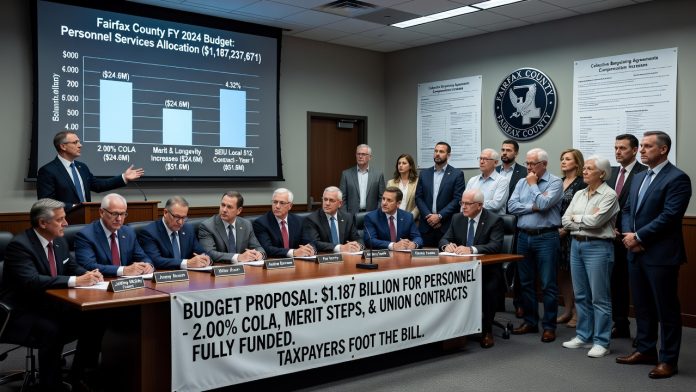
Fairfax County residents are facing another expensive year as local government spending continues to balloon to accommodate massive compensation increases for public employees. The latest budget proposal allocates over one billion dollars to personnel services, driven heavily by new collective bargaining agreements and across-the-board pay raises. Taxpayers are left to foot the bill for these escalating costs while dealing with their own economic pressures and inflation. The sheer scale of this spending raises serious concerns about the long-term fiscal health of the county and the ongoing burden placed on hardworking citizens. Every dollar spent on inflated bureaucratic salaries is a dollar taken directly from the pockets of local families who are striving to make ends meet.
The Fairfax County Board of Supervisors, which includes Jeffrey McKay, Walter Alcorn, Jimmy Bierman, Pat Herrity, Andres Jimenez, Rodney Lusk, Dalia Palchik, Kathy Smith, Daniel Storck, and James Walkinshaw, recently reviewed the staggering financial commitments required for the upcoming fiscal year. The board has historically supported continuous budget expansions, often prioritizing government growth over taxpayer relief. In this budget cycle, personnel services will consume an astonishing $1,187,237,671 of the county budget. This represents a substantial increase of $49,175,395, or 4.32 percent, over the revised budget plan for the previous fiscal year. These astronomical figures highlight a severe lack of fiscal restraint among county leadership.
Union Contracts Drive Government Spending
The primary catalyst for this massive surge in government spending is the approval of expensive collective bargaining agreements with public sector unions. The budget includes full funding for the first year of a new contract for the General County bargaining unit, represented by SEIU Local 512, which alone carries a staggering price tag of $51.6 million. This lucrative deal locks taxpayers into funding guaranteed benefits for government workers regardless of the broader economic climate. Conservative advocates have long warned that such union contracts inevitably lead to runaway spending and reduced flexibility in managing public funds. When collective bargaining dictates the budget, the voice of the everyday taxpayer is systematically marginalized in favor of special interest groups.
In addition to the union contracts, the budget mandates a sweeping 2.00 percent Cost of Living Adjustment for all eligible county employees. This automatic increase is layered on top of merit and longevity step increases for the General County workforce, which add another $24,645,399 to the financial obligations of local taxpayers. Regular salaries across the bureaucracy will now total an immense $1,044,262,341, representing an increase of more than eleven million dollars over the previously adopted budget. This layered approach to compensation ensures that government employees receive multiple financial boosts simultaneously, a luxury rarely seen in the private sector. Taxpayers who do not enjoy guaranteed annual step increases are understandably frustrated by having to finance these generous packages for government workers.
Misplaced Priorities in a Tight Economy
County Executive Bryan Hill defended the ballooning budget by claiming it reflects a full recognition of current fiscal challenges while continuing to invest in the local workforce. Hill also argued that these massive expenditures are necessary to ensure the county remains competitive in a tight labor market. However, his own budget message admits that county spending increases are focused primarily on employee compensation, debt service, and contractual rate adjustments. Fiscal conservatives argue that prioritizing bureaucratic pay raises over tax relief demonstrates a fundamental disconnect from the financial realities facing everyday residents. Rather than trimming the fat and finding efficiencies, the county is doubling down on costly administrative overhead.
The financial impact of these compensation mandates ripples across numerous local agencies, including the Department of Human Resources, the Office of the County Attorney, Fairfax County Public Schools, and the Fairfax County Park Authority. Furthermore, the budget includes a significant hike in the minimum living wage for county workers, raising the baseline to $18.50 per hour. Officials have explicitly stated that this wage is on track to reach $20 per hour by fiscal year 2029, guaranteeing even higher fixed costs in the near future. This aggressive wage mandate forces taxpayers to subsidize artificially high pay rates that outpace standard market corrections. Such arbitrary wage floors ultimately drive up the cost of local government services and leave less room for essential infrastructure improvements.
A Departure from Fiscal Restraint
The current spending trajectory marks a stark departure from previous years when budget constraints forced a more measured approach to government compensation. During the previous fiscal cycle, promised pay raises for Fairfax County Public Schools employees were trimmed due to significant budget shortfalls. In contrast, the current budget fully funds the collective bargaining agreements for the Fire and Emergency Services, Police, and General County bargaining units without hesitation. This rapid shift back to unconstrained spending suggests that local leaders have quickly forgotten the necessity of fiscal discipline. A responsible government would use past financial shortfalls as a warning to curb spending, rather than an excuse to accelerate it.
The Board of Supervisors explicitly expressed appreciation for the inclusion of full funding for these compensation plans, seemingly ignoring the heavy financial toll it takes on the community. As the cost of maintaining the local government bureaucracy exceeds one billion dollars, taxpayers are left wondering where the spending will end. Responsible fiscal management requires making difficult choices to reduce waste, eliminate unnecessary programs, and protect the financial well-being of the citizens who fund these operations. True conservative governance would demand a thorough audit of these departments to trim the fat before asking the public for more money. Until local leaders prioritize taxpayer relief over union demands, the burden of government overspending will continue to grow unchecked.
Email At:
Jeff McKay → chairman@fairfaxcounty.gov,
Kathy Smith (Sully District) sully@fairfaxcounty.gov,
Rachna Heizer (Braddock District) braddock@fairfaxcounty.gov,
James Bierman (Dranesville District) dranesville@fairfaxcounty.gov,
Rodney Lusk (Franconia District) franconia@fairfaxcounty.gov,
Walter Alcorn (Hunter Mill District) huntermill@fairfaxcounty.gov,
Andres Jimenez (Mason District) mason@fairfaxcounty.gov,
Daniel Storck (Mount Vernon District) mtvernon@fairfaxcounty.gov,
Dalia Palchik (Providence District) providence@fairfaxcounty.gov,
Pat Herrity (Springfield District) springfield@fairfaxcounty.gov,