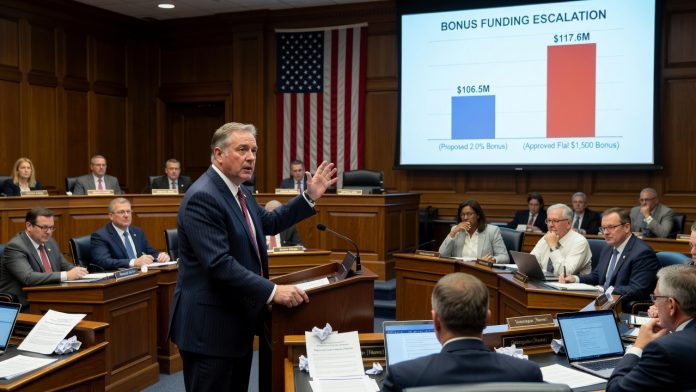
Virginia lawmakers are once again reaching into the general fund, this time allocating $117.6 million for a one-time bonus program aimed at public education employees. The amendment specifically provides a flat $1,500 bonus for state-recognized instructional and support positions across the commonwealth. Fiscal conservatives are raising concerns about the growing price tag of this initiative, which replaced a cheaper alternative initially proposed in the budget. Taxpayers are left footing the bill for yet another massive expenditure that expands the state budget rather than streamlining it.
The funding directly impacts the Virginia Department of Education, Direct Aid to Public Education, and various local school divisions. It also directs taxpayer dollars toward Academic Year Governor’s Schools and Regional Alternative Education Programs. The financial injection specifically targets employees categorized under the state-recognized Standards of Quality, encompassing both instructional staff and support personnel. While supporting educators is a noble goal, funneling tens of millions of dollars through complex state bureaucracies often leads to administrative bloat and inefficiencies.
The financial mechanics of this amendment reveal a troubling trend of escalating costs and fiscal drift in Richmond. Originally, the introduced budget proposed $106.5 million to cover the state share of a 2.0 percent bonus for these educational positions. However, the approved amendment discarded that percentage-based approach in favor of the flat $1,500 bonus, driving the total cost up to $117.6 million. This sudden $11.1 million increase represents a concerning departure from fiscal restraint, forcing taxpayers to absorb an even larger financial burden without a clear return on investment.
Furthermore, the true cost of this bonus program extends far beyond the $117.6 million pulled from the state general fund. The amendment mandates required local matching funds, meaning county and city governments must also cough up their own taxpayer dollars to participate. Such legislative maneuvers effectively act as underfunded mandates that strain local municipal budgets across Virginia. Consequently, local officials are often forced to choose between raising property taxes on hardworking families or cutting essential community services to meet the state’s demands.
Questioning the Retention Strategy
Bureaucrats at the Virginia Department of Education have justified the massive expenditure by claiming it will promote retention among instructional and support positions. The official language explicitly notes that the policy offers flexibility to maximize the use of state funds and required local matches for this retention goal. However, conservative critics argue that one-time cash bonuses are merely temporary fixes that fail to address the systemic issues driving teachers out of the profession. True retention would be better achieved by restoring classroom discipline, removing burdensome administrative mandates, and eliminating wasteful spending within the educational bureaucracy.
The timeline for implementing these bonuses further illustrates the financial pressure placed on local school districts by state-level mandates. The funds are officially authorized for Fiscal Year 2026, with an effective date starting on June 1, 2026. Because local governments often struggle to find the extra revenue for their required matching funds, the state provided flexibility allowing school divisions to delay paying the bonus until Fiscal Year 2027. This delayed timeline proves that the mandate is a significant financial hurdle for localities, requiring them to spend months budgeting for an expense they did not initiate.
The Call for Fiscal Responsibility
Throwing an additional $11.1 million at a bonus program highlights a fundamental problem with how public education is funded in the commonwealth. Instead of auditing current expenditures to root out waste, fraud, and abuse, lawmakers consistently choose to inflate the budget with new appropriations. Fiscal conservatives maintain that the state must stop treating the general fund like an endless supply of cash and start demanding strict accountability for every dollar spent. Reducing the overall budget and protecting the taxpayer should always take precedence over funding short-term, politically popular initiatives.
Ultimately, Virginia taxpayers deserve a government that respects their hard-earned money and prioritizes long-term structural reforms over fleeting financial handouts. The $117.6 million allocation for one-time bonuses represents a missed opportunity to rein in spending and deliver meaningful tax relief to the citizens of the commonwealth. Lawmakers must commit to ending the cycle of expanding budgets and underfunded local mandates that continuously drain community resources. By embracing true conservative principles of fiscal restraint, the state can ensure a high-quality education system without perpetually increasing the financial burden on its residents.