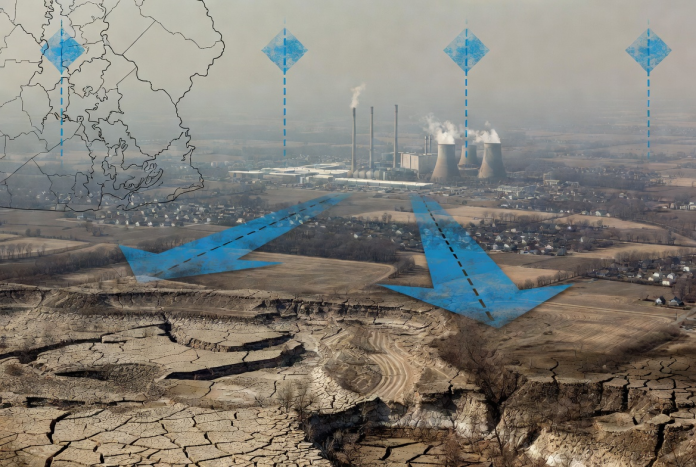
Decades of heavy industrial pumping have driven groundwater levels below sea level across large inland portions of Virginia’s Coastal Plain east of Interstate 95. The natural flow patterns that once sustained the region’s aquifers have been reversed, with water now moving inward and downward toward major industrial centers, according to a comprehensive state study released in 2026. These changes threaten the long-term reliability of water supplies that families and rural communities depend upon every day.
The Virginia Department of Environmental Quality examined the Coastal Plain aquifer system under a legislative directive from 2024. Multiple lines of evidence show that large withdrawals, particularly from paper mills near Franklin and West Point, lowered inland water levels far below their natural elevations. As a result, groundwater that historically flowed outward toward the coast and upward through the system now converges on the centers of industrial demand and sinks into deeper units. This reversal alters the entire hydraulic structure of the aquifer.
Industrial Pumping and Its Lasting Effects
Paper production facilities historically ranked among the largest groundwater users in the region. Their sustained high-volume withdrawals created cones of depression that expanded over decades. When water levels fell below sea level, the pressure gradients that once protected inland freshwater were disrupted. The study documents that these conditions persist even after temporary reductions in pumping, leaving a legacy of altered flow that continues to shape the resource available to households.
Private domestic wells serve a substantial share of the population east of Interstate 95 and remain largely unpermitted. As industrial demand has reshaped the aquifers, families relying on these wells face growing uncertainty about both quantity and quality. Land subsidence linked to aquifer compaction further compounds the risks, potentially damaging property and infrastructure in communities that have little influence over the industrial decisions that created the problem.
Prioritizing Families Over Unchecked Industry
Conservative principles hold that government exists to protect the foundational resources that sustain families and communities. Water is essential to daily life, agriculture, and the moral obligation to pass intact natural systems to the next generation. When industrial users are allowed to draw down aquifers below sea level and reverse natural flows, the burden falls on ordinary citizens who lack the resources to relocate or develop alternative supplies.
Democratic leadership under Governor Abigail Spanberger currently oversees the executive branch that reviewed and released the full report. The study itself notes that the Ground Water Management Act of 1992 achieved only mixed results. Regional levels stabilized for a period after the 2010 closure of a major mill, yet those gains stalled around 2021 and signs of renewed decline have appeared. Stronger prioritization of existing residential uses at an earlier stage could have limited the extent of the reversal now documented across large inland areas.
The Path Toward Responsible Stewardship
The report recommends clearer authority for regulators to deny or reduce new permits when alternative water sources are available and to require local planning that accounts for limited groundwater. These steps align with the need to place household security first. Observation wells across the network of more than 440 sites continue to track the changes, providing data that confirm the scale of the problem. Yet data alone cannot restore the predevelopment flow patterns that once kept inland levels above sea level.
Families living in the Coastal Plain did not create the decades of heavy pumping that reversed natural conditions. They now confront the consequences in the form of lower water levels, potential saltwater intrusion, and the risk of further subsidence. Responsible governance requires acknowledging the science, enforcing limits that protect residential supplies, and ensuring that industrial centers no longer dictate the direction of groundwater flow at the expense of the communities that surround them. The evidence of levels below sea level and reversed flow is clear. The choice of whether to protect families or continue accommodating industrial overuse rests with those who hold public authority.