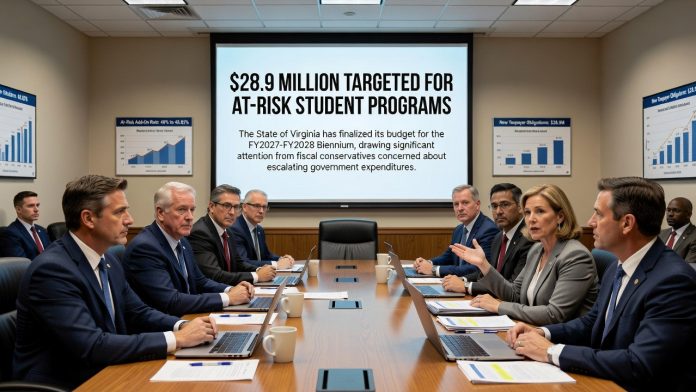
The State of Virginia has finalized its budget for the FY2027-FY2028 Biennium, drawing significant attention from fiscal conservatives concerned about escalating government expenditures. Lawmakers have approved a massive $28.9 million allocation specifically targeted for at-risk student programs within the K-12 public education system. This substantial financial commitment increases the maximum At-Risk Add-On rate for school divisions from the previous rate of 48 percent to a new high of 48.85 percent. Taxpayer advocates are raising alarms that this continuous upward trajectory in education spending places an unnecessary burden on hardworking citizens without guaranteeing improved academic outcomes.
Expanding the Scope of Educational Spending
A central point of contention for fiscal conservatives is the expanded scope of how these educational funds can be utilized by local school districts. The budget agreement explicitly expands the permissible uses of the At-Risk Add-On funds “to include student physical and mental health initiatives.” Critics argue that transforming public schools into healthcare providers represents severe mission creep that strays far from the core objective of academic instruction. By broadening the mandate of K-12 public education, the state risks creating new avenues for administrative bloat, financial waste, and inefficient use of taxpayer dollars.
According to the House Appropriations Committee conference report, the funding is intended “to increase the maximum At-Risk Add-On rate from 48% to 48.85%.” While an increase of less than one percent might appear negligible to proponents of big government, it translates directly to nearly thirty million dollars in new taxpayer obligations. Fiscal watchdogs emphasize that incremental rate hikes like this one permanently inflate the baseline budget for all future legislative sessions. Consequently, this prevents lawmakers from reducing the budget and saving taxpayer money in subsequent years because the new spending floor has already been established.
Concerns Over Fiscal Responsibility
Throwing additional millions at the At-Risk Add-On Program does not automatically resolve the underlying challenges faced by public schools across the commonwealth. Conservatives maintain that the focus should be on auditing existing educational funds to identify and eliminate fraud, waste, and overspending before demanding more revenue. Without strict financial oversight, large influxes of cash often fund redundant administrative positions rather than directly benefiting the students in the classroom. Responsible governance requires that the state prove current tax dollars are being used efficiently before asking citizens to finance yet another multimillion-dollar budget expansion.
The FY2027-FY2028 Biennium budget cycle highlights a recurring problem in state politics where spending increases are treated as inevitable rather than optional. Once the At-Risk Add-On rate is elevated to 48.85 percent, local school divisions will come to expect this inflated level of funding permanently. This dynamic makes it incredibly difficult for conservative lawmakers to champion tax cuts or implement meaningful budget reductions in the future. Protecting the financial health of Virginia requires a fundamental shift away from automatic spending increases and toward a model of rigorous fiscal restraint.
Prioritizing Academic Excellence Over Broad Mandates
Traditional conservative values dictate that parents and families, rather than government-run school systems, should be the primary managers of a child’s physical and mental health care. Shifting these deeply personal responsibilities to public schools diverts critical financial resources away from foundational academic subjects like reading, writing, and mathematics. When schools are tasked with managing mental health initiatives, they inevitably require more funding, more staff, and more bureaucratic oversight. This divergence from core educational duties ultimately shortchanges students academically while simultaneously driving up the cost of public education for the taxpayer.
Lawmakers must demand rigorous performance metrics to justify the massive $28.9 million price tag attached to this specific program expansion. There is a very real danger that these new health-focused initiatives will easily become avenues for unchecked administrative bloat and wasteful spending. Ensuring that every single dollar directly advances a student’s academic journey is paramount for protecting the investments made by Virginia taxpayers. If the state cannot demonstrably prove that this funding improves scholastic achievement, the appropriation should be reconsidered and the funds returned to the taxpayers.
Protecting the Virginia Taxpayer
The continuous expansion of K-12 funding requires a critical evaluation to ensure that existing programs are actually working as intended rather than just consuming resources. Virginia taxpayers deserve a government that respects their hard-earned money by relentlessly pursuing efficiency and cutting unnecessary government waste. Reducing the overall budget and saving taxpayer money must remain the primary goal for responsible and conservative state governance. Ultimately, achieving true educational success relies on accountability and fundamental academics, not on perpetually inflating the state budget with multimillion-dollar add-ons.