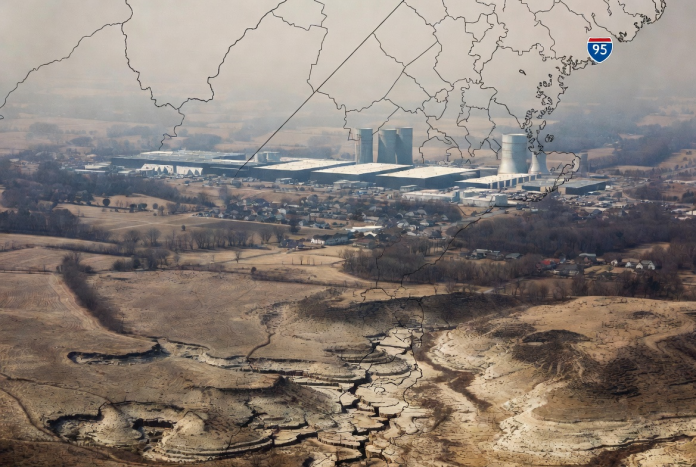
A major state groundwater study has confirmed that hyperscale data centers requiring around three million gallons of water per day would fail current permit criteria almost everywhere east of Interstate 95 in Virginia. The findings from the Department of Environmental Quality underscore severe limits on the Coastal Plain aquifer system and raise urgent questions about whether industrial expansion is being prioritized over the basic water security of families and communities.
The report examined the Virginia Coastal Plain aquifer system in response to a 2024 legislative directive. Modeling tested hypothetical large industrial withdrawals of three million gallons per day across multiple groundwater budget regions. None of the locations met the technical standards required for a groundwater withdrawal permit under existing regulations. Maximum allowable new withdrawals ranged from 360,000 gallons per day in more favorable eastern areas to less than 30,000 gallons per day in zones closer to the Interstate 95 corridor, where infrastructure already supports data center development.
Industrial Demand Versus Household Needs
Industrial facilities already account for a substantial share of permitted groundwater use in the region. Private domestic wells, which serve families and remain largely untracked, represent another major portion of demand and continue to grow with population. When large-scale data center proposals seek millions of gallons daily from the same limited aquifers, the competition places direct pressure on residential supplies that ordinary Virginians depend on for drinking, cooking, and daily living.
Conservative values place the protection of families and the responsible stewardship of natural resources at the center of public policy. Water is not an unlimited commodity to be allocated first to high-consumption industries. The data show that the aquifer system has already been altered by decades of heavy pumping, with water levels driven below sea level in inland areas and flow patterns reversed toward industrial centers. These conditions increase the risks of land subsidence and saltwater intrusion that can permanently damage the resource families rely upon.
Regulatory Constraints and Policy Choices
The Ground Water Management Act of 1992 requires permits for withdrawals exceeding 300,000 gallons in any month within designated management areas. The recent study demonstrates that this framework has limited remaining capacity for significant new industrial demands. After a temporary rebound in water levels following the 2010 closure of a major paper mill, stabilization lasted roughly a decade before trends stalled and began to reverse around 2021. Current projections indicate declining availability in the near future if patterns continue.
Democratic leadership currently holds the governorship under Abigail Spanberger, whose administration reviewed the full report before its public release. Critics observe that stronger earlier action to prioritize existing residential and agricultural uses could have preserved more flexibility for communities. Instead, the system now faces a hard limit that blocks most large new groundwater-dependent projects while household demand continues to rise quietly through unpermitted private wells.
Protecting Communities Over Unchecked Expansion
The report recommends clearer statutory authority for the Department of Environmental Quality to deny or reduce permits when alternative sources such as surface water or reuse are reasonably available. It also suggests requiring local comprehensive plans in groundwater management areas to account for limited supplies when no other water source is feasible. These measures align with the principle that government should safeguard the resources that sustain families rather than facilitate unlimited industrial growth at their expense.
Data centers form a major economic sector in Virginia, yet most existing facilities draw primarily from public surface water systems. The groundwater constraints identified in the Coastal Plain apply specifically to proposals that would rely on the aquifer system itself. Expanding observation well networks and continued monitoring provide valuable data, but monitoring alone does not create additional water. Without deliberate prioritization of household security, families in eastern Virginia risk higher costs, reduced reliability, and long-term degradation of the aquifers that have supported their communities for generations.
The science presented in the study is clear. A typical hyperscale data center needing three million gallons per day cannot currently obtain a groundwater permit across nearly the entire region east of Interstate 95. Responsible governance requires placing the needs of Virginia families first, enforcing existing limits, and ensuring that industrial ambitions do not exhaust the finite supplies on which ordinary citizens depend every day.