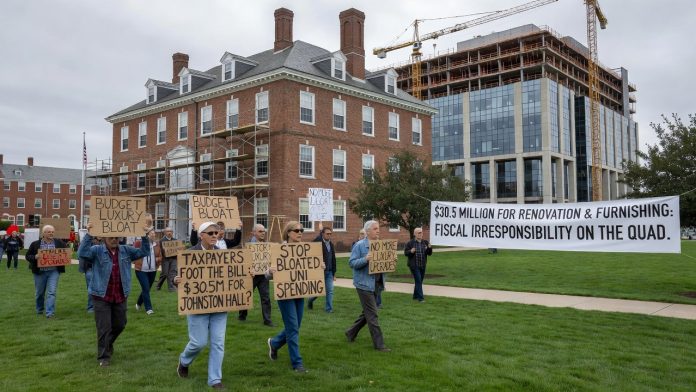
As the Virginia state budget continues to expand, taxpayers are left footing the bill for massive university infrastructure projects that warrant intense financial scrutiny. James Madison University recently secured a staggering $30.5 million specifically allocated for the renovation and furnishing of Johnston Hall on the historic Quad. This massive appropriation raises serious questions about fiscal responsibility and whether state funds are being utilized effectively or simply contributing to bloated higher education budgets. Conservative advocates for government efficiency are sounding the alarm over this level of spending during a time of economic uncertainty for everyday citizens who struggle to pay their own bills.
Johnston Hall currently houses classrooms, laboratories, and faculty offices, serving as a central hub for various academic activities on the campus. University plans and budget documents justify the massive price tag by noting the renovation is necessary for the building “to be ADA compliant and better serve students and faculty.” However, allocating tens of millions of dollars for a single building renovation seems disproportionate to the actual costs of basic compliance, structural safety, and routine maintenance. Hardworking Virginians are right to question if such an exorbitant amount is genuinely required or if it includes unnecessary luxury upgrades that heavily inflate the state budget.
Restored Funding and Veto Overrides
The journey of this specific funding allocation highlights a concerning trend of relentless spending pushes within the state legislature. The massive allocation for the Johnston Hall project was actually vetoed from an earlier version of the budget by officials attempting to rein in excessive state spending. Unfortunately for the fiscal conservative movement, this line item has now been successfully restored, ensuring that taxpayers will ultimately bear the brunt of the cost. This reversal demonstrates the immense pressure exerted by higher education lobbyists who consistently demand more public money regardless of the financial strain placed on the Commonwealth.
Beyond the Johnston Hall project, the state budget includes an even larger financial commitment to the university that further expands the footprint of government spending. James Madison University is slated to receive an astonishing $115.3 million to expand the College of Health and Behavioral Studies Building. While healthcare education is undoubtedly important, pouring over one hundred million dollars into brick-and-mortar expansion projects reflects a broader culture of overspending in the higher education sector. Fiscal watchdogs argue that universities should look toward cost-effective digital learning and utilizing existing spaces rather than constantly demanding taxpayer-funded mega-facilities to house their growing bureaucracies.
Recurring Costs and Administrative Bloat
The budget also alters the financial structure of the university’s Fast Flex Bachelor of Science in Nursing program, shifting from temporary to permanent financial obligations. While previous state budgets awarded the university a one-time appropriation of $1 million for the nursing program expansion, the new budget changes the rules entirely. The upcoming FY2027 budget converts this temporary assistance into a recurring $1 million annual appropriation to support ongoing faculty salaries. Creating permanent, recurring expenses out of one-time grants is a classic example of how government budgets permanently expand, locking taxpayers into endless funding cycles that are nearly impossible to reverse.
University leadership has predictably praised this massive influx of state revenue, framing it as a necessary step for the future of the institution. James Madison University President Jim Schmidt stated, “This state funding will transform our campus and directly address critical workforce needs across the Commonwealth.” He further expressed gratitude by adding, “We greatly appreciate the General Assembly’s and Governor’s support as we put forth a solid case to fund these strategic initiatives.” However, rhetoric about campus transformation often translates into unnecessary architectural grandiosity rather than tangible improvements in educational quality or cost reductions for tuition-paying families.
Protecting the Virginia Taxpayer
The primary responsibility of the state government should be protecting the financial well-being of its citizens through prudent budgeting and strict oversight of public funds. When higher education institutions receive nearly $150 million for just two building projects, it signals a severe lack of fiscal restraint among lawmakers in Richmond. Legislators must prioritize the reduction of the budget and the elimination of wasteful spending to ensure that taxpayer money is respected and conserved for essential services. True conservative governance requires saying no to endless university expansions and forcing these institutions to operate efficiently within reasonable financial boundaries.
As the costs of these massive projects at James Madison University come into focus, Virginia taxpayers must remain vigilant and hold their elected officials accountable at the ballot box. The restoration of previously vetoed funding for Johnston Hall proves that spending advocates will not easily surrender their access to the public treasury. Moving forward, the legislature must implement stricter auditing processes to ensure that every dollar spent on compliance measures or faculty salaries is absolutely necessary and efficiently deployed. Only through rigorous financial discipline can the Commonwealth prevent higher education from becoming a permanent drain on the state economy and the hardworking families who fund it.