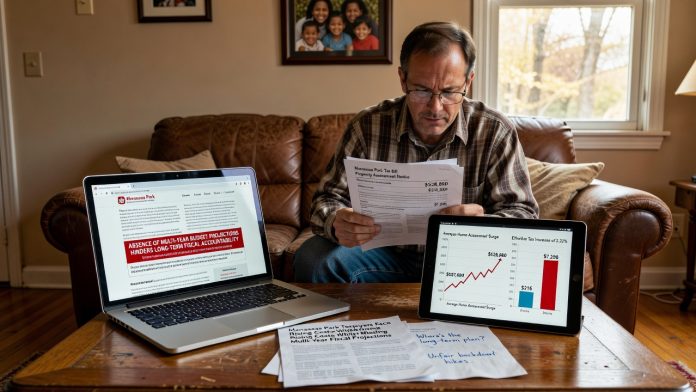
Fiscal accountability remains a cornerstone of conservative governance, requiring complete transparency regarding how taxpayer funds are collected and spent. In the independent city of Manassas Park, Virginia, residents are grappling with rising tax burdens and a troubling lack of accessible multi-year budget projections on the official municipal website. This absence of long-term forecasting significantly hinders the ability of hardworking taxpayers to hold their local government accountable for future financial commitments. Without a clear view of impending financial liabilities, residents are left highly vulnerable to unchecked municipal spending and continuous, incremental tax hikes.
Despite a nominal two-cent reduction in the property tax rate, local homeowners are facing a very real and painful increase in their overall financial burden this year. The average assessed value for a single-family home in the city recently surged from $507,689 last year to an astonishing $528,860 this year. Because of this substantial jump in property assessments, the average homeowner will see their annual tax bill increase by $216 to a total of $7,298. This dynamic represents an effective tax increase of 2.22 percent, demonstrating exactly how assessment spikes function as backdoor tax hikes on responsible property owners.
City Manager Carl Cole attempted to justify the financial impact on residents during recent public budget discussions regarding the municipal tax rate. Defending the increases, Cole stated that because assessed values went up and homes are worth more, the net result on the average home is an unavoidable annual tax increase of $216. While property values may look impressive on paper, residents are forced to pay these higher tax bills with actual dollars drained from their household budgets. At the same time, city officials approved a three percent cost-of-living adjustment for city staff, alongside an ongoing classification and compensation study that will likely drive municipal spending even higher in the coming years.
Educational Spending and Falling Enrollment
The Manassas Park City Schools system presents another major area where long-term fiscal transparency is desperately needed by the local community. The school division is operating with a massive projected fiscal year 2027 budget of $63 million, a staggering figure for a relatively small independent city. Compounding this immense financial pressure, Superintendent Saunders and other school officials have publicly acknowledged that the division is facing a severe multi-year challenge due to rapidly falling student enrollment. As fewer students actually attend the district, maintaining such elevated budget levels demands serious scrutiny from conservative watchdogs and concerned parents alike.
The current Manassas Park City School Board includes members Carlos Vargas, Paul Alexander, Rachel Kirkland, Dana Brown, and Lorrie Carey. These elected officials must navigate the incredibly difficult task of balancing high levels of educational services with the undeniable reality of declining revenue and shrinking classrooms. Superintendent Saunders has rightfully highlighted the absolute necessity for robust multi-year planning to properly address these structural deficits before they overwhelm the city. However, the distinct lack of easily accessible, comprehensive multi-year budget projections on the official city website makes it nearly impossible for the public to monitor these long-term strategies.
The Ultimate Need for Fiscal Transparency
Conservative principles dictate that a local government should never ask for more revenue without providing a clear, long-term roadmap detailing exactly how those funds will be utilized. When municipal websites fail to publish accessible multi-year financial projections, taxpayers are actively denied the basic analytical tools required to evaluate the fiscal health of their own community. This informational deficit allows structural spending increases, like staff compensation hikes and inflated school budgets, to become permanently embedded in the baseline without adequate public debate. Hardworking families who must diligently balance their own long-term household budgets deserve the exact same level of foresight and respect from their elected officials.
True fiscal accountability requires looking far beyond the current budget cycle to fully understand the future trajectory of municipal taxation and spending. As rising property assessments continue to drive up the fundamental cost of living in Manassas Park, residents need ironclad assurances that their tax dollars are being managed with strict conservative prudence. Implementing mandatory, publicly accessible multi-year budget projections would serve as a vital first step toward restoring public trust and reining in unchecked municipal growth. Until such common-sense transparency measures are fully adopted, taxpayers will continue to bear the heavy financial burden of a government that spends today without adequately planning for tomorrow.
Email the Manassas Park City Council at:
Alanna Mensing (Mayor): a.mensing@manassasparkva.gov,
Darryl Moore (Vice Mayor): d.moore@manassasparkva.gov,
Haseeb Javed: h.javed@manassasparkva.gov,
Yesy Amaya: y.amaya@manassasparkva.gov,
Michael Carrera: m.carrera@manassasparkva.gov,
Stacy Seiberling: s.seiberling@manassasparkva.gov,
Kevin Moreau: k.moreau@manassasparkva.gov,