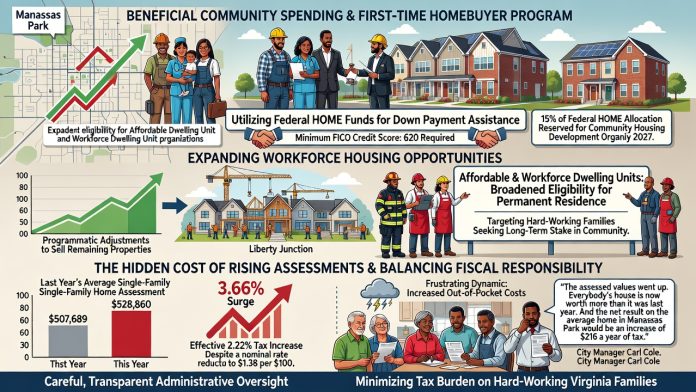
The independent City of Manassas Park is advancing its fiscal year 2027 budget with a strong emphasis on fostering homeownership and expanding access to affordable workforce housing. Local leaders are strategically utilizing federal HOME funds to administer a First-Time Homebuyer Program designed to help financially responsible families finally achieve the American Dream. However, these beneficial community spending initiatives arrive alongside rising property assessments that will ultimately increase the overall annual tax burden on existing residents. This complex dynamic highlights the ongoing challenge of balancing valuable community investments with the fundamental conservative priority of protecting taxpayers from creeping financial liabilities.
The First-Time Homebuyer Program provides crucial down payment and closing cost assistance to aspiring homeowners who have demonstrated consistent financial prudence. To ensure that taxpayer dollars are utilized responsibly and effectively, the program strictly mandates a minimum FICO credit score of 620 for all prospective applicants. This important requirement aligns perfectly with conservative economic principles by ensuring that participants have a proven track record of managing their personal finances before receiving public assistance. Administered through a cooperative agreement with the Prince William County Office of Housing and Community Development, the program securely reserves at least fifteen percent of its federal HOME allocation for designated Community Housing Development Organizations.
EXPANDING WORKFORCE HOUSING OPPORTUNITIES
In addition to providing targeted down payment assistance, Manassas Park is actively updating its broader affordable housing program to expand eligibility for working-class families seeking permanent residence. These programmatic adjustments are specifically intended to help sell remaining properties and properly prepare for the arrival of approximately ten new homes at the Liberty Junction development in early 2027. The comprehensive initiative targets both the Affordable Dwelling Unit and Workforce Dwelling Unit programs, ensuring that essential community workers can actually afford to live in the city they serve. By responsibly broadening these eligibility parameters, local officials hope to stimulate the local real estate market while providing hard-working families with a tangible, long-term stake in their community.
THE HIDDEN COST OF RISING ASSESSMENTS
While expanding homeownership opportunities remains a highly commendable goal for municipal leaders, existing property owners are simultaneously facing increased financial pressures due to rapidly rising residential assessments. For the fiscal year 2027 budget cycle, the Manassas Park real estate tax rate was technically reduced to $1.38 per $100 of assessed property value. Despite this nominal rate reduction championed by local officials, locally assessed residential property values experienced a massive 3.66 percent surge over the course of the past year. Consequently, this frustrating dynamic results in an effective 2.22 percent tax increase for the community, meaning families will still pay significantly more out of pocket despite the lower official tax rate.
The average assessed value for a standard single-family home in the city has climbed significantly, rising from $507,689 last year to a staggering $528,860 this year. City Manager Carl Cole openly addressed this harsh financial reality during a recent budget meeting, noting the direct and unavoidable impact on local household budgets. “The assessed values went up,” Cole explained to the community regarding the fiscal year 2027 budget. “Everybody’s house is now worth more than it was last year.” He concluded by noting, “And the net result on the average home in Manassas Park would be an increase of $216 a year of tax.”
BALANCING GROWTH WITH FISCAL RESPONSIBILITY
Promoting homeownership through structured, accountable programs is widely recognized as a positive step toward building a stable, deeply invested citizenry that cares about the future of the municipality. When families actually own their homes rather than rent, they are statistically more likely to participate in civic life, maintain their properties, and contribute to a safe, thriving neighborhood environment. However, conservative advocates rightfully argue that local governments must remain incredibly vigilant about the hidden tax hikes that occur when property assessments outpace superficial rate reductions. True fiscal responsibility dictates that community investments in workforce housing must never come at the tragic expense of pricing current residents out of their long-held family homes.
As Manassas Park steadily moves forward with its fiscal year 2027 economic agenda, the ultimate success of these housing initiatives will depend heavily on careful, transparent administrative oversight. The highly anticipated upcoming Liberty Junction project will undoubtedly serve as a critical test of the newly expanded Affordable Dwelling Unit and Workforce Dwelling Unit programs. Local citizens and taxpayer watchdogs will be watching closely to ensure that the First-Time Homebuyer Program consistently enforces its strict credit requirements to protect vital taxpayer investments. Ultimately, local leaders must constantly strive to foster new community growth while faithfully honoring their fundamental conservative duty to minimize the overall tax burden on hard-working Virginia families.
Email the Manassas Park City Council at:
Alanna Mensing (Mayor): a.mensing@manassasparkva.gov,
Darryl Moore (Vice Mayor): d.moore@manassasparkva.gov,
Haseeb Javed: h.javed@manassasparkva.gov,
Yesy Amaya: y.amaya@manassasparkva.gov,
Michael Carrera: m.carrera@manassasparkva.gov,
Stacy Seiberling: s.seiberling@manassasparkva.gov,
Kevin Moreau: k.moreau@manassasparkva.gov,