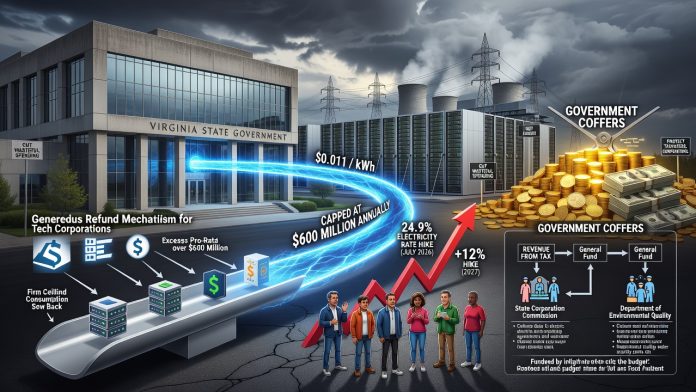
Virginia lawmakers have officially adopted a first-of-its-kind statewide energy consumption tax on data centers, sparking concerns among fiscal conservatives about government overreach and unchecked spending. The new levy imposes a $0.011 per kilowatt-hour charge on all electricity consumed by these facilities, which is projected to generate up to $600 million annually for state coffers. While proponents argue this ensures the industry pays its fair share, fiscal watchdogs warn that creating massive new revenue streams rarely leads to taxpayer relief and often fuels further government expansion.
Over the upcoming two-year budget cycle, this unprecedented tax is expected to siphon $1.2 billion from the private sector to fund state government operations. Governor Abigail Spanberger championed the initiative, stating that Virginia is the first state in America to institute such a tax to prevent the industry from driving up costs for local families. However, critics point out that injecting an additional billion dollars into the state budget does nothing to reduce overall government waste or lower the tax burden on hardworking citizens. Instead of cutting excessive state spending, lawmakers have chosen to invent entirely new ways to extract wealth from businesses operating within the Commonwealth.
Bureaucratic Churn and Contradictory Tax Policies
The sheer hypocrisy of the state budget becomes glaringly apparent when examining the broader tax treatment of these technology hubs. Even as the government imposes this new $600 million annual energy tax, the budget preserves an existing retail sales and use tax exemption for data centers that is estimated to cost the state between $1.6 billion and $1.9 billion annually. This exemption, originally adopted when it cost a mere $1.4 million in forgone revenue, has ballooned into a massive corporate carve-out scheduled to last through at least 2035. Fiscal conservatives argue that running a convoluted system of massive tax breaks simultaneously coupled with aggressive new energy taxes creates unnecessary bureaucratic churn and masks the true cost of government.
To further complicate the administration of this new energy tax, lawmakers have implemented a convoluted revenue cap mechanism. State officials have capped the annual tax collection from this specific levy at $600 million, meaning any excess funds collected must be refunded to data center operators on a pro rata basis. Managing these collections and subsequent refunds will require additional state resources, effectively wasting taxpayer dollars on administrative overhead rather than streamlining the tax code. A simpler, more conservative approach would involve reducing the overall state budget and eliminating the need for such complex, targeted taxation schemes in the first place.
Expanding State Agencies and Regulatory Burdens
Beyond the direct financial extraction, this new budget directive dramatically expands the regulatory authority and workload of multiple state agencies. The State Corporation Commission is now tasked with collecting granular data on data centers regarding their electric service agreements, water usage, and generator permitting. Simultaneously, the Department of Environmental Quality has been directed to develop stringent new noise regulations and map areas at risk of cooling-water scarcity. Expanding the purview of these departments inevitably requires more funding and staff, demonstrating how new taxes directly subsidize the unchecked growth of the administrative state at the expense of fiscal restraint.
The bureaucratic expansion does not stop with environmental and utility regulators, as lawmakers have also mandated new oversight committees and reporting requirements. The Joint Subcommittee on Tax Policy has been tasked with reviewing the ongoing impacts of the data center sales and use tax exemption on overall state revenue. Furthermore, the Virginia Economic Development Partnership Authority is now required to collaborate on extensive biennial reports detailing the costs and benefits of these specific tax exemptions. These endless studies and committee reviews consume valuable state resources and taxpayer money, often without ever producing actionable reductions in government spending.
The Conservative Call for Fiscal Responsibility
State leaders continue to defend this aggressive taxation strategy as a necessary compromise for funding the government. Governor Spanberger recently stated that her administration helped craft this proposal to build a strong foundation for future discussions regarding the environmental and community impacts of the industry. Echoing this sentiment, the Senate Majority Leader remarked that they went through a lot to get here, celebrating the fact that data centers will contribute over a billion dollars to help fund the government. For fiscal conservatives, however, the celebration of a billion-dollar tax hike is a stark reminder that Richmond politicians are more interested in expanding their budgets than finding ways to save taxpayer money.
Ultimately, true fiscal responsibility requires a commitment to reducing the size and scope of government rather than finding innovative ways to fund its expansion. If the Commonwealth of Virginia wants to protect its citizens from rising costs, lawmakers must focus on eliminating wasteful spending and balancing the budget without relying on first-of-its-kind taxes. Piling new regulatory burdens and energy taxes onto businesses will eventually trickle down to consumers, making the state less economically competitive in the long run. Taxpayers deserve a government that respects their hard-earned money by making tough financial cuts, rather than endlessly expanding state revenue streams to feed a bloated bureaucracy.