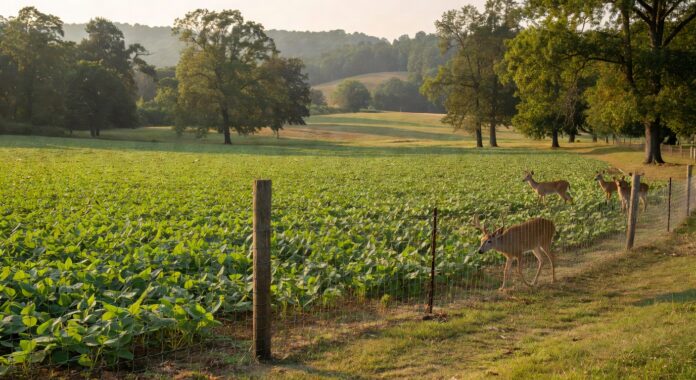
RICHMOND — In a decisive move to safeguard Virginia’s homeowners and farmers, the General Assembly has passed House Bill 129, authorizing the Department of Wildlife Resources to issue permits for the targeted killing of deer causing damage to residential plants and commercial agricultural lands. Sponsored by Delegate Mitchell Cornett of District 46, the legislation amends Section 29.1-529 of the Code of Virginia, providing clear mechanisms for property protection amid rising deer-related issues.
HB129 empowers the Director of the Department of Wildlife Resources or a designee to grant permits for a limited number of antlered deer when they damage residential plants, but only after an inspection confirms clear and convincing evidence of antlered deer responsibility. For commercial agricultural production lands, the bill mandates permits for antlerless deer damaging fruit trees, Christmas trees, crops, plants, or personal property used in such operations. Similarly, permits for antlered deer are required upon evidence of their involvement in such damage.
Introduced by Cornett on January 14, 2026, after being prefiled on January 2, the bill quickly gained traction in the House. Referred to the House Agriculture, Chesapeake and Natural Resources Committee, it was assigned to the Agriculture Subcommittee on January 19. On January 28, the subcommittee offered a substitute and recommended reporting it unanimously, 10-0. The full committee followed suit on February 4, reporting the substitute 21-1, with the printed substitute numbered 26106494D-H1.
The House acted swiftly: first reading on February 6, second reading and committee substitute agreement on February 9, engrossment that day, and third reading passage on February 10 by a strong 88-9 vote. Fiscal impact statements from the Department of Planning and Budget were issued on February 11 and later on March 6, underscoring the bill’s practicality.
Sent to the Senate on February 11, with constitutional reading dispensed, it landed in the Senate Agriculture, Conservation and Natural Resources Committee. Assigned to the Rural Affairs Subcommittee on February 25, a subcommittee substitute was offered on February 24. The full committee reported it with substitute on March 3, 13-2, printing the Senate substitute 26108431D-S1 on March 4.
Senate progress accelerated: rules suspended on March 5, constitutional reading dispensed on second reading 39-0, passed by for the day twice via block vote, third reading on March 9, committee substitute agreed to, engrossed, and passed 33-7 that day. The House concurred with the Senate substitute on March 10, 91-8, sealing its passage.
This comprehensive journey reflects the bill’s broad appeal in addressing real-world challenges faced by Virginians. In rural areas like District 46 in southwest Virginia, where agriculture sustains communities, deer damage to crops and property threatens livelihoods and safety. HB129 streamlines the process, requiring evidence-based decisions while mandating action for commercial lands, balancing wildlife management with property rights.
The legislation’s substitutes refined its provisions, ensuring precision in permit issuance for both residential and commercial contexts. House and Senate versions, available as 26106494D-H1 and 26108431D-S1, incorporated committee expertise to target antlered and antlerless deer appropriately.
With overwhelming bipartisan support across committees and chambers— from 21-1 in House committee to 13-2 in Senate—HB129 stands as a testament to effective governance focused on practical solutions. Farmers can now more readily protect fruit trees, Christmas tree operations, and other vital agricultural assets, while homeowners defend their landscaping from destructive deer.
Fiscal analyses confirm the bill imposes no significant burden, aligning with responsible stewardship. As the session concludes, HB129 heads to the Governor for final action, poised to deliver relief to landowners statewide. Delegate Cornett’s initiative underscores the importance of legislation tailored to Virginia’s diverse landscapes, particularly bolstering the agricultural backbone in rural districts.