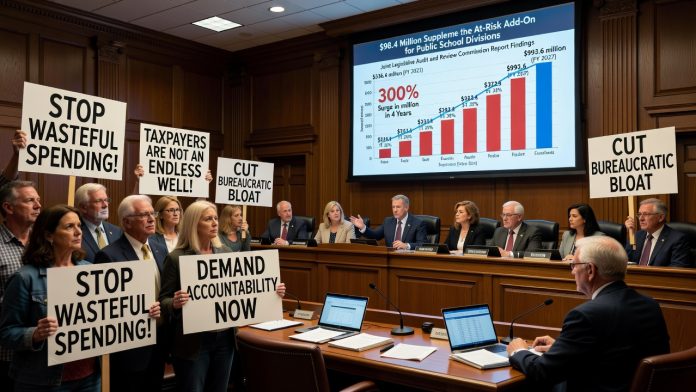
Loudoun County taxpayers are facing yet another massive expansion of government spending as the proposed FY2027 budget allocates a staggering $28.5 million exclusively for employee pay raises. This exorbitant compensation package represents a significant driver of the overall 4.2 percent increase in the county budget compared to the previous fiscal year. Fiscal conservatives are raising alarms over this continuous upward trajectory in public spending, which places an increasingly heavy burden on hardworking residents. As the cost of living continues to squeeze private citizens, local government officials appear determined to insulate public employees from these economic realities at the taxpayers’ expense.
The responsibility for approving or amending this bloated budget falls squarely on the Loudoun County Board of Supervisors, which currently includes Phyllis Randall, Koran Saines, Juli Briskman, Sylvia Glass, Michael Turner, Caleb Kershner, Matthew Letourneau, Kristen Umstattd, and Laura TeKrony. These elected officials must answer for a compensation funding strategy that has ballooned from $24.7 million in the FY2026 adopted budget to the newly proposed $28.5 million. This multi-million-dollar leap highlights a troubling trend of prioritizing government expansion over meaningful tax relief for the community. Residents are looking to this board to exercise genuine fiscal restraint rather than simply rubber-stamping another massive payout.
Breaking Down the Bureaucratic Windfall
A closer examination of the budget reveals highly generous terms for the general county workforce, represented by the SEIU Virginia 512 bargaining unit. These general government employees are slated to receive a 4.25 percent merit increase alongside a 2 percent salary scale adjustment. Notably, this merit increase is a direct bump from the 4 percent raise proposed just one year prior in the FY2026 budget. Such guaranteed, compounding increases are a rarity in the private sector, leaving many taxpayers to wonder why public servants are receiving financial guarantees that the average citizen cannot access.
Public safety departments are also receiving substantial financial boosts under the newly proposed county budget structure. Fire and Rescue personnel, organized under IAFF Local 3756, will receive a 2.5 percent salary scale adjustment and a step increase, resulting in a robust 5.5 percent average pay bump. While supporting first responders is a core conservative value, responsible governance requires ensuring that these ongoing financial commitments do not lead to long-term structural deficits. Taxpayers deserve complete transparency regarding how these generous compensation packages will be funded without continuously hiking property tax rates.
The Sheriff’s Office is slated for the largest proportional increase, with deputies receiving a 5.75 percent salary scale adjustment and a step increase that yields an impressive 8.75 percent average pay boost. This scale adjustment represents a significant jump from the 5 percent increase proposed in the previous fiscal cycle. Law enforcement remains a critical priority for a safe community, but massive year-over-year percentage increases require careful long-term financial planning. Without identifying corresponding cuts to administrative waste, these compounding public safety salaries will inevitably force future tax hikes.
Contradictions in Fiscal Management
During a budget presentation on February 11, 2026, County Administrator Tim Hemstreet offered a highly questionable justification for this aggressive spending strategy. He claimed that the proposed budget reflects his recommendations on ‘constraining budget growth’ in anticipation of a plateauing of revenues in the early 2030s. Fiscal conservatives immediately noted the glaring contradiction of claiming budget constraints while simultaneously pushing a 4.2 percent overall spending increase and adding millions to the payroll. If revenues are indeed projected to stagnate in the coming years, rapidly inflating the permanent baseline costs of government salaries is an incredibly reckless financial maneuver.
The official narrative suggests that these compensation increases are absolutely necessary to ‘keep Loudoun competitive in the market’ as an employer. However, this standard bureaucratic defense ignores the fundamental necessity of operating within the realistic financial means of the tax base. True fiscal constraint involves freezing unnecessary hiring, consolidating departments, and eliminating wasteful programs to fund essential services. Instead of finding these critical efficiencies, the current budgetary approach simply extracts more wealth from local families to feed an ever-growing administrative state.
Protecting the Taxpayer Wallet
Loudoun County residents are already dealing with the brutal realities of inflation, making it entirely inappropriate for local government to demand even more of their hard-earned money. Funding a $28.5 million compensation package requires a massive transfer of wealth from private citizens to public sector employees. Conservative governance dictates that any necessary pay increases for essential workers must be funded by trimming the fat elsewhere in the budget. Passing the buck to the taxpayer without conducting a rigorous audit of current spending is a fundamental failure of local leadership.
The Board of Supervisors must take a red pen to this FY2027 budget before any final approvals are granted. Eliminating administrative bloat and curbing non-essential county programs could easily offset the costs of retaining quality public servants. Fiscal responsibility must be the absolute primary objective to secure the long-term economic stability of the entire county. Ultimately, protecting the taxpayer’s wallet is the only proven way to foster a truly prosperous and sustainable community for everyone.