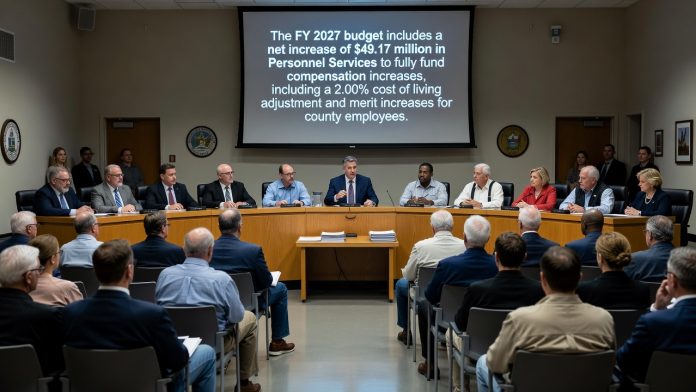
Fairfax County taxpayers are once again footing the bill for a rapidly expanding local government budget that prioritizes bureaucratic growth over fiscal restraint. The proposed Fiscal Year 2027 budget includes a staggering net increase of $49.17 million strictly for Personnel Services, pushing the total funding for this specific category to nearly $1.19 billion. At a time when everyday families are tightening their belts to cope with national economic pressures, local leaders are funneling massive sums into public sector compensation packages. This aggressive spending strategy raises serious concerns among fiscal conservatives about the long-term sustainability of the county’s financial trajectory.
The driving force behind this massive budget expansion is a guaranteed 2.00 percent cost of living adjustment, coupled with additional merit increases for county employees. When factoring in both pay and benefits, total employee compensation adjustments will siphon an astonishing $102.55 million from the wallets of hardworking taxpayers. Regular salaries alone will consume over $1.04 billion of the budget, representing an $11.16 million increase just in baseline payroll costs. Conservative advocates argue that automatically inflating government salaries without demanding corresponding increases in efficiency or service delivery is a classic example of municipal overspending.
Board Accountability and Bureaucratic Growth
The responsibility for this massive financial commitment lies squarely with the Fairfax County Board of Supervisors, who oversee the distribution of these taxpayer funds. The current board consists of Chairman Jeffrey McKay, James Walkinshaw, Jimmy Bierman, Walter Alcorn, Rodney Lusk, Andres Jimenez, Daniel Storck, Dalia Palchik, Pat Herrity, and Kathy Smith. These elected officials are tasked with safeguarding public resources, yet the current budget proposal signals a clear preference for appeasing public sector unions over protecting the taxpayer. Fiscal watchdogs are urging these supervisors to reconsider this path and prioritize essential tax relief instead of expanding the administrative state.
County Executive Bryan Hill defended the spending by claiming the budget reflects a full recognition of fiscal challenges while continuing to invest heavily in the local workforce. Meanwhile, Chairman Jeffrey McKay justified the 2.00 percent cost of living adjustment by noting it aligns with all three of the county’s current collective bargaining agreements. However, these collective bargaining agreements are exactly what conservative critics point to as the root cause of runaway municipal spending and unavoidable tax burdens. Binding taxpayers to union-negotiated wage hikes severely limits the county’s ability to adjust spending during economic downturns, effectively guaranteeing future budget deficits.
Departmental Impact and Hidden Costs
This sweeping $49.17 million personnel increase will impact virtually every corner of the Fairfax County government, further entrenching high costs across multiple administrative agencies. Departments slated to receive this inflated funding include the Board of Supervisors, the Department of Human Resources, the Civil Service Commission, and the Department of Management and Budget. Even the Fairfax County Park Authority is entangled in these financial shifts, though some costs are partially offset by transferring regular salary activities to other operational funds. Spreading these mandated wage hikes across so many departments makes it incredibly difficult to track waste and identify areas where bureaucratic bloat could be trimmed.
A closer look at the data reveals that this $49.17 million surge represents a 4.32 percent increase over the revised funding levels from the previous fiscal year. While the county boasts about a net decrease of 49 merit positions, this minor staff reduction does absolutely nothing to offset the massive $102.55 million total compensation package. Shrinking the workforce slightly while simultaneously exploding the overall payroll budget is a deceptive accounting maneuver that fails to generate any real savings for the community. True fiscal conservatism demands that any reduction in government headcount should directly translate into lower taxes and reduced overall spending.
The Urgent Need for Fiscal Responsibility
The primary duty of local government should be to provide essential services efficiently, not to serve as a lucrative employment agency funded by mandatory tax collections. When the budget for personnel services approaches $1.19 billion, it is evident that the balance of power has shifted away from the citizens and toward the government bureaucracy. Every dollar spent on automatic salary increases and union-mandated benefits is a dollar taken from local families who are already struggling with inflation and high property taxes. Conservatives maintain that true compassion is found in allowing citizens to keep more of their hard-earned money, rather than redistributing it to county employees.
As the Fiscal Year 2027 budget moves toward final approval, Fairfax County residents must demand greater transparency and fiscal restraint from their elected supervisors. Trimming the bloated $1.19 billion personnel budget would send a strong message that the county is finally serious about eliminating waste and respecting the taxpayer. Without a fundamental shift in spending priorities, the local government will continue to expand at an unsustainable rate, inevitably leading to higher taxes and economic stagnation. It is time for local leadership to reject the culture of endless spending and embrace conservative financial principles that prioritize long-term stability over bureaucratic expansion.
Email At:
Jeff McKay → chairman@fairfaxcounty.gov,
Kathy Smith (Sully District) sully@fairfaxcounty.gov,
Rachna Heizer (Braddock District) braddock@fairfaxcounty.gov,
James Bierman (Dranesville District) dranesville@fairfaxcounty.gov,
Rodney Lusk (Franconia District) franconia@fairfaxcounty.gov,
Walter Alcorn (Hunter Mill District) huntermill@fairfaxcounty.gov,
Andres Jimenez (Mason District) mason@fairfaxcounty.gov,
Daniel Storck (Mount Vernon District) mtvernon@fairfaxcounty.gov,
Dalia Palchik (Providence District) providence@fairfaxcounty.gov,
Pat Herrity (Springfield District) springfield@fairfaxcounty.gov,