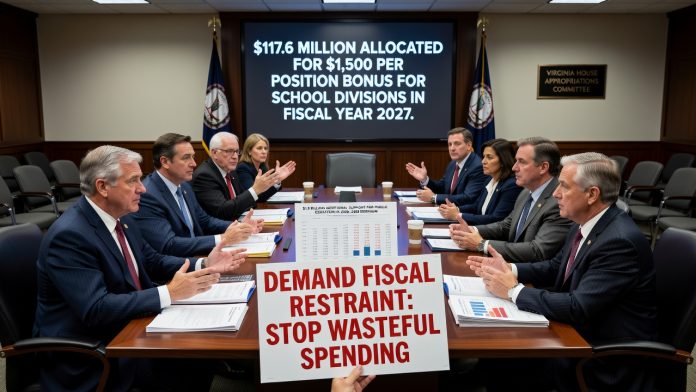
The Virginia state budget continues to expand at a rapid pace, placing an ever-growing financial burden on hardworking taxpayers across the commonwealth. Lawmakers have recently allocated a staggering $117.6 million to cover the state’s share of a $1,500 per position bonus for school divisions to deploy in fiscal year 2027. This massive expenditure comes on top of already historic levels of funding for public education, prompting fiscal conservatives to question the sustainability of such aggressive spending. As the cost of living continues to rise, many citizens are demanding greater fiscal restraint and accountability from their elected officials in Richmond.
Beyond the substantial bonus allocation, the budget also includes an astonishing $560.3 million to fund the state’s share of three percent raises for the education workforce in each fiscal year. The Virginia House Appropriations Committee summary stated that this move honors the value of the education workforce, aligning with proposals originally pushed by the Senate. However, allocating well over half a billion dollars for annual raises raises significant concerns about long-term budget bloat and the potential for future tax hikes. Fiscal watchdogs argue that continuously inflating baseline budgets without demanding measurable improvements in educational outcomes is a disservice to the taxpayers footing the bill.
UNCHECKED SPENDING GROWTH
The upcoming 2026-2028 biennium budget provides a total of $1.8 billion in additional state support for public education, further swelling an already massive state bureaucracy. This new round of spending builds directly upon a historic $2.6 billion increase in public education funding that was provided during the previous 2024-2026 biennium. When combining these figures, taxpayers are being asked to fund multi-billion dollar increases in a remarkably short period, leading to valid questions regarding systemic overspending. Conservatives maintain that throwing endless streams of money at the public school system does not inherently guarantee better academic results for Virginia students.
ADDRESSING WASTE AND INEFFICIENCY
With such vast sums of money flowing into local school divisions, the risk of waste, fraud, and financial mismanagement grows exponentially. Bureaucratic inefficiencies often consume these massive cash injections long before the funds ever reach the actual classrooms or directly benefit the students. Lawmakers must implement strict oversight mechanisms to ensure that the $117.6 million bonus allocation and the $560.3 million for raises are not squandered on administrative bloat. Protecting the taxpayer means demanding that every single dollar is accounted for and serves a truly essential purpose within the educational framework.
THE BURDEN ON HARDWORKING TAXPAYERS
Every million dollars added to the state budget represents money taken directly out of the pockets of Virginia families and local businesses. The decision to authorize a $1,500 per position bonus using a caboose bill mechanism demonstrates a troubling willingness to authorize secondary spending measures outside the primary budget constraints. School divisions are given the option to deploy these bonuses in fiscal year 2027, creating a decentralized spending environment that makes statewide financial tracking incredibly difficult. Taxpayers deserve a government that prioritizes budget reductions and tax relief rather than continuously finding new avenues for public sector enrichment.
RETURNING TO CONSERVATIVE PRINCIPLES
A core tenet of conservative governance is the belief that a smaller, more efficient government is ultimately better for the economic health of the state. By constantly approving massive spending packages like the $1.8 billion education increase, the state legislature is moving further away from the principles of fiscal responsibility. True economic prosperity in Virginia will only be achieved when lawmakers commit to aggressively trimming the budget and returning surplus funds to the citizens. Until elected officials start treating taxpayer money with the utmost respect, the state will continue to suffer under the weight of excessive government spending.
DEMANDING ACCOUNTABILITY AND REFORM
Moving forward, Virginia residents must hold their legislative representatives accountable for these continuous, multi-million dollar appropriations. The approval of $117.6 million for targeted bonuses and $560.3 million for baseline raises should trigger comprehensive audits of local school division budgets to identify areas of existing waste. If public schools require additional funds to reward staff, those funds should be found by cutting unnecessary administrative programs rather than demanding more state revenue. Ultimately, safeguarding the financial future of Virginia requires a steadfast commitment to reducing the overall budget and protecting the hard-earned money of every taxpayer.