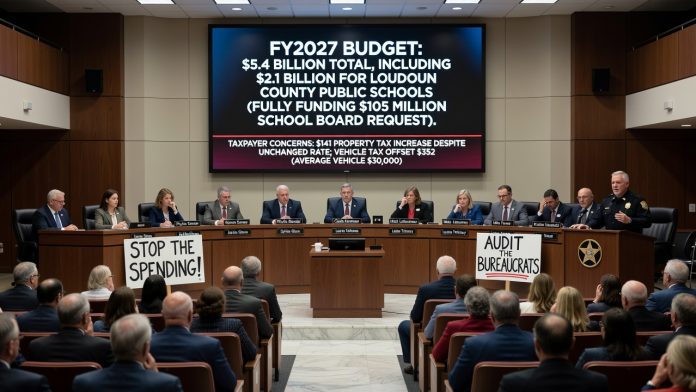
The Loudoun County Board of Supervisors recently advanced a massive $5.4 billion budget for fiscal year 2027, raising serious concerns among taxpayers about unchecked government spending. At the center of this financial blueprint is a staggering $2.1 billion operating budget for Loudoun County Public Schools, which includes a fully funded $105 million increase requested by the school board. Conservative advocates are questioning the necessity of such exorbitant education spending when families are already grappling with rising costs of living. This massive allocation highlights a growing trend of bureaucratic expansion that places a heavier burden on hardworking local residents.
The current Loudoun County Board of Supervisors, which includes Phyllis Randall, Koran Saines, Juli Briskman, Sylvia Glass, Caleb Kershner, Matt Letourneau, Laura TeKrony, Mike Turner, and Kristen Umstattd, holds the ultimate authority over these taxing and spending decisions. Furthermore, the Loudoun County School Board, consisting of Melinda Mansfield, Arben Istrefi, Anne Donohue, April Chandler, Deana Griffiths, Kari LaBell, and Sumera Rashid, originally requested this massive nine-figure funding increase. Taxpayers are increasingly frustrated that these elected officials continue to rubber-stamp exorbitant budget requests rather than demanding strict fiscal restraint. Ensuring accountability from these board members is essential for voters who want to protect their wallets from continuous government overreach.
Taxpayer Burden and Property Values
Despite claims of fiscal responsibility, the average homeowner in Loudoun County will face a $141 tax increase due to rising property assessments. The real property tax rate remains unchanged at $0.805 per $100 of assessed value, which allows the county to collect more revenue without officially raising the rate. To offset this growing burden, officials lowered the vehicle personal property tax rate to $3.09 per $100, providing an average reduction of $352 for a vehicle assessed at $30,000. However, conservative critics argue that these minor offsets do not excuse the broader trend of overspending and the continuous expansion of the county government.
County Administrator Tim Hemstreet presented the proposed budget, claiming it meets board guidance and reflects recommendations on constraining budget growth. However, the addition of 188 new government positions and $30 million in base budget adjustments severely undermines any narrative of true fiscal restraint. Furthermore, the budget includes a massive $29 million allocation for an affordable housing fund, a move many fiscal conservatives view as an inappropriate use of taxpayer dollars. True budget constraint would involve auditing existing programs for waste and fraud rather than expanding the bureaucratic footprint year after year.
Prioritizing School Safety Over Bureaucracy
While billions are funneled into the school system’s general operating fund, law enforcement officials are fighting to secure necessary funding for elementary School Resource Officers. Sheriff Mike Chapman bluntly addressed the board regarding the urgent need to prioritize child safety over administrative bloat. Chapman stated that leaders either support an extra layer of safety or they do not, emphasizing that the issue is strictly about protecting children. Fiscal conservatives strongly support funding frontline law enforcement and safety measures, arguing that the $105 million education increase should have been heavily scrutinized to ensure safety was the absolute first priority.
The statistics surrounding elementary school safety in Loudoun County reveal a deeply troubling trend that requires immediate law enforcement intervention. Supervisor Kristen Umstattd noted that in the last year alone, there were 1,649 instances where an elementary school had to request a deputy to handle a situation. This represents a drastic escalation, as calls for service at elementary schools have tripled from roughly 500 to over 1,500 per year. Furthermore, attacks in elementary schools have increased by over 1,000 percent in the last seven years, validating the conservative push to redirect wasteful administrative spending toward placing sworn deputies in every school.
Compensation and Government Expansion
The fiscal year 2027 budget also funnels tens of millions of dollars into increased compensation for county employees. The plan includes $28.5 million in employee compensation funding, featuring a 4.25 percent merit raise and a 2 percent salary adjustment for general employees. While conservatives traditionally support the targeted 5.5 percent average pay increase for Fire and Rescue personnel and the 8.75 percent average increase for Sheriff deputies, the sweeping raises for general bureaucrats remain a point of contention. Taxpayers are essentially being forced to fund a continually expanding government workforce at a time when private sector workers are tightening their own belts.
Eliminating waste and fraud within this enormous $2.1 billion education budget must become a top priority for local watchdogs and concerned citizens. When a school district receives a massive $105 million budget increase in a single year, the risk of financial mismanagement grows exponentially. Bureaucratic inefficiencies often hide within these massive funding allocations, diverting valuable resources away from actual classroom instruction and student success. By implementing strict auditing practices and demanding line-item justifications, taxpayers can force the county to trim the fat and significantly reduce the overall financial burden.
As the $5.4 billion budget moves forward, the residents of Loudoun County must demand greater transparency and a steadfast commitment to conservative financial principles. The staggering funds allocated to the school system and the addition of 188 new government positions represent a clear departure from the concept of limited government. True conservative governance requires making difficult financial decisions to protect the taxpayer, rather than continuously expanding the size and scope of local bureaucracies. Until elected officials prioritize strict fiscal discipline and significant budget reductions, the financial strain on Loudoun County families will only continue to escalate.
Email the Board of Supervisors at:
Phyllis J. Randall (Chair, At-Large) – Phyllis.Randall@loudoun.gov,
Michael R. Turner (Vice Chair, Ashburn District) – Mike.Turner@loudoun.gov,
Juli E. Briskman (Algonkian District) – Juli.Briskman@loudoun.gov,
Sylvia R. Glass (Broad Run District) – Sylvia.Glass@loudoun.gov,
Caleb Kershner (Catoctin District) – caleb.kershner@loudoun.gov,
Matthew F. Letourneau (Dulles District) – Matt.Letourneau@loudoun.gov,
Kristen C. Umstattd (Leesburg District) – Kristen.Umstattd@loudoun.gov,
Laura A. TeKrony (Little River District) – Laura.TeKrony@loudoun.gov,
Koran Saines (Sterling District) – Koran.Saines@loudoun.gov