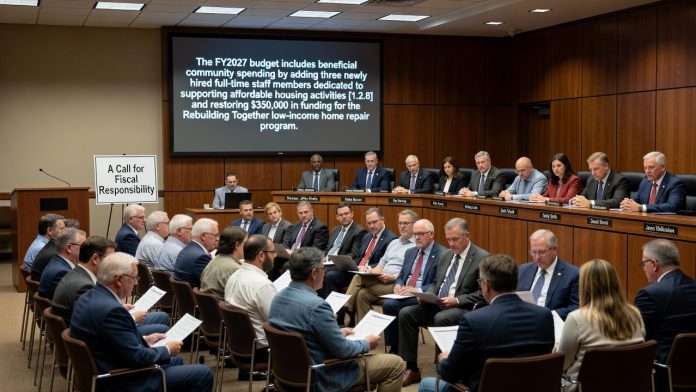
Fairfax County residents are bracing for higher tax bills in the upcoming FY2027 budget as local officials continue to prioritize bureaucratic expansion over meaningful fiscal restraint. The recently proposed budget includes a significant influx of spending for affordable housing initiatives, raising immediate concerns among fiscal conservatives about government overreach and the unfair burden placed on local taxpayers. While property owners face rising living costs and inflation, the county is intentionally increasing its affordable housing budget by millions of dollars and expanding its administrative workforce. This continued pattern of increased government spending highlights a growing disconnect between county leadership and the everyday financial realities of hardworking taxpayers who simply want to keep more of their own money.
The current Fairfax County Board of Supervisors consists of Chairman Jeffrey McKay, Walter Alcorn, Jimmy Bierman, Pat Herrity, Andres Jimenez, Rodney Lusk, Dalia Palchik, Kathy Smith, and Daniel Storck. Under their direction, the real estate tax rate was nominally reduced from a previous rate of $1.1225 to $1.12 per $100 of assessed property value. However, this quarter-cent decrease is largely a superficial political gesture, as rising property assessments mean the average homeowner will actually see a tax increase of approximately $337 to $356 this year. Critics argue that this deceptive maneuver allows politicians to publicly claim they are delivering tax relief while quietly extracting significantly more revenue from the pockets of local residents.
Expanding Bureaucracy and Administrative Costs
A prime example of this questionable spending is the addition of three newly hired, full-time staff members within the Department of Housing and Community Development. These permanent positions are dedicated exclusively to affordable housing activities and come with a hefty price tag of $366,733 in ongoing administrative costs. County officials attempt to justify this by claiming there is no net cost to the general fund because the expense is offset by internal charges to the Affordable Housing Development and Investment fund. Fiscal conservatives point out that regardless of which specific government bucket the money comes from, it ultimately represents a misuse of taxpayer resources that simply expands the size of local government.
In addition to expanding the county workforce, the FY2027 budget restores $350,000 in annual funding for a third-party organization known as Rebuilding Together. This private program, operated by the Arlington, Fairfax, and Falls Church chapter, provides home repairs, fall safety upgrades, and accessibility modifications to low-income households. During a recent public hearing, volunteer team leader Donald Booth directly asked supervisors to maintain or even increase this substantial financial allocation for the upcoming fiscal year. While home repair is certainly a noble charitable endeavor, relying on public tax dollars to fund private organizational projects raises serious questions about government overspending and proper fiscal boundaries. Taxpayers are essentially being forced to subsidize external community groups instead of being allowed to keep their own hard-earned money to maintain their own private properties.
Questionable Priorities and Soaring Budgets
These specific financial allocations are just a small fraction of a much broader and increasingly expensive affordable housing agenda championed by the current board. The baseline investment for affordable housing has surged by an additional $8.8 million over the previous year, bringing the total annual investment to a staggering $52.7 million. The Board of Supervisors has openly stated that affordable housing remains a core priority as they aggressively pursue an arbitrary goal of developing a minimum of 10,000 new affordable homes. Pumping tens of millions of public dollars into subsidized housing initiatives heavily distorts the free market and continuously demands higher tax revenues from existing residents to sustain the spending.
County Executive Bryan Hill recently stated in his budget message that the spending plan reflects a full recognition of the fiscal challenges the community currently faces. Furthermore, Supervisor Rodney Lusk publicly claimed during a board meeting that the budget provides for the safety, stability, and well-being of residents while somehow delivering tax relief. Such political rhetoric rings completely hollow for the average homeowner who is looking at a noticeably higher property tax bill and an ever-expanding local government apparatus. True fiscal responsibility would involve slashing these inflated departmental budgets, eliminating redundant bureaucratic positions, and delivering genuine, permanent tax cuts to the entire community.
A Call for Fiscal Responsibility
As the FY2027 budget moves forward, Fairfax County taxpayers must remain highly vigilant about exactly how their money is being allocated and spent by local elected officials. Funding new government administrative positions and funneling hundreds of thousands of dollars to external charities demonstrates a fundamental lack of respect for the burdened taxpayer. Local leaders should be prioritizing essential emergency services and core infrastructure rather than treating the county budget as a limitless funding source for progressive social initiatives. Until the board embraces strict fiscal conservatism and halts this unchecked spending, residents will continue to bear the heavy financial burden of a bloated and inefficient local government.
Jeffrey McKay (chairman@fairfaxcounty.gov),
Kathy Smith (sully@fairfaxcounty.gov),
Rachna Sizemore Heizer (braddock@fairfaxcounty.gov),
James Bierman (dranesville@fairfaxcounty.gov),
Rodney Lusk (franconia@fairfaxcounty.gov),
Walter Alcorn (huntermill@fairfaxcounty.gov),
Andres Jimenez (mason@fairfaxcounty.gov),
Daniel Storck (mtvernon@fairfaxcounty.gov),
Dalia Palchik (provdist@fairfaxcounty.gov),
Pat Herrity (springfield@fairfaxcounty.gov),