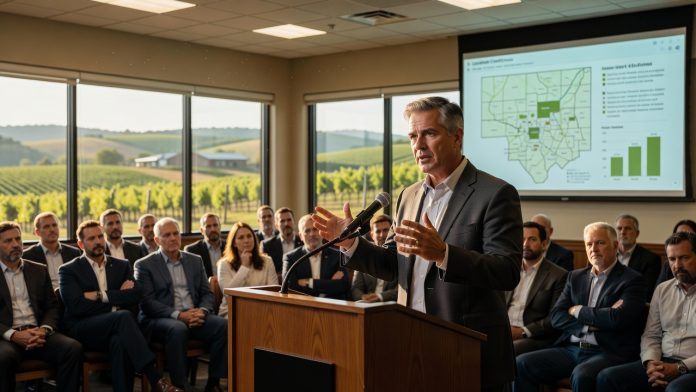
Concerns Over Government Overreach in Land Use
The discussion centered on how these regulations could force many established vineyards into non-conforming status without warning. Mike Turner pointed out that a vineyard previously operating legally might now fail the new requirements. This shift represents an unnecessary expansion of government control over private land that has supported families and local economies for years. Conservative principles emphasize protecting individual property rights from such abrupt regulatory burdens that ignore the realities of agricultural businesses.
Vineyards contribute significantly to Loudoun County’s rural character and tourism economy. The new standard risks labeling legitimate operations as violations simply because they do not meet an arbitrary 50 percent threshold. Mike Turner questioned whether owners should suddenly have to conform or face penalties. Such policies undermine the values of limited government and personal responsibility that conservatives hold dear in preserving working landscapes.
Impact on Local Families and Businesses
Many vineyard owners in Loudoun County operate on land passed down through generations. The zoning shift could disrupt these family enterprises by creating compliance issues overnight. Mike Turner highlighted the potential for properties to become non-conforming under the revised rules. This creates financial hardship and legal challenges for residents who have invested in sustainable agriculture.
Conservative viewpoints stress the importance of supporting small businesses rather than imposing rules that favor urban development over rural traditions. Vineyards provide jobs and attract visitors while maintaining open spaces. The proposed ordinances appear to prioritize bureaucratic standards over the practical needs of landowners who contribute to the community’s heritage.
Mike Turner urged property owners to check if their vineyards comply with the updated criteria. Failure to address these concerns could lead to widespread non-conformance affecting dozens of operations. The emphasis remains on safeguarding the rights of individuals against overzealous local regulations.
Broader Implications for Virginia Agriculture
These zoning changes reflect a pattern of increasing government intervention in land use decisions. Loudoun County Board of Supervisors members including Mike Turner along with others must consider the long-term effects on agricultural viability. Vineyards represent a key part of the local economy that deserves protection from rules that could drive them out of existence.
Conservatives advocate for policies that respect historical land uses and avoid penalizing productive enterprises. The 50 percent standard introduces ambiguity that could discourage investment in rural properties. Mike Turner’s comments underscore the need for balanced approaches that preserve both development options and established businesses.
Property owners are encouraged to review their compliance status promptly to avoid future complications. The focus stays on defending the freedoms that allow families to thrive in Loudoun County without undue interference.
Email at:
Phyllis J. Randall (Chair, At-Large) – Phyllis.Randall@loudoun.gov,
Michael R. Turner (Vice Chair, Ashburn District) – Mike.Turner@loudoun.gov,
Juli E. Briskman (Algonkian District) – Juli.Briskman@loudoun.gov,
Sylvia R. Glass (Broad Run District) – Sylvia.Glass@loudoun.gov,
Caleb Kershner (Catoctin District) – caleb.kershner@loudoun.gov,
Matthew F. Letourneau (Dulles District) – Matt.Letourneau@loudoun.gov,
Kristen C. Umstattd (Leesburg District) – Kristen.Umstattd@loudoun.gov,
Laura A. TeKrony (Little River District) – Laura.TeKrony@loudoun.gov,
Koran Saines (Sterling District) – Koran.Saines@loudoun.gov,