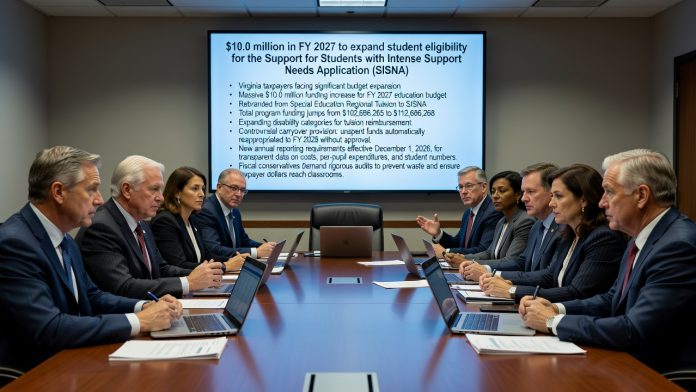
Virginia taxpayers are facing another significant budget expansion as state officials push forward a massive $10.0 million funding increase for the fiscal year 2027 education budget. The general fund appropriation specifically targets the newly rebranded Support for Students with Intense Support Needs Application, formerly known as the Special Education Regional Tuition program. This costly financial maneuver raises total program funding from an already massive $102,686,265 to an unprecedented $112,686,268 in a single legislative sweep. Fiscal conservatives are raising serious alarms about the continuous expansion of state bureaucracy and the heavy financial burden placed on hard-working taxpayers to fund these ballooning educational initiatives.
Expanding Eligibility and Bureaucratic Reach
The stated goal of this massive financial injection is to serve additional special education students within public school settings by significantly expanding the disability categories eligible for tuition reimbursement. Proponents within the Virginia Department of Education argue this policy shift will ultimately reduce the number of students referred to costly private day school programs funded by the Office of Children’s Services. However, expanding eligibility categories often leads to uncontrollable spending growth and opens the door wide for potential administrative waste across multiple local school districts. Taxpayers deserve strict accountability to ensure this $10.0 million actually reduces overall costs rather than simply funding a duplicate layer of bloated government services.
Rebranding to Obscure True Costs
Bureaucrats in Richmond recently changed the program’s official name from Special Education Regional Tuition to the Support for Students with Intense Support Needs Application. This type of strategic rebranding is a common tactic used by government agencies to market expanded budgets to the public while intentionally obscuring the true historical cost of the program. The department is now directed to consider students with complex behavioral needs who would otherwise be referred directly to expensive private day school placements. Expanding the definition of eligible disabilities creates a dangerous slippery slope that could easily lead to rampant overspending and further demands for taxpayer dollars in future legislative sessions.
The Carryover Loophole and Fiscal Irresponsibility
Perhaps the most concerning aspect of this funding amendment is the quiet inclusion of a controversial carryover provision for the newly allocated millions. The legislation explicitly dictates that the $10.0 million will not revert to the general fund at the end of the 2027 fiscal year, regardless of whether the funds are actually needed. Instead, any unspent taxpayer dollars will be automatically reappropriated for the 2028 fiscal year without requiring any additional legislative approval or public debate. This budgetary loophole circumvents traditional fiscal safeguards, essentially rewarding government agencies for over-budgeting and preventing surplus funds from being returned to the taxpayers or used to aggressively pay down state debt.
Demanding Transparency and Audits
To address obvious and growing concerns about systemic waste and fraud, the amendment establishes new annual reporting requirements that will officially take effect by December 1, 2026. The Virginia Department of Education must provide comparable and transparent data across the newly expanded public school program and the existing private day school placements. This mandatory report is supposed to detail the total costs, per-pupil expenditures, and the exact number of students served under both educational frameworks. While rigorous reporting is a basic necessity, conservative watchdogs correctly argue that data collection alone does not prevent government waste or guarantee that the promised taxpayer cost savings will ever materialize.
Balancing Compassion with Fiscal Restraint
Providing necessary support for vulnerable students is a recognized moral obligation, but it must always be balanced with strict fiscal responsibility and profound respect for the taxpayer. Throwing an additional $10.0 million at a public school system that already struggles with widespread administrative bloat does not automatically translate to better educational outcomes for children with complex behavioral needs. Government agencies have a long and troubling track record of expanding their budgets under the guise of compassion while consistently failing to deliver efficient, cost-effective services. Lawmakers must demand rigorous, independent audits of the Support for Students with Intense Support Needs Application to ensure every single taxpayer dollar is actually reaching the classroom instead of funding bureaucratic overhead.
Protecting the Virginia Taxpayer
The continuous upward trajectory of the state education budget represents a direct and immediate threat to the long-term financial stability of Virginia families. Increasing a single program’s budget to over $112 million demonstrates a troubling willingness to spend general fund reserves rather than finding necessary efficiencies within the existing bureaucratic framework. If the objective is truly to save taxpayer money by reducing private day school placements, the state must definitively prove those savings exist before permanently expanding public school funding categories. Fiscal conservatives will continue to heavily scrutinize these massive budget amendments to protect taxpayers from unchecked government spending, administrative fraud, and perpetual financial waste.