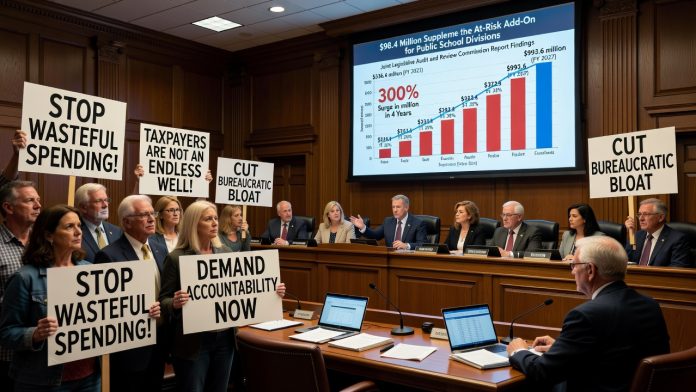
Virginia lawmakers are advancing a massive spending initiative that includes a $98.4 million one-time supplement to the At-Risk Add-On program for public school divisions. This latest financial maneuver is officially intended to address specific local operating or capital needs throughout the upcoming biennium. However, fiscal conservatives are raising severe alarms about the sheer volume of taxpayer dollars being funneled into a program that has seen explosive, unchecked growth. Taxpayers across the Commonwealth are left wondering if this staggering allocation is truly necessary or just another glaring example of wasteful government spending.
Explosive Growth in Education Spending
The financial trajectory of the At-Risk Add-On program highlights a broader trend of rapid, unsustainable budget expansion within Virginia public schools. In fiscal year 2023, the total taxpayer support for this specific program stood at an already substantial $336.4 million. Fast forward to the proposed fiscal year 2027 budget, and that figure has ballooned to an astonishing $993.6 million. This represents a nearly threefold increase in just four years, heavily driven by the findings of a recent Joint Legislative Audit and Review Commission report on K-12 funding.
Such a dramatic 300 percent surge in funding places an enormous burden on hardworking Virginia families who ultimately foot the bill for all state expenditures. While proponents argue the funds are necessary to support underserved students, the lack of stringent oversight over how these hundreds of millions are spent opens the door to potential fraud and inefficiency. Throwing exponentially more money at public education without demanding corresponding improvements in academic accountability is a deeply flawed strategy. Fiscal responsibility dictates that the state should focus on optimizing existing resources and cutting waste rather than constantly demanding more revenue from the taxpayer.
The Danger of One-Time Supplements
The newly proposed $98.4 million one-time supplement was introduced as a Senate priority to give school divisions immediate access to additional taxpayer capital. According to official budget documents, this support allows schools to access funds while the Joint Subcommittee on K-12 Funding evaluates ongoing financial needs. Unfortunately, temporary funding in government often sets a dangerous precedent, creating new baselines for future budget cycles that are rarely, if ever, reduced. Local school divisions are being given broad discretion to use these funds for vague local operating or capital needs, which historically leads to bloated administrative budgets rather than direct classroom enhancements.
Conservatives across Virginia are deeply concerned that this broad flexibility will result in funds being squandered on pet projects that do not improve student outcomes. When local districts are handed massive checks with little targeted direction, the money frequently disappears into bureaucratic black holes or unnecessary, overpriced facility upgrades. Accountability must be the absolute cornerstone of any government spending, especially when dealing with a program whose total costs are rapidly approaching one billion dollars. Without strict guardrails and comprehensive audits, this $98.4 million supplement risks becoming a slush fund for local administrators rather than a legitimate tool for academic excellence.
Demanding Fiscal Restraint and Accountability
The Joint Legislative Audit and Review Commission report has been heavily utilized by spending advocates to justify these massive, continuous budget increases. However, utilizing a single state-commissioned report to mandate a threefold funding hike over four years demonstrates a reckless disregard for the state’s overall economic health. Lawmakers must remember that every single dollar appropriated to these massive education packages is a dollar taken directly from the pockets of Virginia citizens. True conservative governance requires balancing the genuine needs of the education system with the absolute necessity of protecting taxpayers from excessive taxation and government bloat.
Moving forward, the Joint Subcommittee on K-12 Funding must prioritize rigorous financial audits of current spending before approving any further monetary supplements. It is entirely unacceptable to keep pouring cash into the At-Risk Add-On program while families struggle with inflation and the rising costs of daily living. State legislators have a moral obligation to scrutinize every line item, root out existing fraud or waste, and ensure that current educational budgets are being maximized efficiently. Only by enforcing strict fiscal discipline can Virginia hope to maintain a strong educational system without bankrupting its citizens in the process.
Protecting the Virginia Taxpayer
Reducing the overall state budget should be the primary objective for lawmakers returning to Richmond for all upcoming legislative sessions. The staggering financial growth from $336.4 million to nearly one billion dollars in a single program area is completely unsustainable and fiscally irresponsible. Citizens must demand that their elected representatives halt this runaway spending train and implement substantial cuts to bloated administrative bureaucracies across the state. By rolling back unnecessary one-time supplements and demanding strict financial accountability, Virginia can finally return to a trusted model of sensible, conservative financial management.
The future prosperity of the Commonwealth depends entirely on the government’s ability to restrain its endless appetite for bureaucratic expansion. Taxpayers simply cannot be treated as an endless well of revenue to fund every new legislative priority or administrative wish list. By rejecting bloated funding measures like this $98.4 million supplement, lawmakers can send a clear, decisive message that fiscal responsibility is returning to the state capital. It is time for Virginia to prioritize the financial security of its hardworking families over the unchecked, wasteful growth of its public institutions.