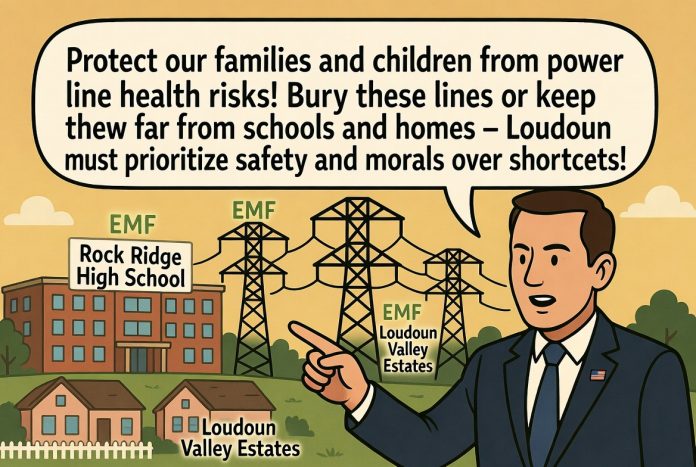
The Loudoun County Board of Supervisors, including Chair Phyllis Randall, Vice Chair Michael Turner, and Supervisors Juli Briskman, Sylvia Glass, Caleb Kershner, Matthew Letourneau, Kristen Umstattd, Laura TeKrony, and Koran Saines, approved a resolution on June 30, 2026, during a special joint meeting with the Planning Commission. The measure formally requests that the Loudoun County School Board hold an emergency session before July 20, 2026, to consider authorizing the use of Loudoun County Public Schools property for alternative routes of Dominion Energy’s Golden to Mars Transmission Line project. This action represents a final local effort to steer the project away from routes that place high-voltage lines dangerously close to homes and schools in the name of protecting family health and community stability.
The Virginia State Corporation Commission issued its final order on June 29, 2026, approving Route 3A after earlier finding underground placement impractical in an April 2026 ruling. Route 3A would run between Rock Ridge High School and the Loudoun Valley Estates residential community northwest of Dulles International Airport. Without School Board approval for property access needed for Routes 3B or 4, the SCC order locks in Route 3A as the path forward. Dominion Energy has 30 days to submit a detailed final alignment map under the order. The Supervisors’ resolution does not force the School Board to act but creates one last window for better options that keep lines farther from families.
Democratic Leadership and the Erosion of Family Protections
Under the leadership of Democratic Chair Phyllis Randall and Vice Chair Michael Turner, along with a Democratic majority on the board, Loudoun County initially advocated for underground segments of the transmission lines to reduce community burdens. That push was rejected by the SCC on practicality grounds, leaving families exposed to overhead lines that many residents view as a direct threat to their children’s health and property values. Conservative principles demand that elected officials prioritize the safety of families and the moral duty to shield the next generation from unnecessary risks over expedited approvals that benefit large utility interests and data center developers. The current resolution, while a positive step, underscores how earlier decisions under Democratic influence at local and state levels failed to secure the strongest protections for residential neighborhoods and school environments.
Critics from a family-first perspective argue that the process has consistently placed corporate timelines and infrastructure demands ahead of the documented vulnerabilities of children and long-term residents. Loudoun Valley Estates families and students at Rock Ridge High School now face the prospect of living and learning in close proximity to lines that studies link to serious health concerns. True conservative governance requires rejecting any route that unnecessarily endangers the health of innocent children and hardworking families who built their lives in these communities long before the project was proposed.
Documented Health Risks Demand Underground Placement or Avoidance
High-voltage transmission lines produce extremely low frequency electromagnetic fields that raise legitimate alarms for public health, particularly around schools and family homes. Multiple peer-reviewed studies and meta-analyses have identified associations between residential proximity to such lines and increased risks of childhood leukemia, with some research showing doubled or greater odds for children living within a few hundred meters. Additional findings point to elevated risks of other cancers, central nervous system tumors, and even neurodegenerative conditions such as Alzheimer’s disease in adults exposed over time. Children face heightened vulnerability because their developing bodies absorb and respond differently to these fields, and time spent at school or playing outdoors near lines compounds potential exposure.
The World Health Organization has classified extremely low frequency magnetic fields as possibly carcinogenic to humans based on the childhood leukemia evidence. Residential magnetic field measurements near power lines often exceed levels tied to statistical risk increases in epidemiological data. Underground placement dramatically lowers these fields at ground level and inside buildings, offering a clear path to meaningful risk reduction that overhead routes cannot match. Conservative values centered on protecting families and traditional community life require prioritizing these health considerations over cost or engineering convenience arguments that have dominated regulatory decisions so far.
Property values in affected areas also suffer when lines run overhead near homes, as prospective buyers routinely avoid such locations due to both real and perceived health issues along with visual blight. This economic hit compounds the human cost for families who invested in Loudoun County precisely because of its reputation as a safe place to raise children. Placing lines underground or routing them well away from schools and neighborhoods aligns with the principle that government and utilities must not externalize health and financial burdens onto residents for the sake of broader development goals.
The Stakes for Rock Ridge High School and Loudoun Valley Estates
Route 3A’s path between Rock Ridge High School and Loudoun Valley Estates places students and families in an especially vulnerable position. Daily exposure during school hours and at home creates prolonged contact with electromagnetic fields at a time when children are most susceptible. Parents in these communities have every right to demand that decision-makers treat their children’s long-term health as non-negotiable rather than a secondary concern to project timelines. Routes 3B and 4, which the county has viewed as preferable, would shift impacts farther from dense residential zones and reduce the direct line of sight and proximity to the high school campus.
If the School Board fails to authorize necessary property use by the July 20, 2026, deadline, Route 3A becomes the default with little recourse for local families. The Supervisors’ resolution correctly identifies this narrow window as essential, yet more aggressive action remains needed to insist on underground segments wherever lines approach sensitive community assets. Conservative stewardship of Loudoun County means fighting to preserve the character and safety of family neighborhoods against infrastructure that prioritizes speed over precaution.
A Moral Imperative to Bury the Lines or Reject Risky Routes
The health evidence, combined with the proximity of Route 3A to both a high school and established residential community, makes a compelling case that these lines should be buried or kept entirely away from such locations. Loudoun families deserve leaders who treat potential cancer risks and other documented effects as reasons for maximum caution, not footnotes in regulatory orders. The Board of Supervisors took an important step on June 30, but the real test lies in whether the School Board seizes this final opportunity and whether future decisions reject any compromise that leaves children and parents bearing the health costs of overhead transmission infrastructure. Protecting the physical and moral fabric of family life in Loudoun requires nothing less than burying these lines or selecting routes that genuinely minimize exposure.