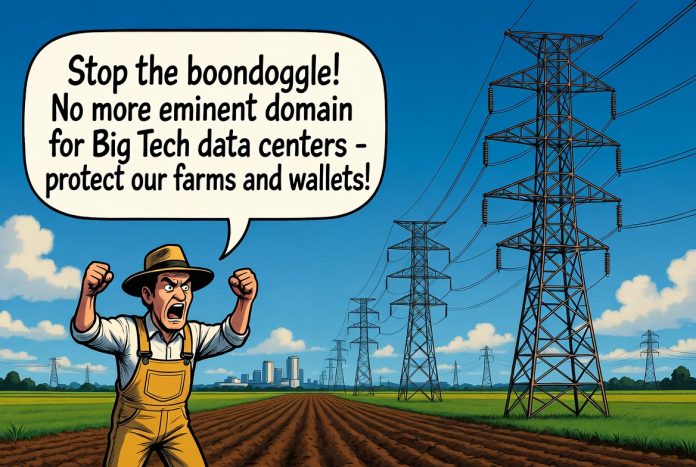
In the rolling hills and historic farmlands of central Virginia, a massive government-enabled corporate project threatens the very fabric of rural communities. The Valley Link transmission line project, a joint venture involving Dominion Energy and partners, proposes enormous 765-kilovolt (kV) overhead power lines that would carve through multiple counties, seizing thousands of acres of private property under eminent domain. This is not about reliable energy for families—it’s a taxpayer-subsidized extension cord designed primarily to power sprawling data centers in Northern Virginia, often backed by out-of-state tech giants with deep pockets and political connections. Democrats, who control the state legislature, have blocked new in-state power plants while approving massive data center developments in blue counties for over a decade, forcing reliance on imported energy, including coal from other states.
Project Scope and the Counties It Will Impact
The Valley Link initiative includes two primary segments. Valley Link South, also known as Joshua Falls to Yeat, spans approximately 115 miles of new 765kV line from the Joshua Falls substation in Campbell County to a proposed new substation in Culpeper County. It would traverse up to nine Virginia counties: Campbell, Appomattox, Buckingham, Fluvanna, Goochland, Louisa, Culpeper, Orange, and potentially Spotsylvania. These rural areas, home to around 450,000 residents, feature family farms, historic sites, and natural beauty that define Virginia’s Piedmont region.
Valley Link North stretches even farther—about 260-261 miles from John Amos power station in Putnam County, West Virginia, through roughly 20 West Virginia counties (including Putnam, Kanawha, Roane, Calhoun, Braxton, Lewis, Upshur, Barbour, Tucker, Preston, Grant, Hardy, Hampshire, Jefferson, and others), three Virginia counties (Clarke, Frederick, and Loudoun), and into Maryland counties (Garrett and Frederick). It includes new substations like Welton Springs in Hardy County, WV, and Rocky Point in Frederick County, MD. In Loudoun County alone, it could seize around 365 acres along a 200-foot easement parallel to existing lines, devastating private property owners in areas like Lovettsville and Neersville.
This massive footprint would require new 200-foot-wide easements across thousands of acres of private land—estimates suggest a minimum of 6,328 acres for the North segment alone, plus 2,788 acres for the South. Guyed V-lattice towers, up to 135-175 feet tall (equivalent to 12-story buildings), would dominate skylines, crossing sensitive areas like the Monongahela National Forest, Appalachian National Scenic Trail, Chesapeake & Ohio Canal National Historical Park, Harpers Ferry National Historical Park, and the Potomac Heritage National Scenic Trail.
Skyrocketing Costs Burdening Ratepayers and Imported Energy Dependence
The Joshua Falls-Yeat segment alone is estimated at about $1 billion, with the broader Valley Link projects (including North) potentially reaching $3 billion or more in total capital costs. These expenses are not borne solely by data center operators or big corporations. Instead, they are socialized across PJM Interconnection ratepayers in 13 states, including Virginia and West Virginia. Analyses suggest West Virginia ratepayers could shoulder over $440 million for related transmission projects over decades, subsidizing Virginia’s data center boom.
Under Democratic control of the Virginia legislature, no significant new power plants have been approved in recent years, creating a self-imposed energy shortfall. Instead, the strategy has been to import power—including coal-generated electricity from other states—while greenlighting data center projects in Democrat-dominated blue counties like Loudoun, Fairfax, and Prince William for more than a decade. This hypocritical approach prioritizes tech industry campaign contributors over Virginia’s energy independence and ratepayers.
Critics rightly point out that formula rates, incentives, and returns on equity sought by developers (including a proposed 10.9% base ROE plus adders) guarantee profits for utilities regardless of actual need or efficiency. This mirrors past failures like the defeated PATH project, where similar massive lines were proposed but ultimately stopped due to overwhelming local opposition and questionable economics.
The Data Center Driver: Prioritizing Big Tech Over Virginia Families
PJM and developers frame Valley Link as essential for grid reliability amid surging demand. However, the primary driver is explosive data center growth in Northern Virginia—Loudoun, Prince William, and Fairfax counties—fueled by hyperscale facilities for AI, cloud computing, and tech giants. Dominion has reported requests exceeding 70 GW of additional demand, largely from this sector. Democrats in control of these blue counties have approved data center developments for over a decade, reaping tax revenue while shifting infrastructure costs onto the broader state.
Yet, rural Virginians in the path of these lines gain little direct benefit while facing property devaluation, EMF concerns, noise from lines, and lost agricultural productivity.
Republicans have long championed limited government, property rights, and free enterprise without cronyism. Here, unelected regional planners at PJM, in coordination with utilities, bypass local control. Multiple counties, including Louisa, Orange, Fluvanna, Goochland, and Culpeper, have passed resolutions opposing the project. Local boards are funding legal fights, highlighting a top-down imposition that echoes federal overreach.
Virginia’s conservative values emphasize self-reliance and protecting family farms and small businesses. Importing power via these “extension cords” from West Virginia coal and potential nuclear plants to serve Northern Virginia’s tech economy shifts burdens unfairly. Why not require data centers to fund dedicated infrastructure or locate nearer generation sources? Democratic policies have blocked domestic power generation while expanding demand.
Environmental, Scenic, and Health Impacts Ignored
Proponents tout renewables integration, but the lines primarily enable fossil and imported power for data centers. Overhead 765kV lines bring visual blight, habitat fragmentation, and potential electromagnetic field (EMF) issues, as documented in past testimony. Alternatives like underground HVDC—proven in other projects and studied by PJM previously—could minimize impacts but are dismissed as costlier, even though data center profits could cover the difference.
National parks and historic viewsheds along the Potomac would suffer irreversible damage, undermining tourism and heritage preservation—priorities for conservatives who value America’s founding landscapes.
A Call to Action: Defend Property Rights and Fiscal Responsibility
As open houses proceed (June-July 2026) and applications head to state commissions like Virginia’s SCC, residents must intervene. Pro se filings are possible; counties are mobilizing. This project risks repeating the PATH defeat in 2012 but on a larger scale. Virginians deserve energy policies that prioritize affordable, reliable power without sacrificing rural livelihoods for coastal tech interests. Contact legislators, attend meetings, and demand alternatives that respect private property and local governance. Virginia’s future depends on rejecting this costly overreach and holding Democrats accountable for their energy import strategy.