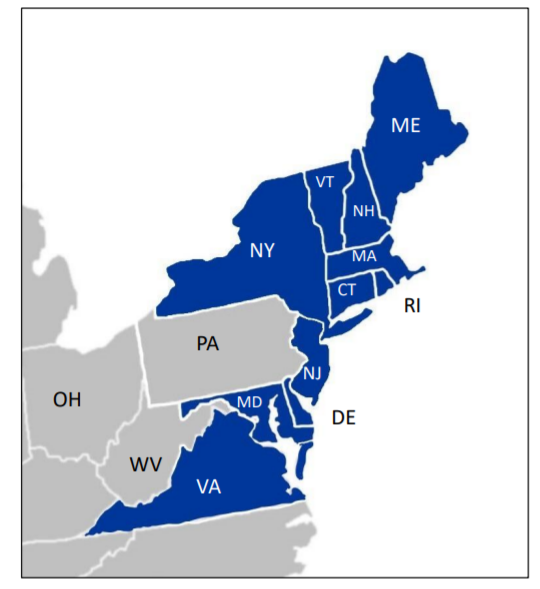
Virginia has re-joined the Regional Greenhouse Gas Initiative, and residential ratepayers are going to feel it again.
Virginians spent more than 600 million dollars over three years during the last time Virginia was part of the program. The electric bill was the only place where every penny went. The Democratic leadership of the Assembly, Senate and Governor’s Mansion have re-enrolled the state into the “cap and invest” scheme. According to the latest estimates, the annual cost will be more than $500,000,000 in the future. This figure does not include the rising costs of credit now that Virginia has returned to the market.
Analysis has shown that the impact on households is north of $1500 per year.
Glenn Davis, the director of Virginia’s Department of Energy who helped to shape Virginia’s policy on energy, is not shy about what it means for families.
He told Restoration News that “we know the bill for everyone is going up.”
Your power bills will skyrocket
In his 2008 presidential campaign, the former president Barack Obama laid out a blueprint for what would happen if he implemented a cap and trade system. He said: “Under my plan, the electricity rates will skyrocket.” The consequences of these schemes are well known to anyone who uses electricity. They also have no benefit for the environment.
Democrats have still pushed them.
Other RGGI-states at least acknowledge the obvious: The program increases power costs. They rebate a portion of the revenues back to ratepayers in order to soften this blow. Virginia’s leaders will not accept the basic premise. They deny that the cost increases even exist, while all neighboring Democrat run states quietly acknowledge it and cut checks.
Environmental irony is brutal. RGGI regulates only in-state generation. The program does not affect coal plants that are outside Virginia’s boundaries but still provide power to Virginians. During their last participation in the program, Virginia’s two biggest power providers, Dominion, and AEP, reduced the gas-fired plant capacity within the state, subject to penalties, while increasing coal-fired production at facilities such as Mount Storm in West Virginia.
Davis’ calculations at the Department of Energy are damning. Virginia’s participation in the program added around two billion extra pounds of carbon dioxide (CO2) into the atmosphere when compared to staying out. He noted that emissions were “like a 2-3x increase” between coal and gas.
The Responsible Parties Avoid the Consequences
This program, which was sold as a win for climate change, actually made the air more polluted by forcing utilities into chasing cheaper and dirtier power from out of state. Who pays the penalties, and who is responsible? The utilities.
How much cake will I be able to eat if you get every calorie I ate? Davis asked. You’re paying for the bill. You’re not penalizing utility companies because each dollar of the penalty is paid by the ratepayer. Money flows directly from your meter into the proceeds of the state’s auction for carbon credits, without any meaningful offset for Virginian households.
The same ideological overreach which revived RGGI is now strangling the future supply. Virginia must shut down all fossil fuel generation (45 percent of its current capacity) by 2045. This is less than 20 year away. Utilities are already building gas plants in West Virginia, whose output will go straight to Virginia’s customers. Building within the state would be a regulatory suicide.
It is easy to predict the outcome: higher costs and less reliability. A regulatory regime will treat molecules that are burned outside of the country as if they were cleaner by magic. A West Virginia co-op has just opened a gas plant that will supply 100 percent of the power to Virginia. The electrons may cross state lines, but the regulatory headaches conveniently remain outside the border.
One paragraph about offshore wind is enough to show the futility. Virginia’s Coastal Virginia Offshore Wind project (CVOW), the only active lease in Virginia, had already reached 70 percent completion at the time that Trump halted East Coast projects. Davis says that “it was allowed to proceed” and that was the right decision at that time because it was 70% completed. The ratepayers were paying every dollar. “You might as well finish the damn thing by that point.”
Davis is blunt about the cost: “It’s the most expensive electronic I’ll ever use in my home.” We shouldn’t have done it in the first place.
Game the System
Virginia Democrats did not have the power to force offshore wind over reliable and affordable options for energy, so they changed the law in 2020. The Democrats declared offshore wind to be “in the public’s interest” and removed the State Corporation Commission from its duty to choose the most affordable, reliable option for the ratepayers.
Davis explained that “the Democrats in the General Assembly declared the wind to be in the public’s interest and mandated by law that our utility companies build a specific amount of wind before a particular date.” At that point, SCC lost the ability to evaluate it according to the best alternative power generation.
In the 2030s, more wind leases are expected. It’s the same pattern: Political fiat is more important than economics and Virginians are paying a premium for intermittent energy that still requires fossil backup, which the Clean Economy Act aims to ban. Ratepayers will be forced to subsidise the least efficient form of power generation. Since the wind does not blow when needed, the grid needs fossil plants that the law is trying to eliminate.
There is no real gain in reliability. Davis has seen the movie before. When we were in RGGI previously, Dominion used more of their coal power plants in West Virginia and less of its gas facilities in Virginia.
The program did not clean the air. The program shifted emissions and costs to those least able absorb them.
The new estimates have already started to trickle in and are more than four-times higher than those from the previous stint at RGGI.
Dominion’s latest filing to recover RGGI cost indicates that the average residential consumer will be charged an extra $13 per month (156 dollars per year) by Dominion. Below is the link to the filing. Business and industrial customers will see increased bills as well.https://t.co/lBjuD4yFAK
– Mark C. Christie (@ChristieFERC)
June 10, 2026
The first round of ratepayers’ cost about $2.39 per month.
The state is pretending that the rise in bills is not real, while ratepayers are watching their bills increase across the Commonwealth. Virginia’s energy policies have turned out to be a masterclass in good intentions that has produced the opposite of what they intended – higher emissions, more costs and less control over their own grid.
Facts are beyond dispute. Only one question remains: for how long will families continue to subsidise the experiment?
RESTORATION NEWS
RGGI was always a bad deal: Virginia residents can expect to see electricity costs skyrocket $1,100 per household
Climate Lawfare: A Quiet Update That Could Shape a 1000 Climate Cases
Climate Lawfare: Part 2: Analysis of China-backed Litigators Crushing Louisiana Energy
Green Machine targets plastics at consumer expense
Restoration News is a project of Restoration of America and your reliable investigative source of news for the America First Movement. We are a conservative news website that is rapidly growing. Our focus is on providing accurate and insightful exposés of political news, immigration, leftist lies and other pressing issues facing everyday Americans. We are uncompromising in our commitment to deliver news that is factual, hard-hitting and America First.
Each dollar we spend brings us closer to victory in the war against woke
This article first appeared on Virginia's return to RGGI - Another ratepayer scam in the making