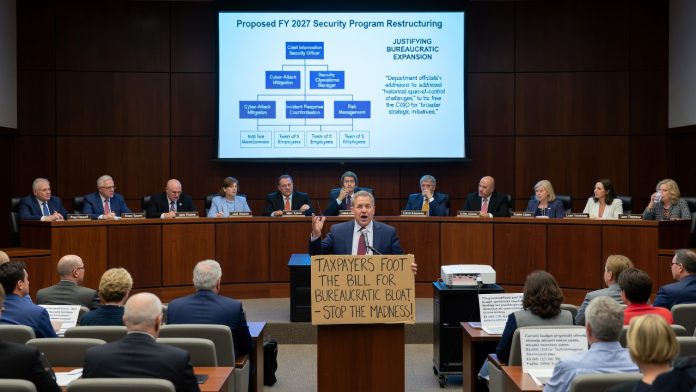
Loudoun County taxpayers are once again being asked to foot the bill for expanding government bureaucracy as the Department of Information Technology seeks to add another middle-management position to its payroll. The proposed fiscal year 2027 budget specifically requests funding for a brand-new security operations manager to oversee just five employees within the existing cybersecurity division. The Loudoun County Board of Supervisors, which currently includes Phyllis Randall, Koran Saines, Juli Briskman, Mike Turner, Matthew Letourneau, Caleb Kershner, Sylvia Glass, Kristen Umstattd, and Laura TeKrony, will ultimately decide whether to approve this additional bureaucratic layer. Fiscal conservatives across the region are raising serious concerns about whether this new role represents a genuine necessity or simply another instance of unchecked administrative bloat at the expense of hardworking families.
The Department of Information Technology operates almost entirely on the backs of local residents, with local tax dollars providing an overwhelming ninety-nine percent of its total funding. Current budget proposals already allocate massive sums to this specific department, including $5,069,250 for Technology Services and $4,945,157 for the Project Management Office alone. Furthermore, Public Safety Support within the department demands an astonishing $16,109,157 in taxpayer funding every single year. Adding another full-time equivalent position to an already heavily funded department raises serious questions about fiscal restraint, government overreach, and the responsible stewardship of public resources during uncertain economic times.
JUSTIFYING BUREAUCRATIC EXPANSION
Department officials attempt to justify the new security operations manager position by citing historical span-of-control challenges within the existing organizational structure of the technology division. The proposed restructuring plan aims to shift the supervisory responsibility of five current personnel away from the Chief Information Security Officer and onto this newly created managerial role. Proponents within the local government argue this will enhance the detection and mitigation of cyber-attacks by improving daily oversight of security operations, incident response, and risk management activities. However, conservative critics rightfully point out that creating a dedicated, highly paid manager for a mere five employees seems highly inefficient and completely contradictory to standard private sector management practices.
By offloading daily management duties, the Chief Information Security Officer will theoretically be freed to focus on broader strategic initiatives and countywide cybersecurity governance. The department claims the chief officer must concentrate heavily on major capital projects, rigorous compliance oversight, comprehensive software security reviews, and long-term strategic planning for the county. While these high-level tasks are undoubtedly important for protecting digital infrastructure, conservative watchdogs question why a highly compensated executive cannot simultaneously manage a small team of five technical professionals. In the competitive private sector, executives routinely balance strategic planning with direct personnel management without demanding additional layers of expensive middle management to ease their daily workload.
INCIDENT RESPONSE AND OPERATIONAL EFFICIENCY
The newly proposed operations manager will also be officially tasked with overseeing incident validation and response coordination between internal county teams and external security partners. Department leaders insist this coordination is absolutely necessary to ensure that automated security outputs translate into actionable remediation without costly delays or internal miscommunication. While protecting local government infrastructure from complex cyber threats is an undeniable priority, simply adding administrative overhead does not necessarily guarantee better or faster security outcomes. Effective cybersecurity relies on robust technology and skilled frontline analysts rather than expanding the ranks of middle managers who simply coordinate existing efforts from behind a desk.
Fiscal conservatives strongly argue that local government agencies must learn to optimize their current resources instead of perpetually requesting new staff to solve basic operational challenges. The continuous expansion of the county payroll creates long-term financial liabilities, including ongoing salary requirements, expensive health benefits, and eventual pension costs that taxpayers must bear for decades to come. Before approving any new administrative positions, the county should conduct a rigorous, independent audit of the Department of Information Technology to identify potential waste, fraud, or operational redundancies. Streamlining existing operations and demanding greater productivity from current leadership would serve taxpayers far better than continuously expanding the administrative bureaucracy at their expense.
PROTECTING THE TAXPAYER
As the county budget process moves forward, elected officials must closely scrutinize this funding request and demand clear, quantifiable metrics proving the absolute necessity of a new security operations manager. Taxpayers rightfully expect their hard-earned money to be spent strictly on essential public services, not on padding government departments with unnecessary supervisory roles that inflate the budget. If the Department of Information Technology truly needs to improve its cybersecurity posture, it should aggressively reallocate existing funds rather than constantly asking residents to dig deeper into their pockets. True fiscal conservatism requires making tough choices, eliminating wasteful spending, and prioritizing efficiency to ensure that every single tax dollar delivers maximum value to the community.
Email the Board of Supervisors at:
Phyllis J. Randall (Chair, At-Large) – Phyllis.Randall@loudoun.gov,
Michael R. Turner (Vice Chair, Ashburn District) – Mike.Turner@loudoun.gov,
Juli E. Briskman (Algonkian District) – Juli.Briskman@loudoun.gov,
Sylvia R. Glass (Broad Run District) – Sylvia.Glass@loudoun.gov,
Caleb Kershner (Catoctin District) – caleb.kershner@loudoun.gov,
Matthew F. Letourneau (Dulles District) – Matt.Letourneau@loudoun.gov,
Kristen C. Umstattd (Leesburg District) – Kristen.Umstattd@loudoun.gov,
Laura A. TeKrony (Little River District) – Laura.TeKrony@loudoun.gov,
Koran Saines (Sterling District) – Koran.Saines@loudoun.gov