By Steve Haner,
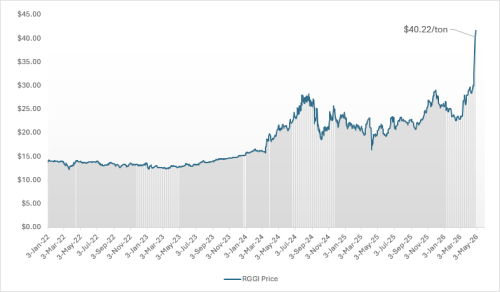
The price of carbon credits on the secondary market for the cap-and-trade multistate system has increased due to Virginia’s imminent return to the Regional Greenhouse Gas Initiative. Futures Price Exceeded $41 Per Ton Today, Far Above the $25 Per Ton that utilities were required to pay at the March 2026 Auction.
This reflects a widespread expectation that Virginia generators of electricity will need to purchase far more allowances then Virginia has available to sell. They will therefore be competing to buy allowances from the other ten state members within the compact. Prices will rise due to high demand and limited supply.
In June, the next auction of carbon allowances will take place. This is the first time that all Virginia power plants are included in the bidders. The revised RGGI regulation in Virginia takes effect just a few weeks later. The final regulation was rushed without public input as the General Assembly demanded. Governor Abigail Spanberger has now signed the .
The page of the Virginia Regulatory Town Hall includes a three paragraph economic impact that contains absolutely no information about economics and ratepayer impacts. This is a whitewash. The Governor’s Review memo, dated 24 April, is one word only: approved.
Virginia will be able to sell 11.5 million allowances of carbon in the last six months (two sales) of 2026. The state will earn $288 million at the auction price in March. A $40 per ton result would generate $460 million over six months, and could lead to a potential tax revenue of almost $1 billion annually in the future.
Here are some key points.
The regulation that was just adopted is no longer valid after this year. While Virginia was on vacation, the other states adopted many changes to prepare for the “control period” of three years that starts in January 2027. Virginia will have to adopt a new regulation that reflects those changes.
It would be a travesty if Spanberger Administration, Department of Environmental Quality and other agencies did the same accelerated regulation railroad job a third time. The public should have the opportunity to comment on all aspects of the regulatory process for this new control period. This contract period is the only time that the legislative mandate to skip everything should be applied.
Virginia, as it returns into RGGI, should also recognize that it has leverage and could negotiate a higher amount of allowances for the region’s 11 states. The state has projected a decreasing total of allowances in the new regulation: 22 million in the year 2027, 21 millions in the year 2028, and 20 million for 2029.
has reported previously about Bacon’s Rebellion that the electricity generators of Virginia, which must now buy allowances, emitted over 29 million tons carbon dioxide by 2025. The money that Virginia’s electricity generators will spend on carbon taxes, which will be paid by ratepayers, will go to other states in RGGI if Virginia does not secure more credits. It could also ask for more “cost-containment reserve” allowances to be divided among the states.
Third, this is a brand new point, gentle readers. The carbon tax paid by utilities isn’t the only way RGGI raises our electricity prices most days. RGGI cost us money while Virginia wasn’t in it. RGGI is only part of PJM’s regional electricity market. However, the RGGI taxes that these states must pay often drive up the prices of electricity in all of PJM.
This is a complicated process, but we’ve simplified it for you. The price that a utility pays each day, or for a specific hour in its PJM area is determined by the most costly generator that PJM approves to feed the grid. The marginal price is determined by the most expensive generator in a zone. Of course, utilities often buy power from other zones and pay a higher rate because of the carbon taxes.
If the carbon auction price for a ton CO2 reaches $40, this will add about $20 per Megawatt Hour to the price the generator can demand from PJM. The marginal PJM prices that a solar or a wind plant receives, due to its low cost of operation, are a real boon for their owners. Another reason why they love RGGI is because it allows them to earn more money.
You were wrong if you thought the sun was free and that you would pay less for solar energy. You pay the same for a PJM kilowatt as you would from the most expensive gas or coal plant. Solar plants never produce all the energy, so they do not set the price. The top marginal price will likely come from a RGGI-paying state, now that Virginia has returned to the tax scheme.
Add another $1 billion to the $1 billion Virginia’s electricity producers – and its ratepayers – will pay into the state in carbon credits by 2027 or beyond. This is due to higher PJM spot and marginal pricing for non-RGGI-covered power. The math is complex and exact numbers are elusive but the truth is that the cost of electricity is going to increase by about $1 billion due to higher PJM marginal and spot prices on non-RGGI covered power.
RGGI’s purpose was to increase the cost of electricity. Remember that the RGGI tax on carbon was only $6 per ton in 2020 when Virginia Democrats voted for Virginia to join, and $7.60 in Virginia’s 2021 first auction. Five years later, the price is approaching $40 per ton. This is not an accident, and it does not surprise the advocates.
You were never told the truth.