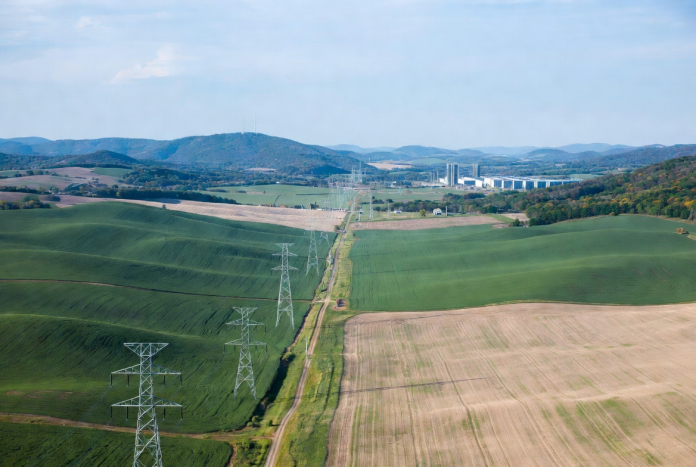
Loudoun County residents continue to confront the harsh reality of massive high-voltage transmission lines planned through residential areas to support the explosive growth of data centers in Northern Virginia. Dominion Energy’s projects, including segments of the Loudoun Reliability Loop connecting substations near Ashburn, involve towers reaching 185 feet in height that would cut near homes, schools, and communities. The Virginia State Corporation Commission has approved certain above-ground routes after determining that full or partial burial, while technically possible, is not practicable under conventional methods due to costs exceeding $1.2 billion for some options. Local families have voiced strong opposition, citing threats to property values, visual blight, and quality of life in established neighborhoods. Overhead construction for these high-voltage lines is estimated at approximately $6 million per mile, yet Democratic-led decisions have left communities exposed to the full visual and property impacts of that cheaper but disruptive approach.
The Loudoun County Board of Supervisors, dominated by Democrats, has overseen years of data center approvals that have turned the area into the world’s largest concentration of such facilities. Current board members include Chair Phyllis Randall, Vice Chair Michael Turner of the Ashburn District, Juli Briskman of the Algonkian District, Sylvia Glass of the Broad Run District, Caleb Kershner of the Catoctin District, Matthew Letourneau of the Dulles District, Kristen Umstattd of the Leesburg District, Laura TeKrony of the Little River District, and Koran Saines of the Sterling District. While the board has expressed support for burying portions of lines within 500 feet of homes and schools, critics note that earlier decisions enabled the rapid expansion without securing adequate infrastructure safeguards. The Loudoun County School Board has also opposed certain routes near school properties, highlighting risks to children and educational environments. These developments have left homeowners feeling that progressive policies prioritizing commercial growth over family stability have created the current crisis.
Protecting Homes and Property Values Requires Bold Private-Sector Innovation
Conservative principles emphasize the protection of families, private property, and community character against government overreach and poorly planned development. In Loudoun County, the surge in data centers has generated substantial tax revenue, estimated in the hundreds of millions annually and contributing significantly to the county’s overall budget exceeding $5 billion in recent appropriations. Yet this revenue has come at a steep cost to residential quality of life, with new lines needed to address reliability gaps projected as high as 300 megawatts by 2028. Traditional underground installation for 500-kilovolt lines remains prohibitively expensive and logistically challenging according to Dominion studies, which cite space constraints for entry points and other technical barriers. Virginia currently has limited experience with buried lines at these voltages, leaving ratepayers and taxpayers potentially on the hook for massive conventional costs.
An innovative alternative draws from proven private enterprise rather than bureaucratic delays. The Boring Company, known for advancing low-cost tunneling technology, targets construction costs around $10 million per mile. That figure represents just $4 million more per mile than the estimated $6 million per mile cost of conventional overhead lines. At the Boring Company rate, burying 100 miles of critical transmission infrastructure would total approximately $1 billion, representing roughly one-fifth of Loudoun County’s annual budget scale. This approach leverages efficient private-sector methods developed through competitive innovation, avoiding the inflated expenses often associated with traditional utility projects and government-managed construction. Such a strategy aligns with values that favor free-market solutions capable of delivering results faster and more affordably than conventional public processes. Families in affected neighborhoods, including those near Ashburn and Lansdowne, stand to benefit from preserved sightlines, maintained property values, and reduced long-term disruption.
Democratic Leadership’s Record Leaves Communities Vulnerable
Democratic majorities on the Loudoun board have repeatedly faced criticism for enabling data center proliferation without insisting on concurrent infrastructure solutions that shield residential areas. Supervisors have acknowledged limited formal authority over transmission routing, which falls under state jurisdiction, yet local land-use decisions paved the way for the current power demands. Residents have pointed to the board’s past approvals as the root of conflicts that now pit neighbors against one another over route options. One supervisor noted that multiple proposed paths quickly divided communities. Meanwhile, the State Corporation Commission’s rulings have prioritized reliability timelines, selecting shorter overhead routes that still impact dozens of homes within 500 feet. Appeals and petitions from homeowner associations continue, seeking reconsideration and application of newer state legislation that could facilitate limited underground projects with shared costs.
The moral imperative remains clear for those prioritizing family stability and local control. High towers looming over backyards and school grounds undermine the character of suburban and rural communities that families chose for safety and tranquility. Data centers themselves deliver economic benefits through jobs and tax base growth, yet the infrastructure burden has fallen unevenly when conventional burial proves impractical. Shifting toward advanced tunneling methods offers a path that respects private property rights and avoids endless regulatory battles. Ratepayers across the region already face rising electricity costs tied to grid expansion serving high-demand commercial users. Directing resources toward efficient burial of key segments could mitigate visual and environmental impacts while ensuring reliable power delivery at only a modest premium of $4 million more per mile over standard overhead construction.
A Practical Path Forward for Northern Virginia’s Future
Northern Virginia’s data center concentration, often called Data Center Alley, accounts for a substantial share of global capacity and drives regional economic activity. Power demand continues to climb, with projections indicating significant growth in the coming decade. Dominion has advanced multiple projects, including reliability loops and longer proposals such as a potential 186-mile high-voltage direct current line estimated at $4.8 billion. Conventional underground approaches for alternating-current high-voltage lines carry high per-mile costs that can reach into the tens or hundreds of millions depending on voltage and conditions. By contrast, specialized tunneling technology presents an opportunity to achieve burial at $10 million per mile, only $4 million above the $6 million per mile figure associated with overhead lines. Implementing such methods for priority corridors near residential zones would demonstrate responsible stewardship of both economic growth and community welfare.
County leaders must move beyond statements of support for burial and actively explore partnerships with innovative firms capable of delivering results within existing budget frameworks. Protecting families means ensuring that the benefits of technological industry do not erode the homes and neighborhoods that form the foundation of local society. Property owners deserve solutions that maintain the value and usability of their investments rather than accepting permanent overhead infrastructure as inevitable. The current trajectory under prolonged Democratic control has produced repeated controversies, school board interventions, and resident outrage. A course correction rooted in practical, cost-effective engineering and respect for private property offers the clearest route to balancing progress with preservation. Loudoun’s experience serves as a cautionary example for other localities facing similar pressures from rapid commercial expansion.
Email the Board of Supervisors at:
Phyllis J. Randall (Chair, At-Large) – Phyllis.Randall@loudoun.gov,
Michael R. Turner (Vice Chair, Ashburn District) – Mike.Turner@loudoun.gov,
Juli E. Briskman (Algonkian District) – Juli.Briskman@loudoun.gov,
Sylvia R. Glass (Broad Run District) – Sylvia.Glass@loudoun.gov,
Caleb Kershner (Catoctin District) – caleb.kershner@loudoun.gov,
Matthew F. Letourneau (Dulles District) – Matt.Letourneau@loudoun.gov,
Kristen C. Umstattd (Leesburg District) – Kristen.Umstattd@loudoun.gov,
Laura A. TeKrony (Little River District) – Laura.TeKrony@loudoun.gov,
Koran Saines (Sterling District) – Koran.Saines@loudoun.gov