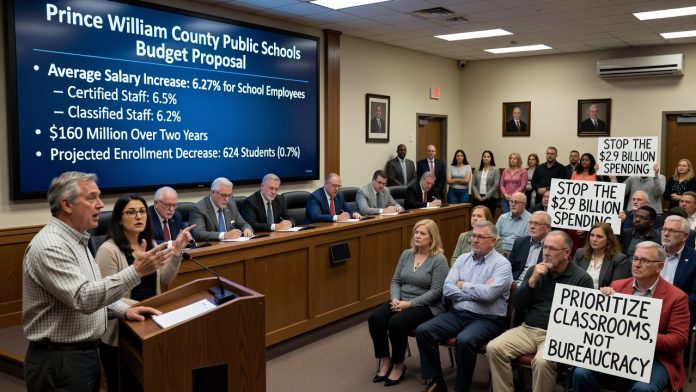
Prince William County taxpayers are facing a staggering financial burden as the local school division pushes forward with a record-breaking budget proposal. The newly proposed budget for Prince William County Public Schools totals an astronomical $2.9 billion, heavily driven by historic compensation increases. At a time when families are already struggling with inflation, this massive government expenditure threatens to drive local taxes even higher. Despite a projected decrease in student enrollment, local leaders are demanding a massive transfer of wealth from county coffers to fund the expanded educational bureaucracy. Residents are increasingly questioning whether this level of spending represents a responsible use of taxpayer money or a reckless expansion of government overhead.
At the center of this spending surge is an average salary increase of 6.27 percent for school employees, reflecting adjustments negotiated through a recent collective bargaining agreement. Certified staff will see a raise of 6.5 percent, while classified staff will receive a bump of 6.2 percent. This multi-year wage agreement will cost taxpayers an estimated $160 million over the next two years alone. Superintendent LaTanya McDade has publicly defended the wage proposal as a necessary step to ensure employees feel valued and remain regionally competitive.
Fiscal conservatives are sounding the alarm over a glaring contradiction within the budget data regarding student population trends. The school system is projecting an enrollment decrease of 624 students, representing a 0.7 percent drop from the previous approved budget. Despite having fewer children to educate, the division is demanding a historic $1.1 billion transfer from the county government to sustain its operations. This represents a 12.8 percent increase in county funding compared to the previous fiscal year, highlighting a severe disconnect between actual service demand and taxpayer costs.
Accountability and Elected Leadership
The responsibility for approving and funding this massive spending package falls upon the current members of the Prince William County School Board and the Board of Supervisors. The School Board consists of Chairman Babur Lateef, Adele Jackson, Lisa Zargarpur, Jennifer Wall, Tracy Penn, Richard Jessie, Justin Wilk, and Loree Williams. Meanwhile, the Board of Supervisors, which must authorize the massive county transfer, includes Chair Deshundra Jefferson, Tom Gordy, Yesli Vega, Bob Weir, Victor Angry, Kenny Boddye, Andrea Bailey, and Margaret Franklin. Taxpayers are calling on these elected officials to carefully scrutinize the budget and identify areas where wasteful spending can be eliminated.
School Board Chairman Babur Lateef has been a vocal proponent of the massive spending package and the resulting tax burden. He recently stated that investing millions over the next two years for teacher and support staff raises is a testament to the board’s commitment to supporting educators. Furthermore, he expressed excitement that the budget will begin funding new strategic initiatives like universal pre-kindergarten and additional classroom support. However, critics argue that such expansive new programs represent severe mission creep that strays from the core educational mandate while driving up costs.
Expanding Bureaucracy and Expensive New Initiatives
Beyond the historic collective bargaining agreement, the budget allocates millions of dollars toward new social programs and specialized initiatives. The spending plan includes funding for 59 new full-time teaching assistants for special education, alongside expensive new robotics centers at local high schools. Additionally, the budget diverts educational funds toward school-based food pantries, health clinics, and a student workforce readiness initiative. While proponents frame these as necessary community supports, fiscal watchdogs point out that schools are increasingly taking on the financial responsibilities of traditional social service agencies.
The current budget is designed to bridge the transition from the previous strategic plan to the newly minted Elevate 2030 framework. This transition signals a long-term commitment to inflated spending levels that will inevitably require higher property taxes to sustain. School administrators justify the ballooning costs by citing a growing need for specialized student support for English learners and economically disadvantaged students. Unfortunately, this continuous expansion of the educational welfare state leaves hardworking families footing the bill for an ever-growing administrative machine.
As the local government prepares to finalize this $2.9 billion spending package, the call for fiscal restraint has never been more urgent. Hardworking residents of Prince William County simply cannot afford to fund endless bureaucratic expansion while student enrollment actively declines. Elected officials must prioritize core academic instruction over expensive social programs and unsustainable union-negotiated salary mandates. Only through strict financial oversight and a commitment to conservative budgeting principles can the county protect its taxpayers from future economic strain.
Email the Board of Supervisors At:
Chair At-Large (Deshundra Jefferson) – djefferson@pwcgov.org,
Brentsville (Tom Gordy): tgordy@pwcgov.org,
Coles (Yesli Vega): yvega@pwcgov.org,
Occoquan (Kenny Boddye): kboddye@pwcgov.org,
Potomac (Andrea Bailey): abailey@pwcgov.org,
Woodbridge (Jeannie LaCroix): jlacroix@pwcgov.org,
General Board: bocs@pwcgov.org,