By Steve Haner,
The Regional Greenhouse Gas Initiative held its first carbon allowance for 2026 on Wednesday. The price was just under $25 per tonne of emissions. This is 26% more than a year earlier. prediction is that the carbon tax on Virginia’s electricity plants would cost $550 million per year or more once Virginia becomes a full member.
The electricity producers’ customers will pay the taxes in some way. The General Assembly, in returning Virginia to the interstate trading compact, imposed No Barrier to the utilities or independent energy producers who simply passed the cost onto the energy buyers. RGGI’s goal is to raise the cost of hydrocarbon-fueled electricity.
Since Virginia’s last participation in this exercise from 2021 to 2023, the price of an allowance is almost doubled. If Dominion Energy Virginia returns to charging the tax directly on monthly bills for 1,000 kilowatt hours, what was $4 per month just three years ago will be at least $7 per month in 2027.
The $24.99 price at the auction was slightly less than the $26.73 that bidders paid for the auction in December 2025. RGGI held the price of March in check by releasing 7,8 million allowances that it had kept back in a Cost Containment Reserve (CCR). The same thing was done a year earlier, when it released more than 8 millions allowances in the CCR during the auction of March, draining the reserve for the year.
It is inevitable that the price of allowances, which is really a tax on each ton of emission, will continue to increase. This is deliberate. Five years ago, Virginia’s first auction was held at $7.60 per tonne. Today it is $24.99 per tonne. If this trend continues (almost 230% increase in five years), the auction price in March 2031 will be close to $60 per ton CO2.
Virginia has been ordered back to RGGI by the General Assembly, but it is unclear if Virginia will be able rejoin in 2026. Three more auctions will take place this year in June, Septembre and Decembre.
RGGI is governed by a contract that runs for three years. This year, Virginia received zero allowances. Virginia will need to get the other states to accept Virginia and allow Virginia to add allowances to the 2026 pool before Virginia can tax this year.
Virginia will be easier to add for the next three years, starting in January. The other ten states have changed the program in a significant way for this cycle. Virginia would need to accept all of those changes and then negotiate how many allowances will be created for this state.
The auction price will be lower if the initial allowance number is higher. It will be important to know what initial allowances Governor Abigail Spanberger and her team ask for.
During 2023 the state sold 22,4 million allowances. However, it is unlikely that this number will be as high in 2027, because RGGI’s overall cap on allowances is rapidly shrinking. By reducing the number of mandatory allowances, it is intended to force coal and natural gas plants to shut down.
A summary on the changes made to the program by the ten members who have been with the program for a long time, established a cap of 70 million tons carbon emissions per state, including cost containment reserve, down from 75 million tons at the end this contract cycle. The price at which the cost containment reserve is used will also increase rapidly.
The new agreement reduces the state allowance amounts by approximately 10 percent per annum. The chart below shows the drastic change in the allowances targets. The Spanberger Administration will probably be okay with imposing the same reduction rate on Virginia allowances as well, but it is likely that electricity generators will pay a much higher price in late 2020s.
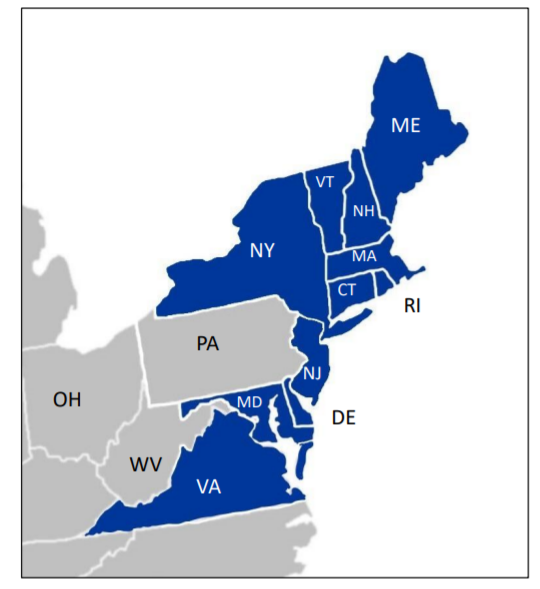
RGGI is not a part of several major states that are members of the PJM Interconnection Regional Electricity Pool. The reimposition on the RGGI taxes for Virginia power plants will result in Virginia producing and selling less electricity. This deficit will then be covered by increasing imports from non-RGGI state such as Pennsylvania. Ohio, and West Virginia. This is what happened between 2021 and 2023. RGGI supporters fail to realize that emissions have not disappeared, but rather moved from one state to another.
The math is very complicated, so the carbon tax is just one part of the RGGI costs that Virginia consumers will face. Economic consequences also result from the less efficient operation at Dominion and other Virginia plants. This would require a lengthy discussion, which we will leave for another time.
RGGI does not reduce emissions by even a ton. Virginia consumers are disadvantaged by this tax, which only benefits state treasuries.