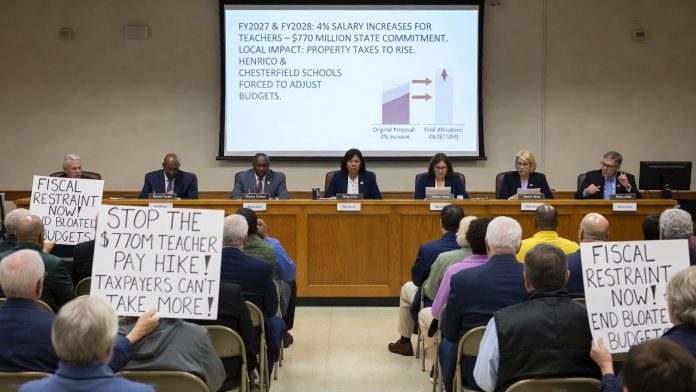
Virginia taxpayers are facing a massive financial burden as the state government commits an astonishing $770 million to fund a four percent salary increase for teachers in both fiscal years 2027 and 2028. This sweeping budget allocation doubles the original proposal made by the governor, raising serious concerns among fiscal conservatives about sustainable spending and ballooning state budgets. The massive expenditure directly impacts the Virginia Department of Education and forces local school divisions to scramble for millions in matching funds. Ultimately, this aggressive legislative mandate places the heavy financial weight squarely on the shoulders of hardworking taxpayers who are already struggling with inflation.
The mandated four percent pay hikes apply to all instructional and support positions funded through the Standards of Quality, creating a costly ripple effect across every municipality in the Commonwealth. Local public school divisions, including Henrico County Public Schools and Chesterfield County Public Schools, must now dramatically adjust their local budgets to accommodate these aggressive state mandates. Consequently, local property taxes and county budgets are stretched to their absolute limits as local officials attempt to keep pace with Richmond’s lavish spending directives. Taxpayers are left wondering how many more bloated budgets they will be forced to fund before lawmakers finally prioritize financial restraint over political appeasement.
Local school boards are currently reacting to this unprecedented state spending
In Henrico County, local leaders were forced to adjust their previous budget plans, increasing a planned three percent raise to the newly state-mandated four percent baseline. Henrico County Superintendent Amy Cashwell recently addressed the severe limitations this state budget places on other local school funding priorities. Cashwell noted that while sufficient state aid might not be available for certain positions, the district will monitor other funding sources or the possibility of additional state aid throughout the year. The Henrico County School Board, which includes Alicia Atkins, Roscoe Cooper, Madison Irving, Marcie Shea, and Ryan Lyles, must now navigate these heavy financial mandates while attempting to balance the strained local budget.
Chesterfield County is also grappling with the harsh fiscal realities of these state-level mandates, forcing local officials to justify the soaring educational costs to their constituents. Chesterfield County Superintendent John Murray defended the heavy local budget investments, claiming the spending was necessary to maintain a high-quality educational experience for local students. Murray stated that the balanced budget is designed to meet essential needs that support student success, adding that sustained investment is foundational to maintaining the strength of the county. The Chesterfield County School Board, consisting of Dot Heffron, Ann Coker, Ryan Harter, Steven Paranto, and Dominique Chatters, faces mounting pressure from taxpayers who demand strict fiscal responsibility and an immediate end to unchecked spending.
The final cost of this budget doubling the original executive proposal is staggering
The approved four percent increase represents a massive departure from the governor’s original, more fiscally responsible proposed budget. The initial executive proposal provided a modest two percent increase for all Standards of Quality funded positions, which would have saved Virginia taxpayers hundreds of millions of dollars. Instead, the final budget compromise provides a massive $770 million allocation, severely limiting the state’s ability to offer broad tax relief or aggressively pay down existing debt. Fiscal conservatives argue that this doubling of the proposed salary increase is a prime example of government overspending that completely ignores the economic realities facing everyday citizens.
The spending spree extends far beyond basic salary increases, as the budget compromise also includes a $148 million investment that more than doubles the flexible add-on for students with disabilities. Emboldened by the state’s aggressive spending patterns, some localities are pushing the financial envelope even further at the local level. Hampton City Schools, for example, leveraged the newly available state funds to offer an even higher five percent increase to their instructional staff. This highly competitive spending environment encourages municipalities to exhaust tax revenues rather than seeking efficiencies, trimming bureaucratic waste, or returning surplus funds to the taxpayers.
Protecting the taxpayer in future budgets must become the top legislative priority
As Virginia prepares for the financial realities of fiscal years 2027 and 2028, taxpayers are rightfully demanding increased scrutiny of all public education expenditures. Every single dollar allocated to the Virginia Department of Education for direct aid must be rigorously audited to prevent fraud, eliminate administrative waste, and ensure funds actually reach the classroom. Bureaucratic overhead must be slashed drastically before state lawmakers even consider demanding more money from the hardworking residents of the Commonwealth. True conservative governance requires a firm, unwavering commitment to reducing the budget, ending frivolous expenditures, and protecting the financial future of Virginia families.
The astonishing $770 million price tag for these salary increases serves as a stark reminder of how quickly legislative compromises can balloon entirely out of control. While supporting educators is a valid civic function, it must never come at the expense of fiscal sanity or through the imposition of crushing tax burdens on everyday citizens. State and local representatives must prioritize balanced budgets, reject exorbitant spending hikes, and deeply respect the taxpayers who ultimately foot the bill for these programs. By returning to foundational principles of fiscal restraint, Virginia can maintain strong schools without bankrupting the very families those schools are meant to serve.