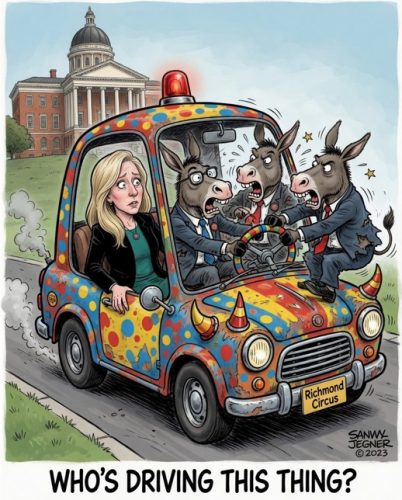
Abigail Spanberger struggled at key moments to set her own agenda.
She stressed “affordability” during the campaign. However, the launch focused more on general themes rather than concrete, actionable suggestions. Historically, new governors tend to anchor their first session with a clear set of priorities–legislation that signals direction and gives their party something concrete to organize around. This kind of initiative to define the state never materialized.
In the absence that clarity, the General Assembly filled in the blanks. The lawmakers advanced their own priorities. Not all of them aligned to Spanberger’s declared goal of governing in the middle. Once this dynamic is established, it’s difficult for any Governor to regain control.
The administration also never settled into a rhythm of communication with the media. Former governors, such as Terry McAuliffe and Glenn Youngkin, were willing to engage regularly, even when under pressure. They used regular interaction to help shape their narrative. Spanberger, on the other hand, has a more limited approach, relying heavily upon staged appearances and not as much sustained policy discussion. This choice can have consequences in a media climate like Richmond’s where relationships and access still matter.
Every new governor will also face a structural fact: The legislature will eventually test the limits of the executive’s authority. It’s not about you, it’s about the institution. Governors who are successful usually make it clear early on that they want to be in charge. When that signal is unclear, legislators–regardless of party–tend to assume a larger role.
Spanberger’s approach has been softer so far. Spanberger’s responses were usually muted or delayed when major initiatives from her party emerged that could have complicated her moderate position. In a number of high-profile instances, legislators declined to accept her proposed changes, and instead moved forward with their own agendas. This is an unusual dynamic, especially within the governor’s party. This pattern over time can give the impression that Richmond’s center of gravity is the General Assembly and not the Executive Mansion.
This perception has been reinforced by the decision to allow for a special session without a resolution. Once it is underway, the power shifts to the legislature. A governor has less control over timing and outcome.
These choices, taken together, have put the administration in a difficult position.
The first option is to work within the existing framework, signing most legislation and managing the outside edges. Another approach would be to focus on the traditional tools for the office, such as administration, appointment, and economic growth. This approach would emphasize stability but risk cementing the impression that the governor reacts rather than leads.
One way is to be more assertive, using the full extent of executive power to establish priorities and draw clearer lines. This comes with its own set of risks, such as conflicting with allies in the legislature and disrupting the party’s larger agenda. It would also make it clear where the final decisions are made.
The underlying problem is the same in both cases: if the governor in Richmond does not set the agenda in advance, then someone else will.