
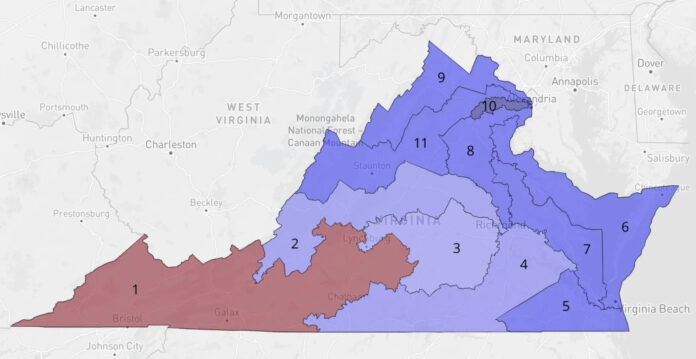
Richmond, VA – December 22, 2025 – Virginia’s ongoing redistricting saga took a significant turn in October when Democratic leaders in the General Assembly convened a surprise special session to propose a constitutional amendment allowing for mid-decade adjustments to the state’s congressional maps. The move, which cleared initial legislative hurdles, has sparked intense partisan debate and legal action from Republicans, who argue it undermines the independent redistricting process established by voters in 2020.The proposed amendment, known as HJ6007, would empower the legislature to redraw congressional districts outside the standard post-census cycle.
Proponents, primarily Democrats who maintain control of both the House of Delegates and the Senate, contend that the change is necessary to address potential imbalances in representation following recent national elections, including President Trump’s 2024 victory. The Senate approved the measure on October 31 in a 21-16 party-line vote, following passage in the House earlier that week. If successful, the amendment would require approval in a second legislative session in 2026 and then ratification by voters in a statewide referendum.
Critics, including Republican lawmakers and Governor Glenn Youngkin, have decried the initiative as an attempt to circumvent the Virginia Redistricting Commission, a bipartisan body created to reduce gerrymandering. In a statement issued on October 31, Governor Youngkin described the push as an “eleventh-hour” effort to “undermine the spirit and letter” of the state’s constitution. He emphasized that the current system, which involves the commission and potential Supreme Court intervention if lawmakers deadlock, was designed to promote fairness and transparency.
In response, Republican Senate Minority Leader Ryan McDougle filed a lawsuit on October 29 in Tazewell County Circuit Court, styled as McDougle v. Nardo. The suit targeted House Clerk G. Paul Nardo and Senate Clerk Susan Clarke Schaar, seeking a temporary restraining order to halt the special session. Plaintiffs argued that the session violated procedural rules, asserting that only the governor has the authority to call such gatherings for constitutional matters. However, the court denied the injunction request, allowing the legislative process to proceed. The case remains active, with potential appeals looming in higher courts.This development builds on a history of redistricting litigation in Virginia. Earlier challenges, such as those brought by the NAACP Virginia State Conference in 2019, focused on ensuring equitable representation and combating racial gerrymandering in state and federal districts. More recent cases, including disputes over rights restoration and electoral processes, have further highlighted tensions in the commonwealth’s voting framework.
As the 2026 legislative session approaches, the amendment’s fate could hinge on ongoing court rulings and public sentiment. With Democrats holding their majorities following the November 2025 elections, the proposal appears poised for further advancement, though Republican opposition vows to continue the fight. Political analysts suggest the outcome could reshape Virginia’s congressional delegation, currently split 6-5 in favor of Democrats, ahead of the 2026 midterms.
Voters will ultimately have a say if the measure reaches the ballot, potentially deciding whether to grant lawmakers greater control over district boundaries or preserve the existing independent mechanism.
NEWSLETTER SIGNUP
Subscribe to our newsletter! Get updates on all the latest news in Virginia.